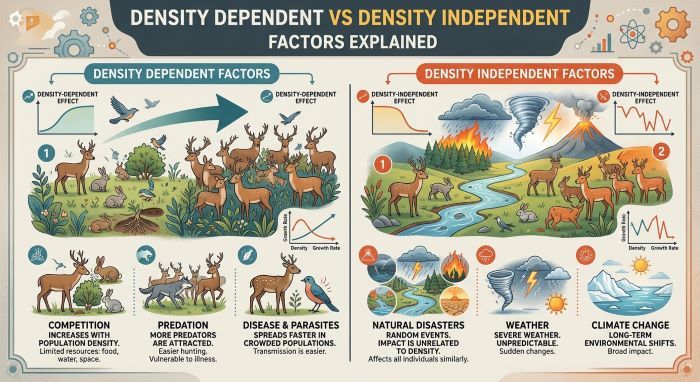
Density Dependent vs Density Independent Factors
If you are studying ecology for a biology class, the AP Biology exam, or just out of curiosity, you will run into one question again and again: what limits how big a population can grow? Ecologists sort the answers into two groups. Understanding density dependent vs density independent factors is the key to answering that question, and to scoring well on any population ecology test.
This guide is set up like a study session. First the core idea, then the two categories with examples, then a simple sorting trick, and finally practice questions with answers so you can check yourself.
The Core Idea in One Line
Ask this: Does the effect get stronger as the population gets more crowded?
- If yes, it is density dependent.
- If no, it is density independent.
That single question solves most exam problems.
What Is Population Density?
Population density is the number of individuals of a species in a given area. For example, 50 deer per square mile, or 200 aphids on one rose bush. As a population grows in the same space, its density rises.
Density Dependent Factors
A density dependent factor is a limiting factor whose effect on a population changes with population density. Usually, the more crowded a population becomes, the stronger the effect. These factors are mostly biotic, meaning they involve living things.
Main Examples
- Competition. When a population is dense, individuals fight over the same food, water, nesting sites, sunlight, or mates. Fewer resources per individual means lower survival and fewer offspring.
- Predation. Predators often focus on prey that are plentiful. As a prey population grows, predators find them more easily and may increase in number too.
- Disease. Germs spread faster when hosts live close together. Outbreaks hit crowded populations harder.
- Parasitism. Parasites move between hosts more easily in dense populations.
- Waste buildup. In crowded spaces, toxic waste can accumulate. Yeast in a sealed container, for example, can be poisoned by its own alcohol.
- Stress and behavior changes. Some animals breed less or become more aggressive when overcrowded.
A Classic Example: Snowshoe Hares and Lynx
In the forests of Canada, snowshoe hare populations rise and fall in cycles of roughly 10 years. When hares are plentiful, lynx have plenty of food, and the lynx population grows. More lynx, along with heavier grazing on plants, push the hare population down. With fewer hares, lynx numbers fall too. Then the cycle begins again. Predation here is a density dependent factor.
Density Independent Factors
A density independent factor affects a population the same way no matter how dense it is. It would kill the same percentage of individuals whether there were 10 or 10,000. These factors are mostly abiotic, meaning nonliving.
Main Examples
- Weather and climate events. Droughts, floods, heat waves, hard freezes, and storms.
- Natural disasters. Wildfires, hurricanes, earthquakes, and volcanic eruptions.
- Seasonal changes. A sudden early frost can kill insects whether there are few or many.
- Human activities. Pollution, pesticide use, deforestation, dams, and habitat destruction often act this way.
A Classic Example: Mount St. Helens
When Mount St. Helens erupted in Washington State in 1980, the blast and ash flattened forests across hundreds of square miles. Plants and animals in the blast zone died regardless of how dense their populations were. The eruption is a textbook density independent factor.
Density Dependent vs Density Independent: Side by Side
| Density Dependent | Density Independent | |
|---|---|---|
| Key question | Does crowding change the effect? Yes | Does crowding change the effect? No |
| Usually | Biotic (living) | Abiotic (nonliving) |
| Examples | Competition, predation, disease, parasitism, waste | Weather, natural disasters, fires, floods, pollution |
| Effect on large populations | Stronger | Same percentage as small populations |
| Link to carrying capacity | Helps keep populations near carrying capacity | Can push populations far below it suddenly |
| Growth model | Logistic (S-shaped) growth | Can cause sudden crashes in any model |
How These Factors Shape Growth Curves
Exponential Growth
With unlimited resources and no limiting factors, a population grows faster and faster. On a graph, this makes a J-shaped curve. Real populations rarely grow this way for long.
Logistic Growth
As a population grows, density dependent factors start to push back. Growth slows and levels off near the carrying capacity, the largest population an environment can support over time. This makes an S-shaped curve.
Density dependent factors are what create that leveling off. They act like a brake that gets pressed harder as the population climbs.
Sudden Crashes
Density independent factors can hit at any time, even when a population is far below carrying capacity. A wildfire or flood can cut a population sharply in a single event.
A Sorting Trick for Exams
When you see a density dependent vs density independent question on a test, run through these three quick checks:
- Is it alive? If it involves other organisms, such as predators, competitors, parasites, or disease, lean density dependent.
- Is it weather, geology, or chemistry? If yes, lean density independent.
- Would a bigger crowd make it worse? If yes, density dependent. If the effect would be the same, density independent.
Tricky Cases
Some factors can fall into either category depending on the situation.
- Shelter during a storm. A storm is density independent. But if only so many safe shelters exist, a crowded population will have more individuals left exposed. In that case, the storm’s effect becomes partly density dependent.
- Food supply during drought. Drought is density independent. But the competition for scarce water that follows is density dependent.
- Human activity. Pollution is usually density independent, but hunting that targets common species can act in a density dependent way.
If an exam question gives extra details, read them carefully. They often hint at which way to classify a tricky case.
Why This Matters Beyond the Classroom
Understanding density dependent vs density independent factors helps scientists and managers make real decisions:
- Wildlife managers set hunting limits by considering how predation and food supply affect deer or elk numbers.
- Public health experts know that diseases spread faster in crowded cities, which shapes vaccination and outbreak plans.
- Farmers watch how pest populations respond to crowding and to weather when deciding how to protect crops.
- Conservationists plan for climate events and habitat loss that can threaten small, vulnerable populations.
Practice Questions
Try these before reading the answers.
1. A flu virus spreads through a crowded colony of bats roosting in a cave. Density dependent or density independent?
2. A late spring frost kills 40 percent of the apple blossoms in an orchard. Density dependent or density independent?
3. As a population of rabbits grows, they run short of grass and many starve. Density dependent or density independent?
4. An oil spill kills seabirds along a coastline. Density dependent or density independent?
5. Which type of factor helps create an S-shaped logistic growth curve?
6. A hurricane destroys nesting trees, and only birds that find the few remaining safe trees survive. Why might this be considered partly density dependent?
Answers
- Density dependent. Disease spreads faster in crowded populations.
- Density independent. The frost affects blossoms regardless of how many there are.
- Density dependent. Competition for food grows as the population grows.
- Density independent. Pollution kills birds whether there are few or many.
- Density dependent factors. They slow growth as the population approaches carrying capacity.
- Because limited safe trees create competition. The hurricane itself is density independent, but the fight for scarce shelter becomes stronger in a crowded population.
One More Memory Tip
Here is a quick way to lock in the density dependent vs density independent difference: picture a crowded elevator versus a sudden rainstorm. In a packed elevator, a cold spreads fast, which is density dependent. A rainstorm soaks everyone outside, no matter how many people are on the street, which is density independent. Picture those two scenes during your exam, and the density dependent vs density independent question will feel much easier.
Before Your Exam
The density dependent vs density independent difference comes down to crowding. Density dependent factors, like competition, predation, and disease, grow stronger as a population becomes more crowded and help hold populations near carrying capacity. Density independent factors, like weather, fires, floods, and pollution, strike with the same force regardless of crowding and can cause sudden crashes. Ask whether crowding changes the effect, and you will be able to sort almost any example. Keep this density dependent vs density independent guide handy as you review, and you will be ready for the test.
Key Takeaways
- Density dependent factors have stronger effects as population density rises. Density independent factors have the same effect regardless of density.
- Density dependent factors are mostly biotic, such as competition, predation, disease, parasitism, and waste buildup.
- Density independent factors are mostly abiotic, such as weather, natural disasters, fires, floods, and pollution.
- Density dependent factors help produce logistic, S-shaped growth curves that level off at carrying capacity.
- Density independent factors can cause sudden population crashes at any time.
- The snowshoe hare and lynx cycle is a classic density dependent example. The 1980 Mount St. Helens eruption is a classic density independent example.
- Ask one question to sort any factor: does crowding change the effect?
- Some factors, like storms that leave limited shelter, can have both density dependent and density independent effects.