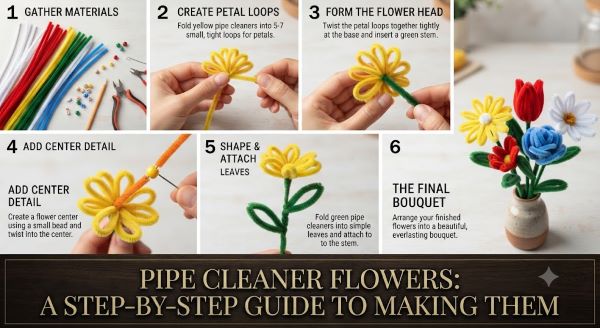
Pipe cleaner flowers are one of the most accessible craft projects available, requiring minimal materials and producing a genuinely charming result whether you’re making them with kids, decorating for a party, or just looking for a relaxing hands-on project. This guide walks through several methods for making pipe cleaner flowers, from simple basic blooms to more detailed layered roses.
What You Need
The core materials for pipe cleaner flowers are minimal and inexpensive. Pipe cleaners (chenille stems) in your desired colors form the petals and stem of the flower. Scissors are needed to trim pipe cleaners to length and clean up any uneven edges. A pencil or thin dowel is useful as a shaping tool for curling petals into rounded shapes. Beads (optional) can be added at the center of a flower for additional visual detail and a more finished look.
Basic Pipe Cleaner Flower (5-Petal Method)
This is the simplest and most beginner-friendly method, well suited for kids or anyone making their first pipe cleaner flowers.
Steps:
- Cut five pipe cleaners to equal length, roughly 6 inches each, for the petals.
- Take one pipe cleaner and twist it into a loop, securing the ends together by twisting them around each other two or three times to form a closed petal shape.
- Repeat this process for all five pipe cleaners, creating five identical petal loops.
- Take a sixth, longer pipe cleaner to serve as the stem and the connecting piece for the petals.
- Wrap the center of each petal loop around the top portion of the stem pipe cleaner, arranging the five petals evenly around the center to form a flower shape.
- Twist the base of all five petals together where they meet the stem, securing everything in place.
- Adjust the petals so they’re evenly spaced and angled slightly outward for a natural, open flower appearance.
Pipe Cleaner Flowers With a Beaded Center
Adding a bead at the center elevates the basic flower with minimal extra effort.
Steps:
- Follow the basic 5-petal method through step 3, creating five petal loops.
- Before assembling the petals onto the stem, thread a bead onto the stem pipe cleaner, sliding it to where the flower center will be.
- Arrange the petal loops around the bead, with the bead sitting at the visual center of the assembled flower.
- Twist the petals and stem together below the bead to secure everything firmly in place, ensuring the bead doesn’t slide out of position.
Layered Pipe Cleaner Rose
This method produces a more sophisticated, rose-like result and takes slightly more practice than the basic flower, but the technique becomes intuitive quickly with a little repetition.
Steps:
- Take a single long pipe cleaner (or twist two together for extra length if needed) and begin coiling one end tightly around itself, creating a small, tight spiral to form the center bud of the rose.
- Continue coiling, but loosen the spiral gradually as you work outward, allowing the loops to become progressively larger, mimicking the way real rose petals unfurl from a tight center outward.
- Once you’ve created a rose shape you’re satisfied with, secure the end by tucking it underneath the outer loop or wrapping it around the base.
- If using a separate stem pipe cleaner, attach the completed rose head to the stem by wrapping the base of the rose around the top of the stem pipe cleaner and twisting to secure.
- Add a few smaller loops of green pipe cleaner near the base to represent leaves, twisting them onto the stem at your desired height.
Tips for a More Polished Finished Look
Use a pencil or dowel to shape petals. Wrapping a pipe cleaner petal around a pencil before releasing it creates a more rounded, naturally curved petal shape rather than a flat, angular loop, producing a noticeably more realistic finished flower.
Vary petal sizes within a single flower. Real flowers rarely have perfectly uniform petals. Cutting petal pipe cleaners to slightly varying lengths, even just a small amount, produces a more organic, less obviously crafted appearance.
Layer multiple colors. Using two shades of the same color, for example a darker pink for the outer petals and a lighter pink for the inner ones, adds visual depth and makes pipe cleaner flowers look more dimensional and intentional rather than flat.
Twist the stem with green pipe cleaner. If your stem pipe cleaner isn’t already green, wrapping a separate green pipe cleaner around the stem in a spiral adds a more finished, realistic appearance and covers any visible twist points from the petal assembly.
Bundle multiple flowers together. A single pipe cleaner flower is a nice individual craft, but bundling several together with floral tape or simply twisting their stems together creates a small bouquet that has significantly more visual impact than a solitary flower, particularly for gift-giving or display purposes.
Using Pipe Cleaner Flowers for Different Occasions
As a kids’ craft activity. The basic 5-petal method is simple enough for children to complete with minimal supervision, making it a popular choice for birthday parties, classroom activities, or rainy-day projects at home.
As party or table decor. A small bundle of pipe cleaner flowers in a vase or scattered across a table provides colorful, low-cost decoration for parties, particularly for spring or garden-themed events where the bright, whimsical aesthetic fits naturally.
As gift toppers or card decorations. A single small pipe cleaner flower attached to a gift bow or glued onto the front of a handmade card adds a charming, dimensional detail that elevates a simple homemade gift or card.
As a teaching tool for fine motor skills. Occupational therapists and early childhood educators sometimes use pipe cleaner crafts, including flowers, specifically because the twisting and shaping motions help develop fine motor coordination in young children in an engaging, low-pressure activity format.
Where to Find Pipe Cleaners and Supplies
Pipe cleaners are widely available at craft stores like Michaels, JOANN, and Hobby Lobby, typically sold in multi-packs with assorted colors at a low cost. Beads and floral tape, if you choose to use them for embellishment or bundling, are available in the same craft store sections, often near other basic craft supplies. Online retailers also offer bulk packs of pipe cleaners in extended color ranges, including metallic or glitter varieties, for anyone looking to create a more elaborate or specifically themed set of pipe cleaner flowers.
Key Takeaways
- Pipe cleaner flowers require minimal materials, primarily pipe cleaners in various colors, scissors, and optionally beads, making them an accessible and inexpensive craft project.
- The basic 5-petal method involves creating five individual petal loops and twisting them around a stem pipe cleaner, making it simple enough for beginners and children to complete.
- A layered pipe cleaner rose, made by coiling a single pipe cleaner with progressively looser loops, produces a more sophisticated result that becomes intuitive with a little practice.
- Shaping petals around a pencil or dowel before releasing them creates more naturally rounded, realistic-looking petals compared to flat, angular loops.
- Varying petal lengths slightly and layering multiple shades of the same color both add visual depth and make finished pipe cleaner flowers look more organic and intentional.
- Bundling several finished flowers together creates a small bouquet with significantly more visual impact than displaying a single flower individually.
- Pipe cleaner flowers work well as kids’ craft activities, party decor, gift and card embellishments, and even as a fine motor skill development tool in early childhood education settings.
- Craft stores like Michaels, JOANN, and Hobby Lobby carry affordable multi-packs of pipe cleaners, with online retailers offering an extended range of colors including metallic and glitter varieties.