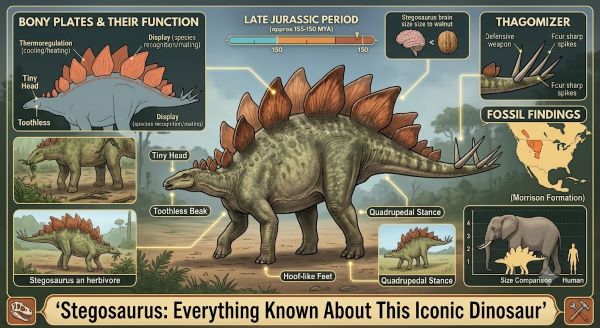
Stegosaurus is one of the most recognizable dinosaurs ever discovered, instantly identifiable by the row of large plates running along its back and the spikes at the end of its tail. Despite that recognizability, the stegosaurus remains a genuinely interesting subject for paleontologists, partly because some of its most distinctive features are still debated more than a century after the first fossils were described. This guide covers what is known about stegosaurus, what remains uncertain, and why this dinosaur continues to capture public imagination.
Basic Facts About Stegosaurus
Stegosaurus lived during the Late Jurassic period, roughly 155 to 150 million years ago, making it one of the dinosaurs that existed well before the more commonly known Cretaceous-period dinosaurs like Tyrannosaurus rex. It inhabited what is now western North America, primarily in the region covered by the Morrison Formation, a major fossil-bearing rock unit spanning parts of Colorado, Wyoming, Utah, and Montana.
The name stegosaurus comes from the Greek words for “roof lizard,” a reference to the initial misinterpretation by paleontologist Othniel Charles Marsh, who first described the species in 1877 and originally believed the plates lay flat across the animal’s back like roof tiles rather than standing upright.
A fully grown stegosaurus measured approximately 9 meters (30 feet) in length and weighed an estimated 5 to 7 tons. It walked on four legs, with shorter front limbs and much longer hind limbs, giving it a posture that sloped downward toward the head.
The Plates: What Were They Actually For?
The plates running along the back of stegosaurus are its single most defining feature, and they remain one of the more debated aspects of its biology.
Defense. The original assumption was that the plates served as armor, protecting the animal from predators like Allosaurus, which shared its habitat and time period. This theory has weakened over time because the plates were not solid bone all the way through. They were relatively thin and contained channels for blood vessels, which would have made them poor armor against a determined predator attack.
Thermoregulation. A widely supported theory holds that the plates functioned primarily to regulate body temperature. The blood vessel channels running through the plates suggest they may have helped the animal absorb or release heat, similar to how some modern reptiles use specific body structures for temperature control. Increasing blood flow to the plates in cool conditions could have warmed the animal, while exposing them to wind in hot conditions could have helped cool it.
Display and species recognition. Another significant theory is that the plates served a social or sexual display function, helping individual stegosaurus identify members of their own species or signal health and fitness to potential mates, similar to the function of antlers or feathers in some modern animals. The plates’ size and the fact that they were positioned to be visible from the side rather than oriented for defense supports this theory.
Most paleontologists today believe the plates likely served multiple functions simultaneously rather than a single purpose, combining elements of thermoregulation and display.
The Tail Spikes (Thagomizer)
At the end of the stegosaurus’s tail were a set of long, sharp spikes, typically four in number, that almost certainly served a defensive function. This structure has been given the informal name “thagomizer,” a term coined in a 1982 Far Side comic strip by Gary Larson and later adopted somewhat seriously by paleontologists due to its usefulness and the lack of a formal scientific term at the time.
The thagomizer was likely swung with significant force given the powerful muscles in the stegosaurus’s hips and tail base. Fossil evidence supports this defensive use directly: an Allosaurus tail vertebra has been found with a puncture wound matching the size and shape of a stegosaurus tail spike, providing direct physical evidence of stegosaurus using its tail as an active weapon against predators.
Diet and Feeding
Stegosaurus was an herbivore, feeding on the low-growing vegetation available during the Late Jurassic period, including ferns, cycads, and horsetails. Its skull was relatively small in proportion to its body, with a narrow beak at the front of the mouth and small, leaf-shaped teeth set further back, suited for cropping plant material rather than extensive chewing.
The position of stegosaurus’s head, low to the ground due to its short front legs, suggests it was primarily a low-browsing feeder, though some paleontologists have proposed that stegosaurus could rear up on its hind legs temporarily to reach higher vegetation, a behavior also proposed for some other quadrupedal dinosaurs.
The Brain and Intelligence
Stegosaurus had a notably small brain relative to its body size, even by dinosaur standards, which were generally lower than modern mammal standards for brain-to-body ratio. This contributed to a once-popular but now debunked myth that stegosaurus had a “second brain” located near its hip region, intended to explain how such a large animal could function with such a small skull-based brain.
This idea has been thoroughly disproven. The structure once interpreted as a second brain near the hip is now understood to be a glycogen body, a structure also found in birds that likely served a role in energy storage or processing rather than neural function. Stegosaurus, like most dinosaurs of its size, relied on a single brain housed in its skull, just a notably small one relative to its overall body mass.
Discovery and Fossil History
The first stegosaurus fossils were discovered in Colorado in 1876 and formally described by Othniel Charles Marsh in 1877, during the height of the intense fossil-collecting rivalry known as the Bone Wars between Marsh and fellow paleontologist Edward Drinker Cope. This period of competitive fossil hunting across the American West produced many of the dinosaur species that remain household names today.
Since the initial discovery, numerous additional stegosaurus specimens have been recovered from the Morrison Formation, giving paleontologists a relatively complete picture of the animal’s anatomy compared to many other dinosaur species known from more fragmentary remains. A particularly well-preserved specimen nicknamed “Sophie,” housed at the Natural History Museum in London, is one of the most complete stegosaurus skeletons ever found and has provided significant insight into the animal’s proportions and posture.
Stegosaurus Species
Several species have been classified under the genus Stegosaurus, though the taxonomy has been revised multiple times as paleontologists reassess which specimens represent genuinely distinct species versus variation within a single species.
Stegosaurus stenops is the best-known and most completely understood species, and the one most commonly depicted in popular media, museum displays, and reconstructions.
Stegosaurus ungulatus was a larger species, known from less complete remains, that may have had a different plate and spike arrangement than S. stenops.
Other species names have been proposed and later reclassified or merged as additional fossil evidence clarified the relationships between different stegosaurus specimens found across the Morrison Formation.
Stegosaurus in Popular Culture
Stegosaurus has remained a fixture in dinosaur media since the early days of paleontological popularization in the late nineteenth century. Its distinctive silhouette, the row of plates combined with the spiked tail, makes it one of the most visually identifiable dinosaurs even to people with no particular interest in paleontology, alongside Tyrannosaurus and Triceratops.
This recognizability has made stegosaurus a recurring figure in films, documentaries, children’s books, and museum exhibits, often depicted in confrontations with Allosaurus given the genuine fossil evidence supporting interaction between the two species during the Late Jurassic.
Key Takeaways
- Stegosaurus lived during the Late Jurassic period, roughly 155 to 150 million years ago, primarily in what is now the western United States within the Morrison Formation.
- The plates along its back remain debated among paleontologists, with current theories favoring a combination of thermoregulation and visual display rather than pure defensive armor.
- The tail spikes, informally called the thagomizer, served a clear defensive function, supported by direct fossil evidence including a puncture wound on an Allosaurus tail vertebra matching a stegosaurus spike.
- Stegosaurus was an herbivore with a small head and beak-like mouth suited for cropping low vegetation including ferns, cycads, and horsetails.
- The long-debunked myth of a “second brain” near the hip has been replaced by the understanding that the structure was a glycogen body, similar to structures found in modern birds.
- Stegosaurus was first discovered and described in 1877 by Othniel Charles Marsh during the competitive Bone Wars period of American paleontology.
- Stegosaurus stenops is the best-known and most completely documented species within the genus, while other proposed species have been reclassified as the fossil record has been reassessed over time.
- A particularly complete specimen named “Sophie,” held at the Natural History Museum in London, has significantly advanced scientific understanding of stegosaurus anatomy and proportions.