Fish Knife vs Butter Knife
Picture a Victorian dinner party. The table is packed with silver, and next to each plate sits a strange little knife with a wide, flat blade and a notch near the tip. Guests in 1870s London would have known exactly what it was for. Today, most of us would guess. Was it for butter? Cheese? Cake? That small puzzle sits at the center of the fish knife vs butter knife question, and the answer tells a fun story about table manners, silver, and status.
This post covers how each knife came to be, how to tell them apart, where they go on the table, and how to use them without feeling awkward at your next formal dinner.
What Is a Fish Knife?
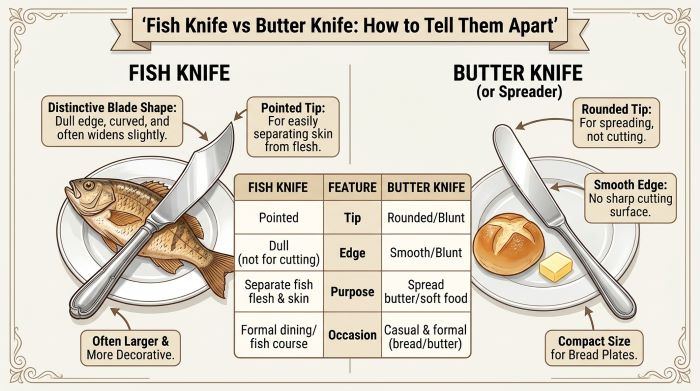
A fish knife is a dinner knife designed for eating fish. It has a broad, flat, blunt blade, often with a pointed or angled tip and a small notch or curve along the top edge. The blade is not sharp, because cooked fish does not need cutting. It needs gentle lifting and separating.
The wide blade lets you slide under a fillet, lift the flesh away from the skin, and push aside small bones. The pointed tip helps you pick out bones and separate flakes. Many fish knives also have decorative engraving on the blade, a sign of how fancy they were meant to look.
A fish knife is usually paired with a fish fork, which is a little wider than a dinner fork.
What Is a Butter Knife?
The term “butter knife” covers two related tools, which adds to the confusion.
The master butter knife is a serving piece. It stays with the butter dish and is used to take a portion of butter from the shared dish and place it on your bread plate. It often has a curved or sabre-like blade and a slightly pointed tip.
The butter spreader is a personal knife. Each guest gets one, placed on their bread plate. It is short, with a rounded, blunt blade made for spreading butter on bread or rolls.
In everyday speech, people often call any dull table knife a “butter knife.” But at a formal table, the term usually means the small spreader on the bread plate.
How the Fish Knife Came to Be
For centuries, wealthy diners ate fish with two forks, or with a fork and a piece of bread. Steel knives had a problem: they reacted with the acids in fish and lemon, which could leave a metallic taste and stain the blade.
In the 1800s, two changes made the fish knife possible. Silver plating became cheaper thanks to new methods like electroplating, and the growing middle class in Britain wanted to show off good manners. Silver did not react with fish the way steel did, so silver fish knives became both practical and a status symbol.
By the Victorian era, owning a full set of fish knives and forks was a sign that a household had arrived. Etiquette guides of the time filled pages with rules about which utensil to use and when.
Interestingly, not everyone approved. Some old aristocratic families looked down on fish knives as a newfangled, middle-class fuss, and kept eating fish with two forks to show their old money status. The fish knife was, in a way, part of a quiet class war at the dinner table.
How the Butter Knife Came to Be
Butter has been on tables for a long time, but individual butter spreaders became common in the 1800s, around the same time as fish knives. As dinner services grew more elaborate, each type of food got its own tool. Separate bread plates and butter spreaders kept each guest’s butter clean and avoided double dipping into a shared dish.
The master butter knife followed the same logic: one serving knife for the communal dish, then personal spreaders for each guest.
Telling Them Apart
The fish knife vs butter knife difference is easy to see once you know what to look for. Here is a quick fish knife vs butter knife cheat sheet.
| Feature | Fish Knife | Butter Spreader | Master Butter Knife |
|---|---|---|---|
| Blade shape | Wide, flat, often with a notch and pointed tip | Short, rounded, blunt | Curved or sabre-shaped, sometimes pointed |
| Size | Similar to a dinner knife, often a bit shorter | Small, shorter than a dinner knife | Small to medium |
| Sharpness | Dull | Dull | Dull |
| Purpose | Separating fish flesh and removing bones | Spreading butter on your own bread | Serving butter from the shared dish |
| Placement | Right of the plate with other knives | Across the bread plate | On or beside the butter dish |
| Belongs to | Each guest | Each guest | The table |
A simple trick: if it sits on the small bread plate at the upper left, it is a butter spreader. If it sits to the right of your dinner plate and has that notched, wide blade, it is a fish knife.
Where They Go in a Formal Place Setting
In a classic formal setting, utensils are placed in the order you will use them, working from the outside in.
- Knives go to the right of the plate, blades facing the plate. If fish is served before the main course, the fish knife sits to the right of the dinner knife, farther from the plate.
- Forks go to the left. The fish fork sits outside the dinner fork if the fish course comes first.
- The bread plate sits to the upper left, above the forks.
- The butter spreader lies across the top of the bread plate, usually with the blade facing down or toward you, and the handle to the right.
- The master butter knife stays with the butter dish.
How to Use a Fish Knife
Holding a fish knife is a little different from holding a regular knife.
- Hold it like a pencil. Pinch the handle between your thumb and first two fingers, rather than gripping it in your palm.
- Use the edge to separate. Slide the blade gently along the natural lines of the fish to break it into bite-size flakes.
- Lift the flesh from the skin. Slip the flat blade under the fillet and ease it away.
- Remove bones. Use the pointed tip to move small bones to the side of your plate.
- Push onto the fork. Use the knife to guide a flake onto your fish fork.
If a small bone ends up in your mouth, remove it discreetly with your fingers and place it on the side of your plate.
How to Use a Butter Spreader
- Use the master butter knife to take a portion of butter and place it on your bread plate.
- Break off a bite-size piece of bread or roll with your hands. Do not cut it.
- Use your butter spreader to butter only that small piece.
- Eat it, then repeat with the next bite.
Buttering the whole roll at once is considered informal. At a casual meal, nobody will mind.
Common Mix-Ups
Using the fish knife for butter. This is the most common mistake, mainly because the fish knife looks so unusual. If it is next to your dinner plate, it is for the fish course.
Using your dinner knife to butter bread. It works, but at a formal table, use the spreader on your bread plate.
Spreading straight from the shared butter dish. Always move butter to your own plate first.
Putting a used knife back on the tablecloth. Once used, rest knives on your plate, not the table.
Do You Need Them at Home?
For most homes, no. A regular dinner knife handles fish just fine, and any dull table knife can spread butter. Fish knives and butter spreaders shine at formal dinners, holiday meals, and for anyone who enjoys setting a beautiful table.
If you collect vintage silver, fish knife sets are easy to find at antique shops and estate sales, often at reasonable prices. They make a fun conversation piece, especially if you share their history with your guests.
Shopping for Vintage Sets
If you are buying silverware secondhand, the fish knife vs butter knife difference matters, because sellers sometimes mislabel them. Look at the blade shape: a wide, flat blade with a notch is a fish knife, while a short rounded blade is a butter spreader. Check for silver hallmarks, small stamped symbols that show the maker and silver content. Sterling silver pieces cost more, while silverplate is more affordable and easier to use every day.
Knowing the fish knife vs butter knife details also helps when you are building a full set. Fish knives usually come in matching sets of six or twelve with fish forks. Butter spreaders often come in sets of their own, and master butter knives are usually sold one at a time. With a little practice, the fish knife vs butter knife puzzle becomes easy to solve at any antique shop.
Setting the Table With Confidence
The fish knife vs butter knife question comes down to blade shape and purpose. The fish knife has a wide, notched, dull blade made for separating flaky fish and removing bones, and it sits beside your dinner plate. The butter spreader is a small, rounded knife that rests on your bread plate, while the master butter knife stays with the shared butter dish. Both were born from the Victorian love of order at the table. Know the fish knife vs butter knife difference, and you will never second-guess your silverware at a formal dinner again.
Key Takeaways
- A fish knife has a wide, flat, dull blade with a notch and pointed tip for separating fish and removing bones.
- A butter spreader is a small, rounded personal knife for spreading butter on bread.
- A master butter knife is a serving piece that stays with the shared butter dish.
- Fish knives became popular in the 1800s as silver plating grew cheaper and silver did not react with fish acids the way steel did.
- In a formal setting, the fish knife sits to the right of the plate and the butter spreader lies across the bread plate at the upper left.
- Hold a fish knife like a pencil and use it to lift and separate flakes, not to saw.
- Move butter from the shared dish to your own plate first, then butter one bite of bread at a time.
- At home, a regular dinner knife works fine, but fish knives and butter spreaders add charm to formal meals.