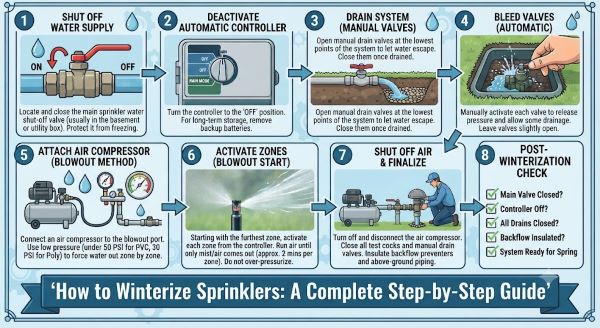
Skipping the process of winterizing a sprinkler system is one of the more expensive mistakes a homeowner can make, since water left inside the pipes expands as it freezes and can crack pipes, valves, and sprinkler heads throughout the entire system. Knowing how to winterize sprinklers properly before the first hard freeze of the season prevents that damage and saves a significant repair bill come spring. This guide walks through the full process of how to winterize sprinklers, the equipment involved, and the timing that matters most.
Why Winterizing Matters
Sprinkler systems are built from a network of underground pipes, valves, and above-ground sprinkler heads that hold water during normal operation. When temperatures drop below freezing, any water remaining in that system expands as it turns to ice. Because pipes and valves are rigid, that expansion has nowhere to go, which cracks the components from the inside.
This kind of damage is often not visible until the system is turned back on in spring, at which point a homeowner discovers multiple leaks, burst pipes, or non-functional valves, sometimes requiring extensive excavation to repair. Properly removing water from the system before freezing temperatures arrive prevents this entirely.
When to Winterize Sprinklers
Timing matters significantly when learning how to winterize sprinklers. The system should be winterized before the first hard freeze, which is typically a sustained period where temperatures drop to 32°F or below for several consecutive hours. In most regions of the northern United States, this falls sometime between mid-October and mid-November, though exact timing varies considerably by climate zone.
Watch your local extended forecast rather than relying on a fixed calendar date. If an early cold snap is predicted, winterize before it hits rather than waiting for a typical seasonal date that may arrive too late that particular year.
Method 1: The Manual Drain Method
This method works for systems specifically designed with manual drain valves, typically found in milder climates with less risk of deep ground freezing.
Steps:
- Turn off the water supply to the irrigation system at the main shutoff valve.
- Open the manual drain valves located at the lowest points of the system, typically near the backflow preventer and at the end of each zone’s piping.
- Allow gravity to drain the water out completely through these valves.
- Once drained, leave the drain valves open through the winter season to prevent any residual water from refreezing inside.
This method is the simplest but only works effectively if the system’s piping was installed with a consistent slope toward the drain points, which not all systems have.
Method 2: The Manual Purge Method (Using Compressed Air)
This is the most common professional and DIY method for how to winterize sprinklers, particularly in colder climates where manual draining alone is not sufficient.
Equipment needed: An air compressor capable of producing sufficient air pressure and volume. For most residential systems, a compressor rated at 50–80 CFM (cubic feet per minute) and capable of reaching the system’s recommended PSI works well. Renting a compressor from a hardware or equipment rental store is common, since most residential air compressors lack sufficient CFM for this task.
Steps:
- Turn off the water supply to the irrigation system at the main shutoff valve.
- Connect the air compressor to the system, typically through a blowout port near the backflow preventer or main valve. A quick-connect fitting designed for this purpose makes the connection straightforward.
- Turn on one zone at a time through the irrigation controller, starting with the zone closest to the compressor connection point.
- Slowly introduce air pressure, staying below the system’s rated PSI limit, typically 50 to 80 PSI for residential systems depending on pipe material (PVC systems generally tolerate less pressure than polyethylene).
- Allow the air to blow through each zone until water stops coming out of the sprinkler heads and only air is being expelled, then move to the next zone.
- Repeat for all zones in the system, including the drip irrigation zones if present.
- Once all zones have been purged, turn off the compressor and disconnect it from the system.
- Set the irrigation controller to rain mode or off mode for the winter to prevent the system from attempting to run on a schedule during the off-season.
Using too much air pressure can damage sprinkler heads and valves, so staying within the manufacturer’s recommended PSI range is important throughout this process.
Method 3: Automatic Drain Valve Systems
Some sprinkler systems are equipped with automatic drain valves that open on their own once water pressure in the system drops below a certain threshold, which happens naturally once the main water supply is shut off.
Steps:
- Turn off the water supply at the main shutoff valve.
- The automatic drain valves, typically located at the low points of each zone, will open automatically as pressure drops, allowing the water to drain out through gravity.
- Run each zone briefly through the controller after shutting off the water supply to help clear any remaining water more efficiently.
This method requires the least manual effort but depends entirely on the system having been installed with automatic drain valves in the first place, which is more common in newer installations than older systems.
Don’t Forget the Backflow Preventer
Regardless of which method you use for how to winterize sprinklers, the backflow preventer requires specific attention since it is particularly vulnerable to freeze damage and often sits partially or fully above ground.
Shut off both the inlet and outlet valves on the backflow preventer. Open the test cocks on the device to release any trapped water and pressure. If your backflow preventer has drain plugs, remove them to ensure complete draining. In regions with severe winters, wrapping the backflow preventer with an insulated cover or foam pipe insulation provides additional protection against extreme cold even after draining.
Common Mistakes to Avoid
Using too much air pressure during the blowout method. This is the most common cause of damage during the winterizing process itself, ironically caused by the process meant to prevent damage. Stay within manufacturer-recommended PSI limits.
Skipping the backflow preventer. This component is often the most expensive single part to replace if it cracks from freezing, and it is easy to overlook since it may not be obviously part of the “sprinkler system” in a homeowner’s mental model.
Waiting too long in the season. An early unexpected freeze can damage an unwinterized system even if the calendar suggests there’s time remaining. Monitor forecasts and winterize proactively rather than reactively.
Forgetting to set the controller to off or rain mode. Without this step, the system may attempt to run on its normal schedule during the winter, which can cause issues even after the physical winterizing process is complete.
When to Hire a Professional
While the manual purge method is achievable for many homeowners with rented equipment, hiring an irrigation professional is worth considering if you do not have access to an appropriately sized air compressor, if your system is complex with many zones, or if you are uncertain about the correct PSI limits for your specific pipe material. Professional winterizing services are relatively affordable, especially compared to the cost of repairing freeze damage that occurs from an improperly winterized system.
Key Takeaways
- Knowing how to winterize sprinklers before the first hard freeze prevents water from expanding and cracking pipes, valves, and sprinkler heads throughout the system.
- Timing should follow your local extended forecast rather than a fixed calendar date, since an early cold snap can damage an unwinterized system regardless of the typical seasonal timing in your region.
- The manual purge method using a rented air compressor is the most common and effective approach, particularly in colder climates, but requires staying within the system’s rated PSI to avoid causing damage during the process itself.
- Systems with manual or automatic drain valves can rely partly or entirely on gravity drainage, though this works best in milder climates or with properly sloped piping.
- The backflow preventer requires specific attention regardless of method, since it is especially vulnerable to freeze damage and is often the most expensive component to repair or replace.
- Common mistakes include using too much air pressure, skipping the backflow preventer, waiting too long in the season, and forgetting to switch the controller to off or rain mode.
- Hiring a professional is a reasonable option for complex systems or if you lack access to a properly sized air compressor, and the cost is typically much lower than freeze-damage repairs.
- Completing the process correctly each fall protects the entire irrigation investment and avoids the surprise of discovering multiple leaks when the system is turned back on in spring.