Female House Finch vs Sparrow
A small brown bird lands on your feeder. It is streaky, plain, and gone in seconds. Was it a sparrow? Most people would say yes. But a big share of the time, especially at a tube feeder, that “sparrow” is actually a female house finch. The female house finch vs sparrow mix-up is one of the most common ID puzzles in North American backyards, and for good reason. Both are small, brown, streaky, and found almost everywhere people live.
The good news: once you know which clues to check, you can tell them apart in a few seconds. This guide works like a detective’s checklist. Go clue by clue, and the answer usually becomes clear.
Meet the Suspects
Female house finch: A native North American finch, originally from the West. In the 1940s, caged birds released on Long Island, New York, started a population that spread across the East. Today house finches live across most of the United States and parts of Canada and Mexico. Males have red heads and chests. Females have no red at all, which is why they get mistaken for sparrows.
House sparrow: Not a true American sparrow at all. It is an Old World bird, introduced from Europe to Brooklyn in the 1850s. It now lives in towns and cities across the continent.
Native sparrows: Song sparrows, chipping sparrows, white-crowned sparrows, and others. These belong to a different bird family than the house sparrow.
When people talk about the female house finch vs sparrow problem, they usually mean the female house sparrow or the song sparrow, since those two look the most alike.
Clue 1: The Face
This is the single best clue, so start here.
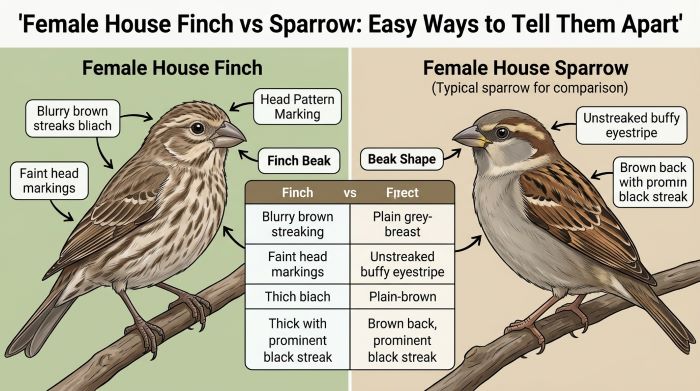
- Female house finch: Plain face. No bold stripes, no eyebrow, no strong markings. Just soft brown streaks all over the head. The face looks blank or “smudgy.”
- Female house sparrow: A clear buffy stripe behind the eye, like a pale eyebrow trailing back. The rest of the face is plain gray-brown.
- Song sparrow: A busy face with dark stripes on the crown, through the eye, and along the cheek, plus a gray eyebrow.
If the face has any clear stripes, you are probably looking at a sparrow. If it looks plain and streaky all over, think female house finch.
Clue 2: The Bill
- Female house finch: A short, thick bill with a curved top edge. It looks stubby and a bit rounded, built for cracking seeds. Many people say it looks like a tiny parrot beak.
- House sparrow: A thick, cone-shaped bill too, but straighter on top. Females have a yellowish or pale bill.
- Song sparrow: A smaller, more pointed cone.
The curved top of the house finch bill is a helpful clue when you get a good look.
Clue 3: The Breast
- Female house finch: Blurry brown streaks down the whole breast and belly, on a whitish background. The streaks look soft and smeared, not crisp.
- Female house sparrow: A plain, unstreaked gray-buff breast. No streaks at all.
- Song sparrow: Crisp dark streaks that often gather into a central spot on the chest.
This clue often settles it. Streaky breast with a plain face? Female house finch. Plain breast with an eye stripe? Female house sparrow. Sharp streaks with a central spot and a striped face? Song sparrow.
Clue 4: The Back and Wings
- Female house finch: Fairly plain gray-brown back with soft streaks. Two thin, faint wing bars.
- Female house sparrow: A boldly striped back in tan, brown, and black, a bit like straw. One pale wing bar is often visible.
- Song sparrow: Streaky brown back with reddish tones in the wings.
Clue 5: The Tail
- House finch: A fairly long tail with a shallow notch at the tip.
- House sparrow: A medium-length tail, more squared off.
- Song sparrow: A longer, rounded tail that it often pumps up and down in flight.
Clue 6: Behavior at the Feeder
How a bird acts can be just as telling as how it looks.
- House finches cling to tube feeders and perch on the ports for long periods. They often come in groups, chatter a lot, and squabble with each other. They love black oil sunflower seeds.
- House sparrows also visit feeders, but they spend a lot of time on the ground, hopping in noisy groups. They are bold, quick to chase other birds away, and often nest in building gaps and birdhouses.
- Song sparrows usually forage on the ground under feeders or in shrubs. They scratch in leaf litter and tend to stay low.
If the bird is hanging on a tube feeder, odds lean toward a house finch. If it is scratching under the feeder, think sparrow.
Clue 7: The Song
If you can hear the bird, the song can confirm your ID.
- House finch: A long, cheerful, warbling song that tumbles up and down, often ending with a rising or buzzy note. Females sing less than males but do call often with a bright “cheep.”
- House sparrow: Repeated, simple “cheep” or “chirrup” notes. Not musical, but constant.
- Song sparrow: A song that starts with a few clear notes, then breaks into a buzzy trill. It is a classic sound of spring.
Apps like Merlin Bird ID from the Cornell Lab of Ornithology can listen and suggest a match in real time.
Female House Finch vs Sparrow: Cheat Sheet
| Clue | Female House Finch | Female House Sparrow | Song Sparrow |
|---|---|---|---|
| Face | Plain, streaky, no stripes | Buffy stripe behind the eye | Bold stripes on head and cheek |
| Bill | Short, thick, curved top | Thick cone, pale or yellowish | Small, pointed cone |
| Breast | Blurry streaks all over | Plain, no streaks | Crisp streaks with central spot |
| Back | Plain with soft streaks | Bold tan and black stripes | Streaky, reddish wings |
| Tail | Long with a shallow notch | Medium, squared | Long, rounded, pumped in flight |
| Feeder habit | Clings to tube feeders | Ground and feeders, in flocks | Mostly on the ground |
| Song | Long, warbling | Simple chirps | Clear notes, then a trill |
Another Look-Alike: The Female Purple Finch
If you live in the East or along the West Coast, the female purple finch adds one more twist. She is also brown and streaky, but she has a bold face pattern with a strong white eyebrow and a dark cheek patch. Her streaks are crisper than a house finch’s, and her bill is more pointed. A plain face points to house finch. A bold, striped face with a white eyebrow points to purple finch.
A Note on Eye Disease
If you see a house finch with red, swollen, or crusty eyes, it may have house finch eye disease, a bacterial infection called mycoplasmal conjunctivitis. It spreads at feeders. If you notice it, take your feeders down for a few days and clean them with a weak bleach solution (about one part bleach to nine parts water), rinse well, and let them dry before refilling. Regular cleaning every couple of weeks helps prevent outbreaks.
Quick Field Routine
When a mystery brown bird shows up, run through this order:
- Face first. Plain or striped?
- Breast second. Streaked or plain?
- Where is it feeding? On the tube or on the ground?
- Listen. Warble, chirp, or trill?
With practice, you will recognize the female house finch vs sparrow difference at a glance, often before the bird even settles.
Practice Makes It Easy
The female house finch vs sparrow skill gets easier with time. Set up a tube feeder and a ground tray near a window, keep binoculars handy, and spend a few minutes each morning watching. Within a week or two, the plain face and blurry streaks of a female house finch will jump out at you, and the female house finch vs sparrow puzzle will feel like second nature.
Case Closed
The female house finch vs sparrow puzzle is easy to solve once you know where to look. A female house finch has a plain, streaky face, a curved stubby bill, and blurry streaks across a pale breast, and she loves to cling to tube feeders. A female house sparrow has a pale stripe behind the eye and a plain breast. A song sparrow has a striped face and crisp streaks with a central spot. Start with the face, check the breast, and watch how it feeds. That is all it takes to name the brown bird at your window and to settle the female house finch vs sparrow question for good.
Key Takeaways
- Female house finches have no red and are often mistaken for sparrows.
- Check the face first: female house finches have a plain, streaky face, while sparrows show clear stripes or an eye line.
- Female house finches have blurry streaks across the breast. Female house sparrows have a plain, unstreaked breast.
- Song sparrows have crisp breast streaks that often form a central spot, plus a boldly striped face.
- The house finch bill is short and thick with a curved top edge.
- House finches cling to tube feeders. Many sparrows feed on the ground below.
- The house sparrow was introduced from Europe in the 1850s, while the house finch is native to western North America and spread east after the 1940s.
- Clean feeders regularly to help prevent house finch eye disease.