Earth science covers an enormous range of subject matter, and narrowing down earth science topics into something manageable depends on what you are trying to do, whether that is building a curriculum, choosing a research focus, or just satisfying curiosity about how the planet works. This guide organizes the major branches of earth science, explains what each one studies, and highlights the specific topics within each field that come up most often in classrooms, textbooks, and research.
What Counts as Earth Science?
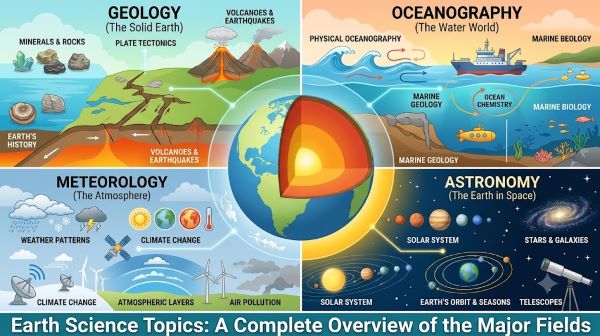
Earth science, sometimes called geoscience, is the umbrella term for the scientific study of the planet’s physical structure, substance, history, and the processes acting upon it. It is typically divided into four major branches: geology, meteorology, oceanography, and astronomy (specifically as it relates to Earth’s place in the solar system). Some classifications add environmental science as a fifth branch given how much overlap exists with the others.
Each of these branches breaks down further into more specific earth science topics, many of which intersect with biology, chemistry, and physics.
Geology
Geology is the study of the solid Earth: its materials, structure, and the processes that shape it over time. It is one of the broadest categories of earth science topics and includes several major subfields.
Plate tectonics examines how the rigid plates that make up Earth’s crust move, collide, and separate, driving earthquakes, volcanic activity, and the formation of mountain ranges and ocean basins. This is one of the most foundational concepts in modern geology, unifying observations that earlier geologists struggled to explain separately.
Mineralogy and petrology study the composition, structure, and formation of minerals and rocks. Understanding how igneous, sedimentary, and metamorphic rocks form gives insight into the processes that have shaped Earth’s crust over billions of years.
Volcanology focuses specifically on volcanic activity, including eruption mechanics, magma composition, and the hazards volcanic events pose to surrounding populations.
Seismology studies earthquakes and the propagation of seismic waves through Earth. This field is essential for both understanding Earth’s internal structure and for practical applications like earthquake hazard assessment and early warning systems.
Geomorphology examines the physical features of Earth’s surface and the processes, like erosion, weathering, and deposition, that create and change those features over time.
Paleontology, while sometimes classified separately, overlaps significantly with geology in its study of fossils and the history of life as recorded in rock layers.
Meteorology and Atmospheric Science
Meteorology studies the atmosphere, weather patterns, and the physical processes that drive them. Among earth science topics, this is one of the most immediately relevant to daily life.
Weather systems cover the formation and behavior of phenomena like fronts, cyclones, anticyclones, and precipitation patterns. Understanding how air masses interact explains why weather changes the way it does from day to day.
Severe weather includes the study of hurricanes, tornadoes, thunderstorms, and blizzards, focusing on the conditions that produce these events and the methods used to forecast and track them.
Climate science examines long-term atmospheric patterns rather than day-to-day weather, including the factors that drive climate variation across regions and over time. This subfield has become especially significant given growing interest in climate change and its long-term effects on global systems.
Atmospheric composition studies the layers of the atmosphere, the gases that compose it, and how human activity has altered atmospheric chemistry, particularly regarding greenhouse gases and ozone depletion.
Oceanography
Oceanography covers the physical, chemical, biological, and geological aspects of the ocean, making it one of the more interdisciplinary earth science topics.
Physical oceanography studies ocean currents, waves, tides, and the physical properties of seawater, including temperature and salinity distribution across different depths and regions.
Marine geology examines the ocean floor, including features like mid-ocean ridges, trenches, and seamounts, which connect directly to plate tectonic processes.
Chemical oceanography studies the chemical composition of seawater and how it changes due to natural processes and human impact, including ocean acidification driven by increased atmospheric carbon dioxide.
Marine biology, while sometimes treated as its own discipline, intersects heavily with oceanography in studying the organisms that inhabit ocean environments and how they interact with physical and chemical ocean conditions.
Astronomy and Earth’s Place in Space
While astronomy is often treated as a separate science, the portion of it dealing with Earth’s relationship to the solar system and broader cosmic environment is a recognized component of earth science topics in most educational frameworks.
Earth-Sun relationships cover the mechanics of seasons, day length variation, and solar radiation patterns that drive much of Earth’s climate and weather behavior.
The Earth-Moon system examines tidal forces, lunar phases, and the gravitational interactions that shape ocean tides and contribute to Earth’s rotational stability.
Planetary comparison studies how Earth’s geological, atmospheric, and oceanic systems compare to other planets, which provides useful context for understanding what makes Earth’s systems distinct and what conditions support life as we know it.
Environmental Science and Earth Systems
Environmental science, while a distinct field in its own right, overlaps substantially with earth science topics, particularly where human activity intersects with natural systems.
Climate change is one of the most widely discussed earth science topics today, covering the causes, evidence, and projected effects of long-term shifts in global climate patterns driven significantly by human greenhouse gas emissions.
Natural resource management examines how minerals, water, fossil fuels, and renewable energy sources are extracted, used, and conserved, along with the environmental consequences of resource extraction.
Soil science studies soil composition, formation, and the role soil plays in agriculture, water filtration, and ecosystem health.
Natural hazards and disaster science examines earthquakes, volcanic eruptions, floods, landslides, and severe storms specifically in terms of risk assessment, prediction, and mitigation for human populations.
Earth’s History and Geological Time
Understanding deep time is central to many earth science topics, particularly within geology and paleontology.
The geologic time scale divides Earth’s 4.6-billion-year history into eons, eras, periods, and epochs based on major geological and biological events, providing the framework scientists use to discuss when specific changes occurred.
Mass extinction events examine the major die-offs recorded in the fossil record, including the five recognized mass extinctions, and the geological evidence used to identify their causes.
The history of Earth’s atmosphere and oceans traces how the composition of air and water has changed dramatically since the planet’s formation, including the rise of oxygen in the atmosphere driven by early photosynthetic life.
Why These Topics Matter
Earth science topics are not purely academic. Understanding plate tectonics informs earthquake and volcano risk assessment for millions of people living near fault lines and active volcanic regions. Meteorology and climate science directly inform agricultural planning, disaster preparedness, and policy decisions around emissions and energy. Oceanography shapes understanding of fisheries, coastal erosion, and the broader effects of a warming planet on sea level and marine ecosystems.
For students and educators, organizing earth science topics by branch makes it easier to build a curriculum that covers the full scope of the field without losing the connections between subjects. Plate tectonics, for example, connects directly to volcanology, seismology, and even oceanography through the study of mid-ocean ridges. Climate science connects meteorology to oceanography through the role oceans play in regulating global temperature.
Key Takeaways
- Earth science topics are generally organized into four major branches: geology, meteorology, oceanography, and the Earth-focused portion of astronomy, with environmental science often treated as an overlapping fifth branch.
- Geology covers plate tectonics, mineralogy, volcanology, seismology, and geomorphology, forming the foundation for understanding Earth’s physical structure and history.
- Meteorology and atmospheric science cover weather systems, severe weather, and climate science, with climate change currently one of the most actively researched and publicly discussed earth science topics.
- Oceanography spans physical, chemical, biological, and geological aspects of the ocean, connecting closely to both geology and climate science.
- The astronomy-related earth science topics focus on Earth-Sun and Earth-Moon relationships and how Earth’s systems compare to other planets.
- Environmental science topics, including natural resource management and natural hazards, apply earth science knowledge directly to human impact and risk management.
- The geologic time scale and the study of mass extinction events provide the framework for understanding Earth’s 4.6-billion-year history.
- These topics matter beyond the classroom because they directly inform disaster preparedness, agricultural planning, energy policy, and broader responses to a changing climate.