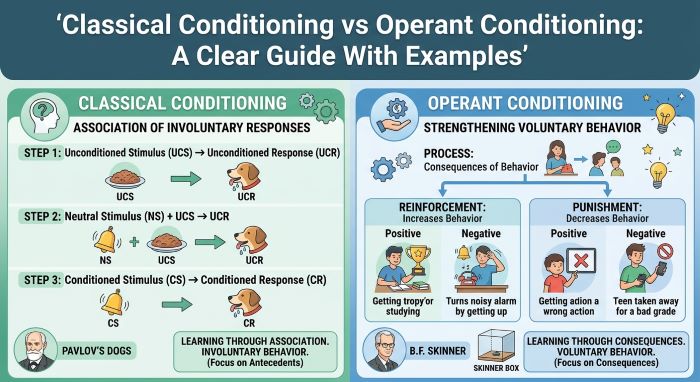
Classical Conditioning vs Operant Conditioning
Your phone buzzes, and your heart jumps a little before you even look at the screen. Your dog sits the moment you pick up a treat bag. A child cleans their room faster when they know a sticker chart is waiting. All three are examples of learning by conditioning. But they do not all work the same way. Understanding classical conditioning vs operant conditioning helps you see why we react, form habits, and change behavior the way we do.
Both theories come from behavioral psychology, and both explain how we learn from our environment. Students meet the classical conditioning vs operant conditioning split early in any intro psychology course. The difference lies in what gets learned and how. This guide explains each one in plain terms, with examples you can spot in daily life.
The Short Answer
- Classical conditioning teaches us to link two stimuli. A neutral signal starts to trigger an automatic response because it keeps showing up before something meaningful. The behavior is involuntary.
- Operant conditioning teaches us to link a behavior with its consequence. We do more of what gets rewarded and less of what gets punished. The behavior is voluntary.
What Is Classical Conditioning?
Classical conditioning is learning by association. It was first described by Ivan Pavlov, a Russian scientist who studied digestion in dogs in the late 1800s and early 1900s.
Pavlov noticed that his dogs began to drool before they got food. They drooled when they saw the lab assistant who fed them, or heard footsteps coming. He set up experiments where he paired a sound, often described as a bell or metronome, with food. After many pairings, the dogs drooled at the sound alone, even with no food in sight.
Key Terms in Classical Conditioning
| Term | Meaning | Pavlov’s Example |
|---|---|---|
| Unconditioned stimulus (UCS) | Something that triggers a natural response | Food |
| Unconditioned response (UCR) | The natural, unlearned reaction | Drooling at food |
| Neutral stimulus (NS) | Something that triggers no response at first | The sound |
| Conditioned stimulus (CS) | The once-neutral signal after learning | The sound, after pairing |
| Conditioned response (CR) | The learned reaction to the CS | Drooling at the sound |
Other Important Ideas
- Acquisition: The stage where the link forms through repeated pairing.
- Extinction: If the sound keeps playing with no food, the drooling fades.
- Spontaneous recovery: After a break, the old response can pop back up.
- Generalization: The dog may drool at similar sounds too.
- Discrimination: With training, the dog learns to respond only to the exact sound.
The Little Albert Experiment
In 1920, psychologist John B. Watson and his assistant Rosalie Rayner showed that fear could be learned this way. They showed a baby known as Little Albert a white rat, which he did not fear at first. Then they paired the rat with a loud, scary noise. Soon Albert cried at the sight of the rat alone and even at other furry objects. The study is now seen as deeply unethical, but it shaped how psychologists think about fears and phobias.
What Is Operant Conditioning?
Operant conditioning is learning by consequences. The idea started with Edward Thorndike, who in the late 1890s watched cats escape from puzzle boxes. He noticed that actions followed by good results became more likely. He called this the law of effect.
B.F. Skinner built on Thorndike’s work in the 1930s and gave operant conditioning its name. He designed a chamber, often called a Skinner box, where rats or pigeons could press a lever or peck a key. Skinner then controlled what happened after each action, such as giving food or stopping an unpleasant noise, and tracked how behavior changed.
Reinforcement and Punishment
Operant conditioning uses four main tools. “Positive” means something is added. “Negative” means something is taken away. “Reinforcement” increases a behavior. “Punishment” decreases it.
| Adds Something | Removes Something | |
|---|---|---|
| Increases behavior | Positive reinforcement: A child gets praise for doing homework | Negative reinforcement: You buckle your seatbelt to stop the car’s beeping |
| Decreases behavior | Positive punishment: A driver gets a speeding ticket | Negative punishment: A teen loses phone privileges for breaking curfew |
Negative reinforcement is the most commonly confused term. It is not punishment. It increases a behavior by removing something unpleasant.
Schedules of Reinforcement
Skinner found that how often you reward a behavior matters as much as the reward itself.
- Fixed ratio: A reward after a set number of actions. Example: a free coffee after every 10 purchases.
- Variable ratio: A reward after an unpredictable number of actions. Example: slot machines. This schedule creates the most persistent behavior.
- Fixed interval: A reward after a set amount of time. Example: a weekly paycheck.
- Variable interval: A reward after unpredictable amounts of time. Example: checking for new messages.
Shaping
Shaping rewards small steps toward a goal. Animal trainers use it to teach complex tricks. Teachers use it when they praise a child for writing one sentence, then two, then a full paragraph.
Classical Conditioning vs Operant Conditioning: Side by Side
| Classical Conditioning | Operant Conditioning | |
|---|---|---|
| Key scientist | Ivan Pavlov | B.F. Skinner (building on Edward Thorndike) |
| What is learned | A link between two stimuli | A link between a behavior and its consequence |
| Type of behavior | Involuntary, automatic (reflexes, emotions) | Voluntary, chosen actions |
| Timing | The signal comes before the response | The consequence comes after the behavior |
| Role of the learner | Passive | Active |
| Classic example | Dog drools at a sound | Rat presses a lever for food |
| Tools | Pairing stimuli | Reinforcement and punishment |
Everyday Examples
Classical Conditioning in Daily Life
- Advertising: Brands pair products with happy music, attractive people, or fun scenes, so you feel good when you see the product.
- Phone notifications: The sound of a text alert becomes linked with social contact, so you feel a small rush when you hear it.
- Food aversions: If you got sick after eating a certain food, you may feel queasy just smelling it later.
- Anxiety at the dentist: The smell of the office or the sound of the drill can trigger fear before any treatment starts.
- Holiday feelings: A certain song may bring back warm feelings because it played during happy family moments.
Operant Conditioning in Daily Life
- Parenting: Sticker charts, allowances, and time-outs all use reinforcement or punishment.
- Work: Bonuses and commissions reward high performance.
- Apps and games: Streaks, badges, and random rewards keep users coming back.
- Dog training: Giving a treat when a dog sits makes sitting more likely.
- School: Grades, praise, and detention shape student behavior.
How the Two Work Together
In real life, both types of conditioning often happen at the same time. Think about a dog and a leash. Through classical conditioning, the dog gets excited when it sees the leash because the leash predicts a walk. Through operant conditioning, the dog learns that sitting calmly gets the leash clipped on faster.
Therapists also use both. Exposure therapy uses principles from classical conditioning to weaken fear responses. Behavior plans use operant conditioning to build new habits.
Criticisms and Limits
Both theories have shaped psychology, but neither explains everything.
- They downplay thinking. Later research showed that people and animals form expectations and make predictions, not just automatic links.
- Biology sets limits. Some links form more easily than others. For example, people learn to fear snakes much faster than flowers.
- Learning by watching. Albert Bandura’s work on observational learning showed that people learn by watching others, without being rewarded or punished themselves.
Tips for Remembering the Difference
If you are studying for a psychology exam, try these memory tricks for classical conditioning vs operant conditioning:
- Classical = signal before. The signal comes first and predicts what happens next.
- Operant = operates on the environment. The learner acts, and the environment responds.
- Involuntary vs voluntary. If the response is a reflex or emotion, think classical. If it is a choice, think operant.
- Pavlov’s dogs drool. Skinner’s rats press.
Why This Matters Outside the Classroom
Knowing classical conditioning vs operant conditioning is useful in daily life, not only on tests. Parents can use reinforcement to build good habits instead of relying on punishment. People trying to break a bad habit can spot the cues that trigger cravings, a classical conditioning link, and change the rewards that keep the habit going, an operant conditioning link. Teachers, coaches, and managers use both ideas every day, often without naming them.
Even app designers rely on these ideas. Notification sounds become cues, and random rewards keep users scrolling. Seeing classical conditioning vs operant conditioning at work in your own phone can help you decide how much control you want those apps to have.
Final Thoughts
The classical conditioning vs operant conditioning difference comes down to what we learn to connect. Classical conditioning links two events, so an automatic reaction moves from one to the other. Operant conditioning links a behavior to its outcome, so rewards and punishments shape what we choose to do. Once you understand classical conditioning vs operant conditioning, you will start spotting both in ads, apps, classrooms, and your own daily habits. That awareness is the first step to using them on purpose, whether you are training a puppy or building a better routine.
Key Takeaways
- Classical conditioning links two stimuli, so a neutral signal starts to trigger an automatic response.
- Operant conditioning links a voluntary behavior to its consequence through reinforcement or punishment.
- Ivan Pavlov is linked with classical conditioning. B.F. Skinner, building on Edward Thorndike’s law of effect, is linked with operant conditioning.
- In classical conditioning, the signal comes before the response. In operant conditioning, the consequence comes after the behavior.
- Negative reinforcement increases behavior by removing something unpleasant. It is not the same as punishment.
- Variable ratio schedules, like slot machines, create the most persistent behavior.
- Everyday examples include ads and phone alerts for classical conditioning, and sticker charts and bonuses for operant conditioning.
- Both types of conditioning often work together, and both are used in therapy, parenting, and training.