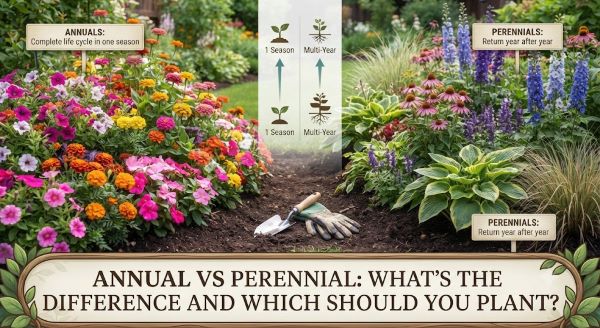
Walking into a garden center and deciding between annual vs perennial plants is one of the first real decisions a new gardener faces, and the choice affects everything from your budget to how much maintenance your garden requires year after year. This guide breaks down exactly what separates these two categories, the practical trade-offs of each, and how to decide which fits a given spot in your yard.
What Does Annual vs Perennial Actually Mean?
The core distinction in annual vs perennial plants comes down to lifecycle length.
Annual plants complete their entire life cycle, from germination to flowering to seed production to death, within a single growing season. They do not survive winter (or whatever dormant season applies in your climate) and must be replanted from seed or as new plants each year to have them in your garden again.
Perennial plants live for more than two growing seasons, typically going dormant during winter and regrowing from the same root system the following spring. Many perennials live for many years, sometimes decades, once established, returning reliably without needing to be replanted.
This single distinction in lifecycle drives most of the practical differences between the two categories that matter for garden planning.
Annual vs Perennial: Cost Comparison
Annuals are generally cheaper per plant at the time of purchase, but since they need to be replaced every single year, the cumulative cost over time is often significantly higher than perennials, which only require a one-time purchase (and occasional division or replacement as the plant ages) for years of continued blooms.
A garden bed filled entirely with annuals might cost noticeably less to plant initially but require repurchasing and replanting that same investment every spring indefinitely. A bed of established perennials represents a larger upfront cost but spreads that investment across many growing seasons, often becoming the more economical choice within just two to three years.
Annual vs Perennial: Bloom Time and Garden Color
Annuals typically bloom continuously throughout the entire growing season from planting until frost, providing extended, reliable color for months at a time. This is one of the primary reasons gardeners choose annuals for high-visibility areas like entryway pots, window boxes, or borders where consistent color is the priority.
Perennials, by contrast, typically have a more limited bloom window, often just two to six weeks at some point during the growing season, though the specific timing varies significantly by species. This means a perennial garden requires more intentional planning, often called succession planting, where different perennial species are selected specifically to bloom at staggered times throughout the season to maintain continuous color rather than relying on a single plant’s extended bloom period.
Annual vs Perennial: Maintenance Requirements
Annuals require replanting every year but often need less ongoing maintenance during their single season of growth, since they are bred and selected specifically for vigorous, low-maintenance blooming within a compressed timeframe.
Perennials require less work in terms of replanting but often need more specific ongoing maintenance, including dividing overgrown clumps every few years, cutting back dead growth at the end of the season, and sometimes more particular soil or care requirements depending on the specific species. Established perennials, once they have settled into a garden bed, generally require less day-to-day attention than annuals, but the maintenance tasks they do require tend to be more specialized.
When to Choose Annuals
Annuals make the most sense in several specific situations. For containers, hanging baskets, and window boxes, where you want maximum, consistent color for a single season and don’t need (or want) the same plants to return next year, since refreshing the look annually is often desirable in these prominent display areas. For filling gaps in a new garden while perennials are still establishing, since perennials often take a full season or two to reach their mature size and full blooming potential. For gardeners who enjoy redesigning their garden’s look each year, since annuals offer the flexibility to completely change a color scheme or planting plan annually without removing established plants. For areas where you want guaranteed, predictable blooms for a specific event or season, since annuals’ reliable single-season performance makes them more predictable than perennials, which can have variable bloom timing based on weather conditions in a given year.
When to Choose Perennials
Perennials make more sense for the backbone of a garden design intended to remain consistent for years, since they provide a structural foundation that doesn’t need to be entirely replanted each season. For reducing long-term gardening costs and effort, since the investment in establishing perennials pays off through years of return growth without repurchasing. For supporting local pollinators and wildlife more effectively, since many perennial species, particularly native ones, have co-evolved with local pollinator populations in ways that many common annual varieties have not. For larger garden beds where the cost of annually replanting the entire space would be prohibitive, perennials offer a far more economical approach to filling significant square footage.
Can You Mix Annual vs Perennial Plants in the Same Garden?
Most experienced gardeners use a combination of both rather than choosing exclusively one or the other. A common and effective approach uses perennials as the structural backbone of a garden bed, providing the consistent year-to-year framework and seasonal interest, while annuals fill in gaps between perennials and provide continuous color during periods when the perennials in that section are not actively blooming.
This combined approach captures the cost-efficiency and ecological benefits of perennials alongside the reliable, extended color and design flexibility that annuals provide, producing a garden that looks fuller and more continuously colorful than either category could achieve entirely on its own.
A Few Plants That Blur the Line
Some plants behave differently depending on climate, which adds a layer of complexity to the annual vs perennial distinction. Many plants sold and treated as annuals in colder climates are actually perennials in warmer regions, since they simply cannot survive winter temperatures outside their native warm-climate range. Examples include certain varieties of salvia, verbena, and some types of begonias, which persist as perennials in mild climates but must be replanted annually in regions with hard winter freezes. Checking your specific USDA hardiness zone against a plant’s listed perennial range clarifies whether a given species will actually return in your particular climate or needs to be treated as an annual regardless of how it’s categorized on the plant tag.
Key Takeaways
- The core annual vs perennial distinction comes down to lifecycle: annuals complete their entire life cycle within one growing season, while perennials live for multiple years, regrowing from the same root system.
- Annuals cost less per plant initially but require annual repurchasing, often making them more expensive cumulatively over several years compared to a one-time perennial investment.
- Annuals typically bloom continuously throughout the growing season, while perennials have shorter, more specific bloom windows, requiring succession planting for continuous color across a perennial garden bed.
- Perennials require less frequent replanting but more specialized ongoing maintenance like dividing and seasonal cutback, while annuals require simpler care within their single growing season.
- Annuals make the most sense for containers, filling gaps in new gardens, and situations calling for guaranteed, predictable color during a specific season or event.
- Perennials make more sense as the structural backbone of a long-term garden design, for reducing overall gardening costs over time, and for supporting local pollinator populations more effectively.
- Most experienced gardeners combine both categories, using perennials as a structural foundation and filling gaps with annuals for continuous, flexible seasonal color.
- Climate affects the annual vs perennial classification for many species, since plants treated as annuals in cold climates may behave as true perennials in warmer regions, making it worth checking your specific hardiness zone before planning.