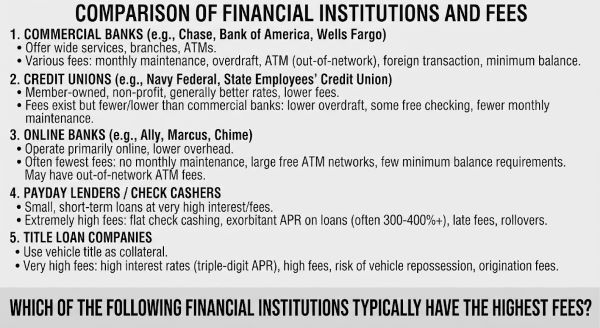
If you have encountered the question “which of the following financial institutions typically have the highest fees” in a personal finance course, a banking exam, or while comparing your own options, the answer depends on understanding how different institution types are structured and what drives their cost models. This guide ranks the major categories of financial institutions by typical fee levels and explains the underlying reasons behind those differences.
The General Ranking
Among the most common categories tested on this topic, the institutions that typically have the highest fees, ranked from highest to lowest in most comparisons, are:
- Check-cashing stores and payday lenders
- Traditional big banks (national and regional banks)
- Credit unions
- Online-only banks
This ranking holds across most standardized personal finance curricula and reflects real differences in business model, overhead, and customer base between these institution types.
Why Check-Cashing Stores and Payday Lenders Top the List
When the question asks which of the following financial institutions typically have the highest fees, check-cashing services and payday lenders are almost always the correct answer in a multiple-choice format. These businesses charge fees that are dramatically higher than traditional banking institutions, often in ways that are not always obvious from the advertised rate.
Check-cashing services typically charge a percentage of the check’s value, commonly between 1% and 12% depending on the type of check and the state’s regulations. A government or payroll check might carry a lower fee, while a personal check can carry a fee at the high end of that range or beyond.
Payday lenders charge fees that, when converted to an annual percentage rate (APR), routinely exceed 300% to 400%. A typical payday loan fee of $15 to $20 per $100 borrowed sounds modest in isolation, but because these loans are structured around very short repayment periods, often two weeks, the effective annual rate becomes extreme when annualized.
These businesses primarily serve people without easy access to traditional banking, often due to poor credit history, lack of a bank account, or immediate cash needs that cannot wait for traditional banking processes. The high fees reflect both the risk profile of the lending and the lack of competitive pressure in a market segment where customers often have limited alternatives.
Why Traditional Big Banks Rank Second
Traditional big banks, meaning large national or regional banking institutions, typically rank as the second-highest category when answering which of the following financial institutions typically have the highest fees. These institutions maintain extensive physical branch networks, large staffs, and significant overhead costs, all of which factor into their fee structures.
Common fees at traditional big banks include monthly maintenance fees (often $10 to $15 unless minimum balance requirements are met), overdraft fees (commonly $30 to $35 per incident), out-of-network ATM fees, wire transfer fees, and account closure fees for accounts closed shortly after opening.
Big banks can charge these fees in part because of brand recognition, the convenience of widespread branch and ATM access, and a customer base that includes many people who do not actively shop around for lower-fee alternatives. The overhead required to maintain thousands of physical branches nationwide is a significant driver of these costs compared to leaner institution types.
Why Credit Unions Rank Lower
Credit unions consistently rank below traditional big banks when comparing which of the following financial institutions typically have the highest fees, and this difference comes down to their fundamental structure. Credit unions are not-for-profit financial cooperatives, owned by their members rather than by shareholders seeking a profit.
Because credit unions do not need to generate returns for external shareholders, they typically pass along cost savings to members in the form of lower fees, better interest rates on savings accounts, and lower interest rates on loans. Many credit unions waive monthly maintenance fees entirely, charge lower overdraft fees, and offer free or low-cost checking accounts as standard.
Membership in a credit union is usually tied to a specific employer, geographic area, association, or other qualifying criteria, which limits credit unions’ total customer base compared to big banks but allows them to operate with a more member-focused fee structure.
Why Online-Only Banks Typically Have the Lowest Fees
Online-only banks, sometimes called neobanks or digital banks, generally rank lowest in fee structure when answering which of the following financial institutions typically have the highest fees, since these institutions are built around minimizing the overhead categories that drive costs at traditional banks.
Without physical branches to maintain, online banks operate with significantly lower overhead. This allows many online banks to offer no monthly maintenance fees, no minimum balance requirements, and often higher interest rates on savings accounts than traditional banks can match, since the cost savings from not maintaining branches can be redirected toward more competitive account terms.
The trade-off with online-only banks is the absence of in-person service and, in some cases, more limited ATM access, though most online banks have addressed this through partnerships with large ATM networks that allow fee-free withdrawals.
A Quick Reference Comparison
| Institution Type | Typical Monthly Fee | Typical Overdraft Fee | Why Fees Are Higher or Lower |
|---|---|---|---|
| Payday lenders / check cashers | N/A (fee-per-transaction, often 300%+ APR equivalent) | N/A | High risk lending, limited customer alternatives |
| Traditional big banks | $10–$15 | $30–$35 | High overhead from branch networks |
| Credit unions | $0–$5 | $20–$28 | Not-for-profit, member-owned structure |
| Online-only banks | $0 | $0–$10 (often waived) | No physical branch overhead |
Why This Question Matters Beyond the Test
Understanding which of the following financial institutions typically have the highest fees has practical value beyond passing a quiz. The fee differences between institution types compound significantly over time, particularly for people living paycheck to paycheck who may be more likely to rely on check-cashing services or overdraw an account regularly.
A person using a check-cashing service consistently instead of a free checking account at a credit union could lose hundreds or even thousands of dollars annually in fees that would otherwise stay in their pocket. This is part of why financial literacy curricula place such heavy emphasis on this exact comparison: the gap between institution types is not marginal, it is often dramatic.
Key Takeaways
- Which of the following financial institutions typically have the highest fees is most often answered correctly as check-cashing services and payday lenders, which can carry effective annual rates exceeding 300%.
- Traditional big banks rank second, driven primarily by the overhead costs of maintaining extensive branch and ATM networks, with monthly fees around $10 to $15 and overdraft fees around $30 to $35.
- Credit unions rank lower than big banks because of their not-for-profit, member-owned structure, which allows them to pass cost savings on to members through lower or waived fees.
- Online-only banks typically have the lowest fees of all major institution types, since they avoid the overhead of physical branches entirely and can pass those savings to customers.
- The gap between these institution types is not minor. Choosing a check-casher or payday lender over a credit union or online bank can cost a person hundreds to thousands of dollars annually.
- Membership requirements limit who can access credit unions, while online banks and big banks are generally open to any qualifying applicant regardless of employer or location.
- Standardized personal finance curricula consistently rank these four institution types in the same order: payday lenders and check cashers highest, followed by big banks, then credit unions, then online-only banks lowest.
- Understanding which of the following financial institutions typically have the highest fees helps explain why financial literacy programs emphasize avoiding check-cashing services and payday loans whenever a traditional banking alternative is accessible.