Construction Jobs Hiring Near Me
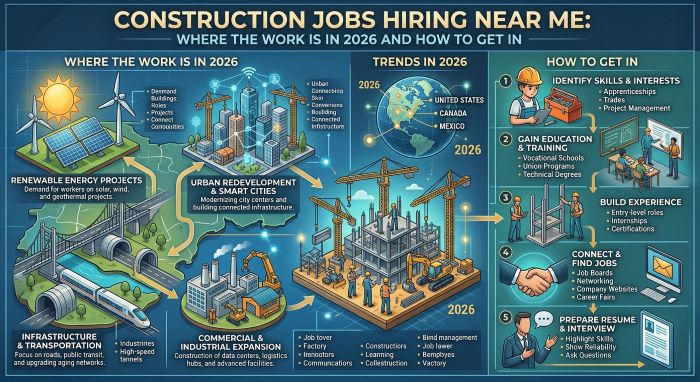
The construction industry needs about 349,000 new workers in 2026, according to Associated Builders and Contractors, a national trade group. And that number climbs to an estimated 456,000 in 2027. Older workers are retiring faster than new ones are joining, while data centers, infrastructure projects, and manufacturing plants keep breaking ground. For anyone searching for construction jobs hiring near me, that adds up to real opportunity, even for people with no experience at all.
This guide breaks down the roles that are hiring, where to find them, what they pay in general terms, and the fastest ways to get started.
Why Construction Is Hiring
A few big forces are driving demand:
- Retirements. ABC’s economist has said most of the 2026 demand stems from workers retiring. Many skilled tradespeople are in their 50s and 60s.
- Data centers. The rush to build data centers for artificial intelligence and cloud computing has created huge demand for electricians, laborers, and equipment operators.
- Infrastructure. Roads, bridges, water systems, and power grids need repair and upgrades across the country.
- Manufacturing. New factories for chips, batteries, and other products require large construction crews.
- Housing. Many regions still have a housing shortage, which keeps residential builders busy.
Entry-Level Construction Jobs
You do not need a trade license to start. These construction jobs hiring near me often accept beginners:
Construction Laborer
Laborers prepare job sites, move materials, clean up, dig trenches, and assist skilled trades. It is physical work, but it is the most common way into the industry.
Helper or Apprentice
Helpers work alongside electricians, plumbers, carpenters, and other trades. It is a paid way to learn a skill on the job.
Flagger
Flaggers control traffic around road work zones. Most states require a short certification course.
Material Handler
Material handlers load, unload, and move supplies on large sites or at building supply yards.
Site Cleanup Crew
Some companies hire workers to clean finished homes and commercial spaces before they are handed over to owners.
Skilled Trades in High Demand
If you want higher pay over time, these trades are among the most sought after:
| Trade | What They Do | How People Usually Start |
|---|---|---|
| Electrician | Install and repair wiring, panels, and lighting | Apprenticeship, typically 4 to 5 years |
| Plumber | Install and repair water, gas, and drainage systems | Apprenticeship |
| HVAC technician | Install and service heating and cooling systems | Trade school or apprenticeship |
| Carpenter | Build frames, forms, cabinets, and finishes | Helper role or apprenticeship |
| Heavy equipment operator | Run excavators, bulldozers, and cranes | Training program, some need certification |
| Welder | Join metal for structures and pipelines | Trade school and certification |
| Ironworker | Install structural steel and rebar | Apprenticeship |
| Roofer | Install and repair roofs | Often on-the-job training |
| Concrete finisher | Pour and finish concrete slabs and walls | On-the-job training |
What Construction Jobs Pay
Pay depends on the trade, your experience, union status, and where you live. In general:
- Entry-level laborers often start in the high teens to mid twenties per hour in many areas, with higher pay in large cities and union jobs.
- Apprentices earn a percentage of a journeyworker’s wage, with raises as they progress.
- Licensed electricians, plumbers, and other journey-level tradespeople can earn well above the national median wage, especially with overtime.
- Specialized work, such as on large data center or industrial projects, often pays a premium.
Check local wage data on the Bureau of Labor Statistics website or with your local union hall for accurate numbers in your area.
Who Is Hiring Construction Workers
General Contractors
Large builders and general contractors hire for commercial, industrial, and infrastructure projects. Check their careers pages and job boards in your area.
Specialty Contractors
Electrical, plumbing, HVAC, and roofing companies are often the busiest hirers. ABC reported that nonresidential specialty trade contractors added about 95,000 jobs from August 2024 into 2025, a sign of steady demand.
Homebuilders
National and regional homebuilders hire laborers, framers, and site supervisors.
Union Halls
Building trades unions, such as the IBEW for electricians and the UA for plumbers and pipefitters, run apprenticeship programs and dispatch members to jobs.
Staffing Agencies
Agencies such as PeopleReady and Labor Finders place general laborers on construction sites, often on short notice.
Government Projects
State transportation departments and local governments hire for road and public works projects.
How to Find Construction Jobs Hiring Near Me
- Search job boards for “construction laborer,” “helper,” or your target trade plus your city.
- Visit active job sites and ask for the site supervisor. Some foremen hire on the spot.
- Contact local union halls to ask about apprenticeship openings and application dates.
- Call specialty contractors directly. Small electrical or plumbing shops often hire helpers by word of mouth.
- Check Apprenticeship.gov, the U.S. Department of Labor’s site for registered apprenticeships.
- Visit your local American Job Center for free help and training programs.
Certifications That Help You Get Hired
- OSHA 10-Hour Construction: A basic safety course many employers require or prefer. It can be completed in a couple of days.
- OSHA 30-Hour: A more advanced safety course for supervisors and experienced workers.
- Flagger certification: Required for traffic control roles in most states.
- Forklift certification: Useful for material handling roles.
- First aid and CPR: Valued on many job sites.
- CDL (commercial driver’s license): Opens doors to hauling and equipment transport jobs.
What You Need to Get Started
- Reliable transportation. Job sites move, often outside public transit routes.
- Basic tools. Some laborer jobs require a tape measure, hammer, utility knife, and tool belt.
- Safety gear. Steel-toe boots are often required. Employers usually provide hard hats, vests, and eye protection.
- Physical fitness. Expect lifting, bending, climbing, and working outdoors in all weather.
- A clean drug test. Many contractors require testing, especially on large projects.
Apprenticeships: Earn While You Learn
Registered apprenticeships combine paid on-the-job training with classroom instruction. You earn wages from day one, with raises as you progress, and you finish with a recognized credential and no student debt. Many programs accept applicants with a high school diploma or GED and basic math skills.
Application windows for union apprenticeships can be limited, so check dates early and apply on time.
Common Questions
Can I get a construction job with no experience? Yes. Laborer and helper roles are common starting points.
Is construction work seasonal? In cold climates, some outdoor work slows in winter, but indoor, commercial, and data center projects often continue year-round.
Do women work in construction? Yes, and many programs actively recruit women into the trades.
How long until I earn good money? Many apprentices see steady raises each year and reach journey-level pay in four to five years.
A First-Year Roadmap
Getting started in construction can feel like a maze. Here is a simple roadmap many new workers follow after finding construction jobs hiring near me.
Month 1: Get Job-Ready
- Earn your OSHA 10-Hour Construction card.
- Buy steel-toe boots, work gloves, and basic hand tools.
- Make a simple resume listing any physical or hands-on work, such as landscaping, warehouse jobs, moving, or home projects.
Months 1 to 2: Land Your First Role
- Apply for laborer and helper roles with contractors and staffing agencies.
- Show up early, every day. Reliability is the number one thing foremen look for.
- Learn the names of tools and materials. Ask questions when you are unsure.
Months 3 to 6: Pick a Direction
- Notice which trades you enjoy working near. Electrical, plumbing, carpentry, and equipment work each feel different.
- Ask skilled workers how they got started.
- Research apprenticeship programs and their application dates.
Months 6 to 12: Apply for an Apprenticeship
- Submit applications to union and non-union registered apprenticeships.
- Study for any entrance tests, which often include basic math and reading.
- Keep working as a laborer or helper while you wait, which builds experience that strengthens your application.
What a Typical Day Looks Like
Construction days often start early, sometimes as early as 6 or 7 a.m. Crews begin with a safety briefing, often called a toolbox talk, then move into the day’s tasks. Laborers might unload materials, set up scaffolding, clean work areas, or help skilled workers. Breaks are scheduled, and the day often ends by mid-afternoon. Overtime is common on busy projects, which can boost your pay.
Weather plays a big role. Expect heat in summer, cold in winter, and rain days that may change the schedule. Dressing in layers and staying hydrated help a lot.
Questions to Ask Employers
When comparing construction jobs hiring near me, ask:
- What is the starting pay, and how often are raises given?
- Is overtime common, and how is it paid?
- Do you provide safety gear and tools?
- Is there a path to an apprenticeship or skilled role?
- Where are the job sites, and how often do they change?
Build Your Future
Construction jobs hiring near me are easier to find than in many other fields, with the industry needing about 349,000 new workers in 2026 and even more in 2027. Start as a laborer or helper, earn an OSHA 10 card, and look into apprenticeships that pay you to learn a trade. Data centers, infrastructure, and housing projects are creating steady work across the country. If you are ready to work with your hands and build something real, now is a strong time to search for construction jobs hiring near me.
Key Takeaways
- Associated Builders and Contractors says the industry needs about 349,000 new workers in 2026 and about 456,000 in 2027.
- Retirements, data centers, infrastructure, manufacturing, and housing are driving demand.
- Entry-level construction jobs hiring near me include laborer, helper, flagger, and material handler.
- In-demand trades include electrician, plumber, HVAC technician, carpenter, welder, and heavy equipment operator.
- An OSHA 10-Hour Construction card is a quick credential that many employers want.
- Registered apprenticeships pay you while you learn and lead to journey-level credentials.
- Check Apprenticeship.gov, local union halls, specialty contractors, and staffing agencies for openings.
- Bring reliable transportation, s