
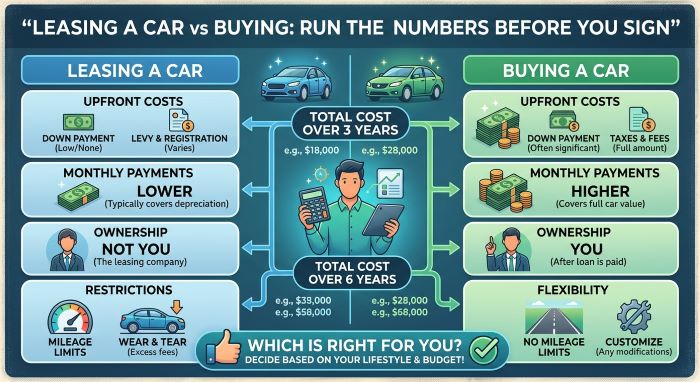
Leasing a Car vs Buying
Dealers love to talk about monthly payments. That is the number that gets people to sign. But the monthly payment hides most of the story, and leasing a car vs buying looks very different once you add up the full cost over several years. This guide skips the sales pitch and walks through a simple worked example, the fees people forget, and the questions that point you to the better deal for your situation.
One note first: I am not a financial advisor, and the numbers below are examples to show how the math works. Rates, prices, and fees vary by location, credit score, and dealer. Use your own quotes for a real decision.
How Each Option Works
Buying means you pay for the whole car, either in cash or with a loan. Once the loan is paid off, the car is yours. You can keep it, sell it, or trade it in.
Leasing means you pay to use the car for a set period, usually 24 to 39 months. Your payments cover the car’s expected drop in value during that time, plus interest (called the money factor) and fees. At the end, you return the car, buy it at a set price, or lease another.
A Worked Example
Let us compare the two using a car with a sticker price of about $35,000. These figures are rounded and simplified, but they show the shape of the decision.
The Lease
- 36-month lease
- Due at signing: about $3,000 (first payment, fees, and some down payment)
- Monthly payment: about $450
- Mileage limit: 12,000 miles a year
Total paid over three years: about $3,000 plus 35 payments of $450, or roughly $18,750.
At the end, you own nothing. You hand back the keys.
The Purchase
- 60-month loan
- Down payment: $5,000
- Loan amount: $30,000 plus taxes and fees, at a moderate interest rate
- Monthly payment: roughly $600
After three years, you have paid $5,000 plus 36 payments of $600, or about $26,600. You still owe money on the loan, but you also own a car with real value. A three-year-old car often keeps around half to 60% of its original price, depending on the model and market.
If the car is worth about $19,000 and you owe about $13,000, you have roughly $6,000 in equity. Subtract that from what you paid, and your true cost for three years of driving is about $20,600.
What the Example Shows
Over three years, the lease and the purchase cost about the same in this example. The lease has a lower monthly payment and less cash up front. The purchase builds equity.
The big difference shows up later. If you keep the purchased car for years after the loan is paid off, you drive with no payment at all. A leaser who signs lease after lease always has a payment.
The Long View: Seven to Ten Years
Stretch the timeline and the leasing a car vs buying math changes. Buying usually wins on total cost.
- Leasing for nine years means three back-to-back leases, each with fees, money due at signing, and monthly payments the whole time.
- Buying and keeping one car for nine years means five years of loan payments, then four years with no payment, plus rising repair costs as the car ages.
For most people who keep cars a long time, buying costs less overall. Leasing costs more in exchange for always driving a newer car under warranty.
Fees People Forget
Lease Costs to Watch
- Acquisition fee: Charged at the start, often several hundred dollars.
- Disposition fee: Charged when you return the car, unless you lease or buy another from the same brand.
- Mileage overage: Often around 15 to 30 cents per mile over your limit. Going 5,000 miles over at 25 cents a mile costs $1,250.
- Excess wear and tear: Dents, scratches, worn tires, and stained seats can lead to charges at turn-in.
- Early termination: Ending a lease early can be very expensive.
- Gap insurance: Often required or included, to cover the difference if the car is totaled.
Purchase Costs to Watch
- Interest: Longer loans, like 72 or 84 months, mean lower payments but more total interest.
- Depreciation: New cars lose value fastest in the first few years.
- Repairs after warranty: Older cars need tires, brakes, and bigger repairs.
- Being “underwater”: With a small down payment and a long loan, you can owe more than the car is worth for years.
Questions That Point You to the Answer
How Many Miles Do You Drive?
The average American drives roughly 13,000 to 14,000 miles a year. Most leases allow 10,000 to 15,000. If you drive a lot for work or have a long commute, buying usually makes more sense. Higher-mileage leases exist but cost more.
How Long Do You Keep Cars?
If you like a new car every two or three years, leasing fits that habit. If you drive cars until the wheels fall off, buy.
How Rough Are You on Cars?
Kids, dogs, construction sites, and tight city parking all lead to wear. Leasing companies may charge for it at turn-in. If your cars tend to get banged up, owning removes that stress.
Do You Want to Customize It?
Lift kits, new wheels, tinted windows, and aftermarket stereos are usually off limits on a lease, or must be removed before return. Owners can do what they like.
Is Cash Flow Tight Right Now?
Leasing often means less money up front and a lower monthly payment. That can help if you need a reliable car but want to keep more cash available. Just remember the payments never end if you keep leasing.
Do You Use the Car for Business?
Business owners and self-employed people may be able to deduct part of a lease payment or part of the costs of owning a car. The rules are specific, so talk with a tax professional.
Leasing a Car vs Buying: The Trade-Offs
| Leasing | Buying | |
|---|---|---|
| Monthly payment | Usually lower | Usually higher |
| Upfront cost | Often lower | Often higher with a down payment |
| Ownership | None | Full, once the loan is paid |
| Mileage limits | Yes | No |
| Wear charges | Possible at turn-in | None, but it affects resale value |
| Customization | Limited | Unlimited |
| Repairs | Mostly covered by warranty | Your cost after warranty ends |
| Long-term cost | Higher if you lease forever | Lower if you keep the car for years |
What About Electric Vehicles?
EVs add a wrinkle. Battery and charging technology change quickly, and some buyers worry about how fast older EVs will lose value. Leasing can shift that risk to the leasing company. In some cases, incentives on EVs have also been easier to get through a lease than a purchase, though these rules change. Check current offers and tax rules before you decide.
Tips if You Decide to Lease
- Negotiate the car’s price (the capitalized cost) just like you would when buying.
- Ask for the money factor and multiply by 2,400 to get a rough interest rate.
- Choose a mileage limit that matches your real driving.
- Keep your down payment small. If the car is totaled early, a large down payment can be lost.
- Get a pre-inspection a few weeks before turn-in to fix small issues for less.
Tips if You Decide to Buy
- Get pre-approved for a loan from a bank or credit union before visiting the dealer.
- Keep the loan term to 60 months or less if you can.
- Put at least 10 to 20 percent down to avoid owing more than the car is worth.
- Consider a certified pre-owned car to skip the steepest drop in value.
- Plan to keep it well past the payoff date to get the most value.
A Middle Path: Buy Used
There is a third option many people overlook in the leasing a car vs buying debate: buying a lightly used car. A two- or three-year-old car has already taken the biggest drop in value, often at the end of someone else’s lease. You pay less than new, you still own the car, and many come with remaining factory warranty or a certified pre-owned warranty.
For budget-minded drivers, this can beat both a new lease and a new purchase. It is worth adding to your leasing a car vs buying comparison before you visit the dealer. You may find that the smartest move in the leasing a car vs buying decision is neither a brand-new lease nor a brand-new loan.
So, Lease or Buy?
Leasing a car vs buying is a trade between flexibility and long-term savings. Leasing gives you lower payments, a new car every few years, and fewer repair worries, but you never stop paying and you never own anything. Buying costs more up front, but it builds equity and becomes much cheaper once the loan is gone. Run your own numbers with real quotes, be honest about how many miles you drive and how long you keep cars, and the leasing a car vs buying decision will become much clearer.
Key Takeaways
- Leasing means paying to use a car for 24 to 39 months. Buying means paying for the whole car and owning it.
- Over three years, total costs can look similar, but buying builds equity while leasing leaves you with nothing to sell.
- Over seven to ten years, buying and keeping one car usually costs less than leasing back to back.
- Watch lease fees: acquisition, disposition, mileage overage of about 15 to 30 cents a mile, and wear charges.
- Watch purchase costs: long loan terms, interest, depreciation, and repairs after the warranty ends.
- Leasing suits low-mileage drivers who want a new car every few years and lower monthly payments.
- Buying suits high-mileage drivers, people who keep cars a long time, and anyone who wants to customize.
- These are example numbers, not financial advice. Get real quotes and consider a professional for your situation.

