TPT
More than 7 million educators have used it. Over 85 percent of U.S. teachers have shopped on it. And 10,000 of its sellers have each earned more than $10,000. Those numbers belong to TPT, the online marketplace better known as Teachers Pay Teachers, which turned 20 years old in 2026.
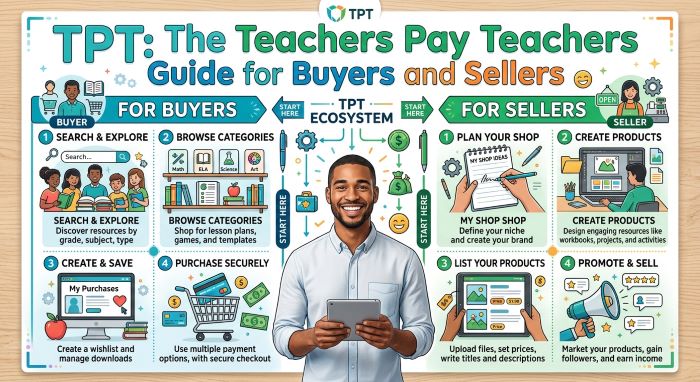
For buyers, it is a place to find lesson plans, worksheets, games, and units made by other teachers. For sellers, it is a way to earn extra income from work they already do. This guide covers how the site works, what it costs, what changed for sellers in 2026, and how to get the most out of it on either side.
What the Marketplace Is
Teachers Pay Teachers is a website where educators buy, sell, and share teaching materials. Most resources are made by classroom teachers, former teachers, tutors, and specialists. The site covers every grade from PreK to 12 and almost every subject, from phonics and math to science labs, art, music, and special education.
Resources come in many formats:
- Printable worksheets and task cards
- Full lesson plans and multi-week units
- Slide decks and digital activities
- Classroom decor and organization tools
- Assessments, rubrics, and exit tickets
- Games, centers, and seasonal activities
- Bundles that group many resources at a discount
Many resources are free. Others range from a dollar or two to larger bundles that cost much more.
A Short History
A Teacher’s Idea
The site launched in 2006. It was founded by Paul Edelman, a former New York City public school teacher. His idea was simple: teachers already create great materials, so why not give them a place to share and sell those materials to each other?
Growth Through the Years
The marketplace grew fast as more teachers went online. By the 2010s, some sellers were earning full-time incomes. As of 2022, more than 300 teachers had become millionaires through the platform, according to IXL Learning.
The IXL Era
In March 2023, IXL Learning, the company behind the popular IXL practice program, acquired the marketplace. The price was not disclosed. IXL also owns other education brands, and the deal brought the marketplace into a larger family of learning tools.
Turning 20
In September 2026, the company marked its 20th anniversary. It said more than 7 million educators worldwide had used the site and that 10,000 Teacher-Authors had each earned more than $10,000 over two decades.
How Buying Works
Buying is simple. You create a free account, search for what you need, and check out.
Finding Good Resources
With millions of listings, search skills matter. Here are a few tips:
- Filter by grade, subject, and format. This narrows results fast.
- Read the preview. Most listings show sample pages.
- Check ratings and reviews. Other teachers often point out errors or strengths.
- Look at the seller’s store. A seller with many well-rated products is usually a safe bet.
- Check standards alignment. Many resources list which standards they cover.
- Start with free resources. They let you test a seller’s style before you buy.
Saving Money as a Buyer
- Buy bundles. They often cost much less than buying each item alone.
- Shop site-wide sales. The site runs big sales a few times a year, often around back-to-school and teacher appreciation.
- Follow sellers you like. Many sellers discount new products for a short time.
- Leave feedback. Buyers can earn credits toward future purchases by leaving reviews.
- Use a wish list. Save items and buy them during sales.
School Purchasing
Many schools and districts buy resources for their teachers. The company offers school purchasing options, including school access programs that let teachers use resources with school funds. Ask your school whether it has an account before you spend your own money.
How Selling Works
Selling is where the site gets more complex. Any teacher can open a store, upload resources, and set prices. The marketplace handles payments, hosting, and delivery. In return, it keeps a share of each sale.
Seller Plans in 2026
Seller terms changed in late 2026. According to a comparison of platforms published in October 2026, the current options look like this:
| Plan | Cost | Seller Keeps | Key Rule |
|---|---|---|---|
| Basic | One-time $29 fee | 55% of each sale, minus a 30-cent fee per resource | Can sell elsewhere |
| Exclusive | $59.95 per year | 80% for a limited time, dropping to 77.5% on January 1, 2027 | Digital resources must be sold only on the marketplace |
The older Premium plan closed to new sign-ups on October 1, 2026. Existing Premium sellers must choose between the two new plans.
What the Numbers Mean
Here is a simple example using a $5 resource:
- A Basic seller keeps about $2.45.
- An Exclusive seller keeps about $4.00 now and about $3.88 starting in 2027.
At that price, the Exclusive fee pays for itself after roughly 39 sales a year. Sellers with steady sales usually do better on Exclusive. New sellers, or those who sell in many places, may prefer Basic.
The Exclusivity Debate
The new Exclusive plan requires sellers to sell their digital educational resources only on the marketplace. That means no selling the same items on a personal website, through a membership, or on other platforms.
Some sellers have pushed back. An online petition launched on October 1, 2026, asked the company to reconsider terms that restrict off-platform sales. Sellers who run their own websites or sell through other channels now face a hard choice between higher payouts and more freedom.
Is Selling Worth It?
For some teachers, selling is life-changing. For most, it is a modest side income. The company’s former CEO said in 2022 that the average seller earns a profit in the low single-digit thousands.
Success often depends on:
- Niche. Focused products, like a specific reading program or grade-level math skill, often sell better than broad ones.
- Quality. Clean design, clear directions, and accurate content lead to good reviews.
- Volume. Most successful stores have dozens or hundreds of products.
- Consistency. Adding new products over time builds a store.
- Marketing. Many top sellers use Pinterest, Instagram, blogs, and email lists to drive traffic.
Tips for New Sellers
- Start with what you use. Your best classroom materials are your first products.
- Make a free product. It draws buyers to your store.
- Write clear titles and descriptions. Use words teachers search for, like grade level, skill, and format.
- Create strong previews. Show buyers exactly what they get.
- Bundle related products. Bundles raise the average sale.
- Respect copyright. Use only fonts, clip art, and images you have rights to use commercially.
- Track your numbers. Watch which products sell and make more like them.
- Choose your plan with care. Compare your expected sales against the Exclusive fee and the exclusivity rule.
Pros and Cons of TPT
Pros
- Huge selection of teacher-made resources
- Many free materials
- Products made by people who know classrooms
- Easy setup for sellers
- Large built-in audience of buyers
Cons
- Quality varies from seller to seller
- Search results can be crowded
- Seller payouts on the Basic plan are lower
- The Exclusive plan limits where sellers can sell
- Some resources may not match your school’s curriculum
Alternatives to Consider
Sellers who want more control sometimes look at other options. These include selling through their own websites with tools like Shopify or Gumroad, or through other education marketplaces. Each option has trade-offs. Your own website gives you full control and keeps more of each sale, but you must bring your own traffic. The marketplace offers a ready audience but takes a cut and sets the rules.
Buyers can also find free resources from state education departments, nonprofits, and open education sites. Mixing free and paid resources can stretch a classroom budget.
How Teachers Use It in Real Classrooms
Teachers use the site in many ways:
- New teachers use full units to get through their first year.
- Veteran teachers buy fresh activities to refresh old lessons.
- Substitute plans are a popular category for days when a teacher is out.
- Special educators find resources made for specific needs.
- Homeschool families buy lessons and printables for home learning.
Many teachers say the biggest benefit is time. Planning takes hours, and a well-made resource can give some of that time back.
Licenses: What Buyers Can and Cannot Do
Many buyers do not read the fine print, but it matters. Most resources come with a single-user license. That means the teacher who buys the resource can use it with their own students. It does not mean they can share the file with every teacher on their grade-level team.
If colleagues want to use the same resource, sellers usually offer extra licenses at a discount. Buying them keeps you on the right side of the seller’s terms and supports the teacher who made the work.
A few other rules to keep in mind:
- Do not post paid files on public websites or shared drives open to anyone.
- Do not resell or repackage another seller’s work.
- Check the terms of use page inside each file, since rules can differ from seller to seller.
Digital Tools and Easel
More classrooms now run on laptops and tablets, and the marketplace has adapted. Its Easel tool lets teachers turn many PDF resources into digital activities. Students can type answers, drag items, and draw right on the page. Teachers can then assign the activity through common learning platforms.
This helps teachers who bought printable resources years ago reuse them in digital form. It also means sellers who build products with digital use in mind can reach more buyers.
Planning a Week With Marketplace Resources
Here is how a third grade teacher might use TPT to plan a week of math on fractions:
| Day | Resource Type | Purpose |
|---|---|---|
| Monday | Slide deck lesson | Introduce fractions with visuals |
| Tuesday | Task cards | Small group practice |
| Wednesday | Digital activity | Independent practice on devices |
| Thursday | Game or center | Hands-on review |
| Friday | Exit ticket or quiz | Check understanding |
Buying a fractions bundle from one seller often covers all five days. That keeps the style consistent for students and saves the teacher from searching for five separate items. This is one reason bundles are among the best sellers on TPT.
Common Questions
What does TPT stand for? It stands for Teachers Pay Teachers.
Who owns the site? IXL Learning acquired it in March 2023.
Is it free to use? Creating a buyer account is free, and many resources are free. Paid resources are priced by sellers.
How much do sellers keep? Basic sellers keep 55 percent minus a 30-cent fee per resource. Exclusive sellers keep 80 percent for a limited time, dropping to 77.5 percent in 2027.
Can sellers sell on other sites? Basic sellers can. Exclusive sellers must sell their digital educational resources only on the marketplace.
When was it founded? In 2006, by former New York City teacher Paul Edelman.
Why TPT Still Matters to Teachers
Twenty years after it launched, TPT remains the largest marketplace of its kind. It gives buyers a deep library of classroom-tested resources and gives sellers a ready audience. The 2026 seller changes have stirred real debate, mostly around exclusivity and payouts. Teachers who know the rules can still make TPT work for them, whether they want to save planning time or build a side income.
Key Takeaways
- TPT stands for Teachers Pay Teachers, a marketplace for PreK to 12 teaching resources.
- It was founded in 2006 by former New York City teacher Paul Edelman.
- IXL Learning acquired the company in March 2023.
- More than 7 million educators have used the site, including over 85 percent of U.S. teachers.
- In 2026, seller plans changed to Basic, with a one-time $29 fee and a 55 percent payout, and Exclusive, at $59.95 a year with an 80 percent payout.
- The Exclusive payout drops to 77.5 percent on January 1, 2027, and requires selling digital resources only on the marketplace.
- The Premium plan closed to new sign-ups on October 1, 2026.
- Buyers can save with bundles, sales, wish lists, and credits from leaving feedback.