Extended Cab vs Crew Cab
Truck shopping comes with its own vocabulary, and cab size is one of the first terms that trips people up. Stand two pickups side by side and the difference is plain: one has small rear doors and a tight back seat, the other has four full doors and a back seat an adult can actually ride in. That is the heart of the extended cab vs crew cab choice. But the right pick depends on how you use a truck day to day, so instead of a spec dump, this guide walks you through six questions. Answer them honestly and the decision usually makes itself.
Quick Definitions
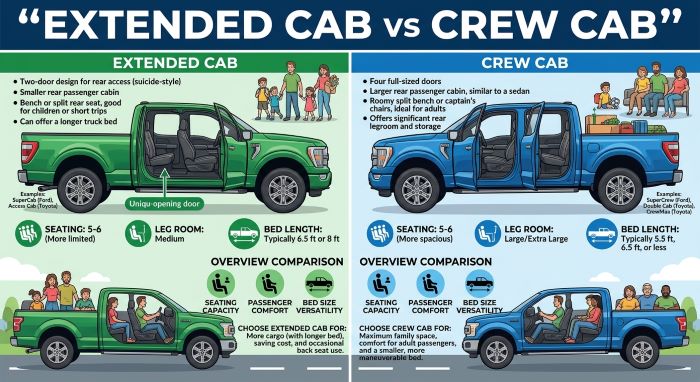
Extended cab: A truck with one full row of seats up front and a small second row behind it. Rear doors are smaller than front doors, and on some models they open backward and only work when the front doors are open. The rear seat is best for kids, short rides, or extra storage.
Crew cab: A truck with two full rows of seats and four full-size doors that open like a sedan’s. The back seat has real legroom for adults.
There is also the regular cab, with only one row of seats. It is mostly sold as a work truck these days.
Brand Names Can Be Confusing
Each automaker uses its own labels, and they change from time to time. Here are names you will often see:
| Brand | Extended Cab Name | Crew Cab Name |
|---|---|---|
| Ford | SuperCab | SuperCrew |
| Chevrolet and GMC | Double Cab | Crew Cab |
| Ram | Quad Cab (on some models) | Crew Cab or Mega Cab |
| Toyota | Double Cab or XtraCab | CrewMax or Double Cab (Tacoma) |
| Nissan | King Cab | Crew Cab |
Lineups shift by model year, and some brands have dropped extended cabs on certain trucks. Always check the current configurations for the exact model you want. Note that “Double Cab” means different things at different brands, which is one more reason to look at the truck in person.
Question 1: Who Rides in the Back, and How Often?
This is the biggest factor in the extended cab vs crew cab decision, and it is worth being honest about.
If you regularly carry adults or teenagers, a crew cab is close to essential. Extended cab rear seats tend to be upright, with limited knee room. They are fine for a 15-minute trip, but few adults want to sit there for an hour.
If you carry young children in car seats, a crew cab is also much easier. Full-size rear doors make it simpler to lift a child in and buckle them. Rear-facing seats in particular need space that many extended cabs cannot provide. Check the owner’s manual for car seat guidance on any truck you consider.
If the back seat will mostly hold a toolbox, a dog crate, or groceries, an extended cab may be all you need.
Question 2: How Much Bed Do You Need?
Here is the extended cab vs crew cab trade-off most buyers do not think about at first. Total truck length is limited, so a bigger cab often means a shorter bed.
On many full-size pickups:
- Extended cabs often pair with a standard bed around 6.5 feet long.
- Crew cabs often pair with a short bed around 5.5 to 5.8 feet, with a 6.5-foot bed available on some models.
Some heavy-duty crew cabs offer an 8-foot bed, but that makes for a very long truck.
That extra foot of bed matters if you haul plywood, drywall, dirt bikes, or long lumber. A 4-by-8 sheet of plywood will lie flat between the wheel wells on many full-size beds, but you will only close the tailgate on an 8-foot bed.
If you mainly haul camping gear, mulch bags, or a couple of bikes, a short bed works well.
Question 3: Where Will You Park It?
Crew cabs are long. A full-size crew cab with a standard bed can stretch well past 20 feet. That length can create real headaches:
- Some home garages are too short.
- City parking spaces and parking garages can be tight.
- Turning circles are wider, which makes U-turns and tight lots harder.
An extended cab with a short bed is usually the most compact full-size option. If you live in a city or have a small garage, measure before you buy. Mid-size trucks, such as the Toyota Tacoma, Ford Ranger, and Chevrolet Colorado, are another way to get a crew cab in a smaller package.
Question 4: Are You Towing or Hauling Heavy Loads?
Cab size can change towing and payload numbers, though not always in the way you might expect.
- Payload is how much weight the truck can carry in the cab and bed combined. A heavier crew cab body can mean slightly lower payload than a lighter extended cab with the same engine.
- Towing capacity depends mostly on engine, axle ratio, and towing package. Cab size plays a smaller role, but it can shift the numbers.
- Wheelbase is longer on crew cabs, which can make towing a big trailer feel more stable on the highway.
If towing is your main job, compare the specific configurations you are considering on the manufacturer’s spec sheets, not just the general model.
Question 5: What Is Your Budget?
Crew cabs usually cost more than extended cabs with the same trim and engine. The gap often runs a few thousand dollars, and it can be larger depending on the model and options.
There are a few other cost points to keep in mind:
- Fuel economy: Crew cabs weigh a bit more, which can trim fuel economy slightly.
- Insurance: Rates vary more by driver, location, and trim than by cab size, but it is worth getting quotes.
- Availability: Crew cabs make up a large share of pickups sold today, so dealers often have more of them on the lot. Extended cabs can be harder to find in some trims.
If you are buying a work truck that will rarely carry passengers, the extended cab can save you real money.
Question 6: How Long Will You Keep It, and Who Will Buy It Next?
Crew cabs are in high demand on the used market, especially among families. That popularity often helps them hold value well.
Extended cabs still sell, especially to contractors and buyers on a budget, but the pool of buyers can be smaller. If you trade in vehicles every few years, resale value is worth a thought.
If you plan to keep the truck for a decade, think about how your life may change. A single buyer today may have kids or carpool duties in five years.
Extended Cab vs Crew Cab: A Side-by-Side Look
| Extended Cab | Crew Cab | |
|---|---|---|
| Rear doors | Smaller, sometimes rear-hinged | Four full-size front-hinged doors |
| Rear seat | Tight, best for kids or short trips | Roomy enough for adults |
| Common bed length (full-size) | About 6.5 ft | About 5.5 to 5.8 ft, longer beds on some models |
| Overall length | Shorter with short bed | Longer |
| Price | Lower | Higher |
| Best for | Work trucks, solo drivers, hauling long cargo | Families, carpools, daily driving with passengers |
| Resale demand | Moderate | High |
Profiles: Which Buyer Are You?
The contractor. Hauls materials daily, rarely has passengers, needs a long bed. Extended cab.
The family hauler. Carries kids to school, sports, and road trips, tows a camper on weekends. Crew cab.
The weekend adventurer. Brings friends to trailheads, hauls bikes and kayaks. Crew cab with a short bed, or a mid-size crew cab.
The city dweller. Needs a truck now and then but parks on the street. Extended cab with a short bed, or a mid-size truck.
The budget buyer. Wants a full-size truck at the lowest price. Extended cab.
Test Drive Tips
- Sit in the back seat yourself. If you would not want to ride there for an hour, adults will not either.
- Install your child’s car seat at the dealership if you have one.
- Try parking it in a tight space and backing it into a spot.
- Measure your garage before you go, and bring the numbers.
- Ask about the exact bed length, not just “short bed” or “standard bed.”
One Last Tip on Resale and Trade-Ins
If you plan to trade in your truck in a few years, ask the dealer which configurations move fastest in your area. In many markets, buyers searching for used trucks filter by cab size first, and the extended cab vs crew cab demand can differ by region. Rural areas with lots of contractors may favor long beds, while suburbs often favor crew cabs. Knowing local demand can help you choose a truck that holds its value, and it adds one more angle to the extended cab vs crew cab decision.
The Verdict
The extended cab vs crew cab decision comes down to people versus cargo. Crew cabs win for passengers, families, comfort, and resale demand. Extended cabs win for longer beds, lower prices, and easier parking. Answer the six questions above, sit in the back seat of each before you buy, and you will land on the right truck for the way you actually live. The extended cab vs crew cab choice is easier when you start with how you use the truck, not with what looks best on the lot.
Key Takeaways
- Extended cabs have a small rear seat and smaller rear doors. Crew cabs have four full doors and an adult-size back seat.
- Brand names vary: Ford uses SuperCab and SuperCrew, Chevy and GMC use Double Cab and Crew Cab, and Toyota uses names like CrewMax.
- Bigger cabs often mean shorter beds. Full-size extended cabs often pair with about 6.5-foot beds and crew cabs with about 5.5 to 5.8-foot beds.
- Crew cabs are longer, which can make garages, city parking, and tight turns harder.
- Crew cabs usually cost a few thousand dollars more than extended cabs with the same trim and engine.
- Crew cabs tend to have strong resale demand, especially among families.
- Choose an extended cab for work, long cargo, and lower cost. Choose a crew cab for regular passengers and car seats.
- Always sit in the rear seat and check exact bed lengths and specs for the model year you want.