Best Practices for Remote Hiring
Hiring someone you may never meet in person feels risky at first. You cannot read the room, shake a hand, or watch how a candidate treats the receptionist. But companies of every size now hire remotely as a normal part of doing business, and the ones that do it well have learned that a good remote process can actually be fairer and faster than an in-office one. The difference comes down to a few habits. This field guide walks through the best practices for remote hiring, step by step, from the first job post to the end of a new hire’s first 90 days.
It is written for hiring managers, founders, and HR teams who want a practical playbook, not theory.
Step 1: Decide What “Remote” Means for This Role
Before writing a word of the job post, answer these questions:
- Fully remote, hybrid, or remote within a region? Be specific.
- Which countries or states can you legally hire in? Payroll, taxes, and labor law differ by location.
- What time zones need to overlap? If the team meets daily at 10 a.m. Eastern, say so.
- Is any travel required? Many remote roles include a few in-person meetups a year.
Vague answers here cause wasted interviews later. One of the most important best practices for remote hiring is setting these boundaries up front.
Step 2: Write a Job Post That Filters for You
A remote job post reaches far more people than a local one. That is great for reach but can bury you in unqualified applicants. A clear post does the screening for you.
Include:
- The real job. Describe what the person will do in a typical week, not a wish list.
- Must-have versus nice-to-have skills. Keep the must-have list short.
- Location and time zone rules. “Remote, U.S. only, must overlap 4 hours with Pacific time.”
- Pay range. Several U.S. states and cities, including California, Colorado, New York, and Washington, require salary ranges in job postings. Even where it is not required, ranges save time for everyone.
- Tools and work style. Mention the main tools you use and how the team communicates.
- Hiring steps. Tell candidates what the process looks like and how long it takes.
Step 3: Source Beyond the Usual Job Boards
General job boards work, but remote roles benefit from targeted channels:
- Remote-focused job boards that cater to distributed teams
- LinkedIn with location filters set to the regions you can hire in
- Professional communities on Slack, Discord, or industry forums
- Employee referrals, which often bring in strong, well-matched candidates
- Freelance platforms for contract-to-hire roles
Track where your best candidates come from so you can focus your budget next time.
Step 4: Build a Structured Interview Process
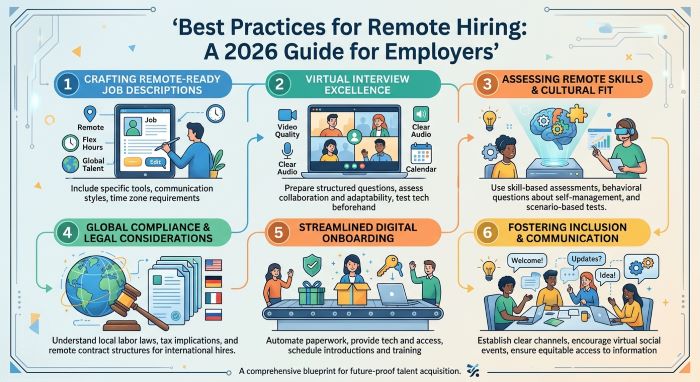
Structured interviews, where every candidate answers the same core questions and is scored on the same criteria, are one of the most reliable ways to predict job performance. They also reduce bias, which matters even more when you cannot rely on in-person impressions.
A typical remote process looks like this:
- Application review using a simple scorecard
- Short screening call (20 to 30 minutes) to confirm basics like location, pay range, and availability
- Skills assessment related to the real work
- Structured video interviews with two or three team members
- Final conversation with the hiring manager
- Reference checks
Aim to move candidates through in two to three weeks. Strong remote candidates often have several offers.
Step 5: Use Skills Assessments, Not Trick Questions
A short, relevant assessment shows you how someone actually works.
- Keep it short. Two to four hours at most. Longer take-home tests drive away good candidates.
- Make it relevant. Use a realistic task, such as editing a short document, reviewing a piece of code, or drafting a customer reply.
- Pay for long assessments. If a task takes more than a few hours, consider paying candidates for their time.
- Score it fairly. Use the same rubric for every submission.
Step 6: Run Video Interviews Well
Video interviews are the heart of remote hiring. A few habits make them work better:
- Send the link, agenda, and interviewer names in advance.
- Test your setup. A stable connection, clear audio, and decent lighting set the tone.
- Start with a few minutes of small talk to help candidates relax.
- Assign question areas to each interviewer so you do not repeat yourselves.
- Take notes during or right after each interview using the scorecard.
- Leave time for the candidate’s questions. Remote candidates often care about communication, meetings, and work-life boundaries.
Do not judge candidates on their home background, internet speed, or a pet walking by. Focus on the answers.
Step 7: Test for Remote Work Skills
Remote work demands a few specific strengths. Ask about them directly:
- Written communication. Look at the quality of their emails and assessment responses.
- Self-management. “Tell me about a project you completed with little supervision.”
- Asynchronous collaboration. “How do you keep teammates in other time zones up to date?”
- Problem solving alone. “What do you do when you are stuck and your manager is offline?”
- Boundaries. “How do you structure your day when working from home?”
Step 8: Protect Against Hiring Fraud
Remote hiring has created new risks. Employers have reported cases of candidates using fake identities, stand-ins during interviews, or AI tools to fake answers in real time. U.S. authorities have also warned about schemes in which workers using stolen identities obtain remote tech jobs.
Simple safeguards help:
- Verify identity. Check a government ID during onboarding, and match it to the person on camera.
- Keep cameras on during interviews.
- Ask follow-up questions that require real-time thinking and personal examples.
- Check references directly using contact details you find yourself, not only ones the candidate provides.
- Run background checks where legal and appropriate.
- Watch for red flags, such as refusing video, inconsistent work history, or requests to ship equipment to a different address than the one on file.
This is one of the newer best practices for remote hiring, but it has quickly become essential.
Step 9: Handle Compliance and Pay Correctly
Hiring across state or national lines adds legal steps:
- Register as an employer in each state where you have employees, if required.
- Follow local labor laws on overtime, breaks, and paid leave.
- Use an employer of record (EOR) to hire full-time employees in other countries without setting up a local company.
- Classify workers correctly. Treating a full-time worker as a contractor can lead to penalties.
- Decide on a pay philosophy. Some companies pay the same for a role everywhere. Others adjust by location. Be consistent and transparent.
When in doubt, talk to an employment lawyer or a payroll provider who specializes in remote teams.
Step 10: Make the Offer and Close Quickly
- Call before you send the written offer. It feels more personal.
- Include the full package: salary, benefits, equipment, home office stipend, and paid time off.
- Give a reasonable deadline, often three to five business days.
- Stay in touch between the offer and start date.
Step 11: Onboard With Intention
A rough first week can undo all your hiring work. Good remote onboarding includes:
- Equipment that arrives before day one
- Accounts and logins ready on the first morning
- A clear 30-60-90 day plan with goals
- An onboarding buddy who is not their manager
- Short daily check-ins during the first two weeks
- Introductions to key people across the company
- Written documentation they can read at their own pace
Ask new hires for feedback after 30 days and use it to improve the process.
Remote Hiring Checklist
| Stage | Key Action |
|---|---|
| Planning | Define location, time zone, and pay rules |
| Job post | Clear duties, must-have skills, pay range, process |
| Sourcing | Remote boards, LinkedIn, referrals, communities |
| Screening | Short call to confirm basics |
| Assessment | Short, relevant, fairly scored task |
| Interviews | Structured questions, shared scorecard |
| Fraud checks | ID verification, cameras on, direct references |
| Compliance | Registration, classification, EOR if needed |
| Offer | Call first, full package, clear deadline |
| Onboarding | Equipment ready, buddy, 30-60-90 plan |
Mistakes to Avoid
- Copying an office job post and adding “remote” to the title
- Long, unpaid take-home tests
- Unstructured “vibe check” interviews
- Hiring in a location you cannot legally employ people
- Skipping identity checks
- Leaving new hires alone in their first week
Sample Structured Interview Questions
Strong questions are a core part of best practices for remote hiring. Here are examples you can adapt, grouped by skill:
Communication
- “Walk me through how you would update a teammate in another time zone about a delayed project.”
- “Tell me about a time a written message was misunderstood. What did you do?”
Ownership
- “Describe a project where you had to figure out the next steps on your own.”
- “Tell me about a mistake you made at work and how you handled it.”
Collaboration
- “How do you build relationships with coworkers you have never met in person?”
- “Describe a disagreement with a remote teammate and how you resolved it.”
Role skills
- Ask two or three questions tied directly to the job’s core tasks, and use the same questions for every candidate.
Score each answer on a simple 1 to 4 scale using a shared rubric, and write down short evidence for each score. This keeps your team focused on what the candidate actually said, not on gut feeling.
Measuring Your Hiring Process
Following best practices for remote hiring also means tracking whether your process works. Useful measures include:
- Time to hire: Days from posting to accepted offer.
- Offer acceptance rate: How many candidates accept your offers.
- Source of hire: Which channels produced your best hires.
- Candidate experience: A short survey for candidates, including those you did not hire.
- 90-day retention and performance: Whether new hires are succeeding.
Review these numbers every quarter. Small changes, like shortening a take-home test or replying to candidates faster, can make a big difference. Teams that measure and refine their best practices for remote hiring tend to get better results with each new role.
Putting It Into Practice
The best practices for remote hiring come down to clarity, structure, and trust backed by verification. Define the role and its location rules, write a job post that screens for you, use structured interviews and short skills tests, guard against fraud, and onboard with a real plan. Teams that follow these best practices for remote hiring tend to hire faster, make fewer bad hires, and keep people longer. Start by tightening one stage at a time, and your remote hiring process will improve with every role you fill.
Key Takeaways
- Define fully remote, hybrid, or regional rules, plus time zone and travel needs, before posting a job.
- Write clear job posts with real duties, short must-have lists, pay ranges, and hiring steps.
- Several states, including California, Colorado, New York, and Washington, require pay ranges in job postings.
- Use structured interviews with shared scorecards to improve fairness and accuracy.
- Keep skills assessments short and relevant, and consider paying for longer tasks.
- Protect against hiring fraud with ID checks, cameras on, and references you verify yourself.
- Handle compliance by registering where needed, classifying workers correctly, and using an employer of record abroad.
- Onboard with equipment ready on day one, a buddy, and a 30-60-90 day plan.