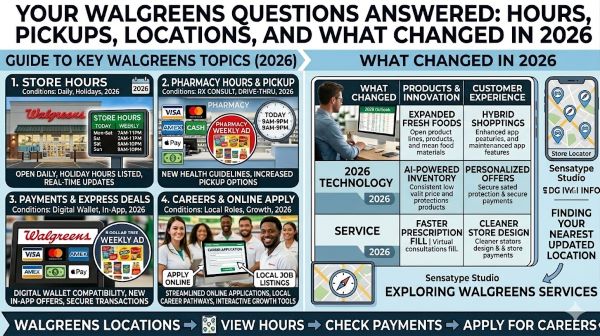
Most people do not think about Walgreens until they need it, and by then the questions are urgent. Is the pharmacy still open? Will my prescription be ready before they close? Is the location near my office one of the ones that shut down? This article is built around those real questions instead of a tour of the company, because that is how people actually use a drugstore: in a hurry, with a specific need, hoping the doors are open.
We will work through the things that trip people up most: the gap between when the store is open and when the pharmacy counter is open, how to time a pickup so you are not stuck waiting, the fastest ways to find a location, and the practical effect of the ownership change that happened in 2025. By the end you should be able to handle any Walgreens errand without a wasted trip.
The Single Most Useful Thing to Understand
If you take away one idea from this guide, make it this: the store and the pharmacy are two different operations under one roof, with two different schedules. Almost every frustrating Walgreens trip comes from confusing the two.
The retail floor, where you grab snacks, cards, shampoo, and over-the-counter medicine, stays open the longest. The pharmacy counter, where prescriptions are filled, closes earlier and even shuts down for a stretch in the middle of the day. So you can walk into a brightly lit, fully open store at 8:30 p.m. and still find the pharmacy gate pulled down for the night.
Once that clicks, everything else gets easier. When your errand is a prescription, you check the pharmacy schedule, not the store schedule. When your errand is anything else, the longer store hours apply. Keeping those two separate in your head prevents the most common drugstore disappointment there is.
Walgreens Store Hours
Let us start with the retail side, since it is the simpler of the two. Most Walgreens stores keep generous hours so you can run in for essentials early or late.
A typical store runs along these lines:
- Monday through Saturday: roughly 7 a.m. or 8 a.m. until 10 p.m. or 11 p.m.
- Sunday: often a little shorter, frequently 8 a.m. to 10 p.m.
Some locations are open 24 hours, with the retail floor never closing, although the count of around-the-clock stores has shrunk as the company tightens its operations. Hours track local demand, so a high-traffic city store may stay open later than a quieter neighborhood one.
Holidays bring shorter hours rather than closures in most cases. The chain rarely locks its doors entirely, even on big holidays, because people need medicine and last-minute items no matter the date. Expect trimmed hours on days like Thanksgiving and Christmas. The safe habit is to confirm your store’s holiday schedule in advance, since a reduced-hours day can catch you out.
Walgreens Pharmacy Hours
Now the part people get wrong. Walgreens pharmacy hours are shorter than the store hours and include a quirk that surprises first-timers: a daily midday break.
The usual pattern looks like this:
- Monday through Friday: about 8 a.m. or 9 a.m. to 8 p.m. or 9 p.m.
- Saturday: commonly 9 a.m. to 6 p.m.
- Sunday: often 10 a.m. to 6 p.m.
The detail that catches people: most pharmacy counters close for roughly half an hour each day so staff can take a meal break, traditionally somewhere around 1:30 p.m. to 2:00 p.m. Arrive in that window and the counter may be shut even with the store humming around it. Build your trip around that gap and you avoid a needless wait.
The drive-thru adds another wrinkle. Its hours usually mirror the walk-in counter, but at busy stores the window can close 15 to 30 minutes earlier. If you are counting on a late drive-thru pickup, verify that time on its own.
Holidays compress the schedule further. The pharmacy often runs limited hours or closes outright on Christmas, Thanksgiving, and New Year’s Day, even when the store stays open. So for any prescription need around a holiday, the pharmacy schedule is the one that governs your plans. A quick call to the counter is the surest way to confirm same-day timing.
Timing a Prescription Pickup Without the Wait
This is the practical skill nobody teaches you. A little timing turns a prescription run from a hassle into a two-minute stop.
Submit early in the day. A new prescription typically takes one to two hours to fill. If you drop it off or send it over in the morning or early afternoon, you give the staff time to prepare it and yourself a comfortable window to collect it before closing. Wait until the last hour and you risk the counter closing before it is ready.
Use the app or text alerts. Rather than guessing, request the refill through the app or website and wait for the notification that it is ready. Showing up before that alert is the classic mistake that leaves you standing at the counter while it gets filled.
Avoid the rushes. The busiest times are right at opening, over the lunch hour, and in the early evening when people stop in after work. If your schedule is flexible, mid-morning or mid-afternoon, outside the lunch break, tends to be quietest.
Know your counter’s direct line. The pharmacy has its own phone number, separate from the main store line, listed on the store’s page online. Calling it directly is the fastest way to check whether your order is ready or confirm the counter is open right now.
Set up refills and longer supplies. For medications you take regularly, automatic refills and a 90-day supply cut your number of trips dramatically. Fewer visits means fewer chances to hit a closed counter.
Finding a Walgreens Near Me
When you need a Walgreens near me, the goal is to find one that is both close and actually open, and given recent closures, that second part matters more than it used to. A few tools make it quick.
The official store locator on the company website is the most reliable, showing each store’s retail and pharmacy hours, address, phone number, and services. Because the chain has been closing underperforming stores, the locator is the safest way to confirm a store is still operating before you drive over.
A maps app on your phone is the fastest in-the-moment option. A quick search pulls up nearby stores by distance with hours and directions. The company’s own mobile app goes a step further by linking a store search to your prescription account, so you can find a store and handle refills together.
If your real need is medication and you are open to any provider, search pharmacy near me instead. That widens the field to include other drugstores, grocery and big-box pharmacies, and clinics, which is useful when you want whichever counter is open latest or closest. A pharmacy near me search is especially handy after hours or on holidays, when schedules differ and you just need one that is open. The lesson with either search is the same: check the pharmacy hours specifically, not just the store hours, whenever your trip is about a prescription.
What the Walgreens Pharmacy Can Do for You
The Walgreens pharmacy is the core of the business, and it handles much more than handing over pill bottles. Knowing the full range helps you get more value from each visit.
Filling, refilling, and transferring prescriptions. You can start a new prescription, refill an existing one, or move your prescriptions over from another pharmacy. Transfers are easier than people expect, since the staff handle the back-and-forth with your old pharmacy for you.
Vaccines and immunizations. The counter administers flu shots, COVID-19 vaccines, shingles vaccines, and more, frequently on a walk-in basis. Booking online trims the wait if you would rather schedule.
Pharmacist advice. A pharmacist can answer questions about interactions, side effects, timing, and how a new medication fits with what you already take. This consultation is free and often more available than a follow-up with your doctor, so it is worth using.
Maintenance medication tools. Automatic refills, refill reminders, and 90-day supplies are designed for ongoing prescriptions and reduce both trips and the chance of running out.
Delivery and central fulfillment. Beyond the local counter, the pharmacy operation includes home delivery and centralized facilities that fill certain prescriptions and route them to stores or your door. This behind-the-scenes setup is part of how the chain has reshaped its pharmacy model in recent years.
One small but useful point: when a medication question comes up, remember the pharmacy keeps its own direct phone line apart from the store’s general number. Calling it gets you to someone who can check your specific order without bouncing you around.
Everything Else Under the Roof
A Walgreens trip is rarely only about prescriptions, and the rest of the store covers a lot of ground.
You will find over-the-counter medicine, first aid, vitamins, and wellness products filling a sizable chunk of the floor, usually with staff nearby for questions. The photo department prints pictures and makes cards, books, and gifts, often with same-day pickup. There is a solid beauty and personal care section spanning cosmetics, skincare, and hair care. And the convenience-store basics, snacks, drinks, household items, cleaning supplies, cover the quick run you do not want to make a full grocery trip for.
Many stores also offer the myWalgreens rewards program, which earns cash back and unlocks member pricing, worthwhile if you shop there often. Some locations provide health testing or clinic services, though the availability of in-store clinics has shifted with the company’s restructuring, so check whether yours still offers them.
The Big Change: Walgreens Went Private
The most significant recent development is not about hours or aisles. In August 2025, after nearly a century as a publicly traded company, Walgreens was taken private by the investment firm Sycamore Partners in a deal valued around $10 billion, and up to roughly $23.7 billion counting debt. The broader business was split apart, with the retail drugstore continuing as Walgreens and other pieces, including the international Boots chain and several healthcare arms, becoming separate companies. A new chief executive, Mike Motz, took over.
For shoppers, the headline effect is store closures. Even before the sale, the company had laid out a plan to close roughly 1,200 underperforming stores, and more than a thousand have already closed. Under private ownership, the strategy centers on a leaner network focused on the strongest locations, which points to continued closures.
What this means in practice is mostly continuity with one caveat. Day to day, your local store and pharmacy work the way they always have, filling prescriptions and selling the same goods. The caveat is reliability of any single location over time. In busy areas, little changes. In lower-traffic, rural, or lower-income areas, the odds that a particular store closes are higher, so it is wise to confirm a location is open rather than assuming, especially for a pharmacy you depend on.
If a store you use does close, your prescriptions can move to another Walgreens or a different pharmacy entirely, and the app or the customer support line can arrange the transfer. The practical mindset for 2026 is simply to check before you rely, rather than to worry.
A Few Habits That Make Walgreens Easier
Pulling it together, a handful of habits prevent nearly every common headache.
Check the pharmacy hours, not just the store hours, whenever your trip involves a prescription. Remember the midday break around 1:30 p.m. to 2:00 p.m. and steer around it. Submit prescriptions early in the day and wait for the ready notification before going. Use the app to manage refills and find your nearest open store in one place. And around holidays, confirm the pharmacy schedule specifically, since it tightens more than the store does.
For anyone on long-term medication, setting up automatic refills and a 90-day supply is the single biggest convenience upgrade, turning a monthly errand into a quarterly one and cutting your exposure to closed counters and out-of-stock moments.
Saving Money on Your Prescriptions
Cost is the quiet stress behind a lot of drugstore visits, and a few moves can lower what you pay without much effort.
Start with generics. When a generic version of your medication exists, it is chemically equivalent and usually far cheaper than the brand name. Ask the pharmacist or your prescriber whether a generic is available, since switching can cut the price sharply.
Next, confirm your insurance is on file and current. The price you pay depends heavily on your plan, and an outdated or missing insurance record can leave you paying full cost by mistake. A quick check at the counter prevents that.
It also pays to compare. Prices for the same medication can vary between pharmacies, and prescription discount cards or savings programs sometimes beat your insurance copay, especially for common generics. There is no harm in asking what a medication costs with a discount program versus through insurance and taking whichever is lower.
For ongoing medications, a 90-day supply often costs less per dose than three monthly fills, and it means fewer trips. Mail-order options can be cheaper still for routine prescriptions, trading a little immediacy for a lower price.
Finally, talk to the pharmacist if a cost surprises you. They deal with pricing all day and can often suggest a lower-cost alternative, flag a manufacturer coupon, or point you toward a savings program you did not know existed. The counter is not just for picking up bottles. It is a resource for spending less on them.
What to Do When the Counter Is Closed
It happens to everyone eventually. You need a medication and the pharmacy counter has already closed for the night, the lunch break, or a holiday. A plan keeps a closed counter from becoming an emergency.
First, the store itself may still be open even when the pharmacy is not, which means you can still buy over-the-counter remedies for things like pain, allergies, or an upset stomach while you wait for the counter to reopen. That covers a lot of minor needs overnight.
For a prescription you cannot wait on, look for a nearby 24-hour pharmacy. Even though around-the-clock locations have grown less common, larger cities usually still have at least one, and a quick search will surface the closest option that is open right now. Calling ahead confirms both that it is open and that it can fill what you need.
If you are out of a critical medication and cannot reach any open pharmacy, an urgent care center or, for a true emergency, an emergency room can help bridge the gap. This is the last resort, not the first move, but it exists for situations where going without is genuinely risky.
The better fix is prevention. Refilling a few days before you run out, rather than on the last pill, gives you a buffer against closed counters and out-of-stock moments. Automatic refills make this nearly effortless, since the system starts the refill before you would otherwise think to.
Frequently Asked Questions
Why is the pharmacy closed when the store is clearly open? They run on separate schedules. The pharmacy keeps shorter hours and closes for about 30 minutes midday for a staff break, often around 1:30 p.m. to 2:00 p.m., while the retail floor stays open.
How early should I submit a prescription for same-day pickup? New prescriptions usually take one to two hours, so submitting earlier in the day, ideally before late afternoon, gives the best chance of collecting it before the counter closes.
Are all Walgreens stores 24 hours? No, and fewer are than in the past. Many keep long hours without being fully around the clock, and the pharmacy almost always closes before the store does.
Does the drive-thru close at the same time as the counter? Usually, but it can close 15 to 30 minutes earlier at busy stores, so confirm it separately for a late pickup.
Is Walgreens shutting down for good? No. It went private in 2025 and is closing weaker stores as part of a turnaround, but it still runs thousands of locations across the country.
How do I move my prescriptions to a different store or pharmacy? Request a transfer through the app, the website, or by calling the pharmacy counter, which coordinates with the other pharmacy for you.
Do I need an appointment for a vaccine? Many locations take walk-ins for common vaccines, but availability depends on the store, the season, and staffing. Booking online reserves your spot and usually means a shorter wait, which is the safer bet during busy flu-shot months.
Is the rewards program worth joining? If you shop there regularly, yes. The myWalgreens program earns cash rewards on purchases and unlocks member pricing and personalized deals at no cost to join, so frequent shoppers tend to come out ahead over time.
Key Takeaways
- The store and the pharmacy run on separate schedules, so when your errand is a prescription, check the pharmacy hours rather than the store hours.
- Walgreens store hours generally run from 7 a.m. or 8 a.m. to 10 p.m. or 11 p.m., a bit shorter on Sundays, with some 24-hour locations, though hours vary by store.
- Walgreens pharmacy hours are shorter than store hours, typically 8 a.m. or 9 a.m. to 8 p.m. or 9 p.m. on weekdays, 9 a.m. to 6 p.m. Saturday, and 10 a.m. to 6 p.m. Sunday, and they tighten on holidays.
- Most pharmacy counters close for about 30 minutes midday, often around 1:30 p.m. to 2:00 p.m., so avoid that window, and confirm pharmacy hours directly when timing matters.
- Time prescription pickups by submitting early in the day, waiting for the ready notification, avoiding peak rushes, and setting up automatic refills or a 90-day supply.
- To find a Walgreens near me, use the official locator, the mobile app, or a maps search, and confirm the location is still open given recent closures.
- Search pharmacy near me when you mainly need medication and want to compare which counter is closest or open latest, especially after hours or on holidays.
- The Walgreens pharmacy fills, refills, and transfers prescriptions, gives vaccines, offers free pharmacist advice, and supports delivery and 90-day supplies, with new prescriptions usually taking one to two hours.
- Beyond the pharmacy, stores offer photo services, over-the-counter health products, beauty and personal care, everyday essentials, and the myWalgreens rewards program.
- Walgreens went private under Sycamore Partners in August 2025 and is closing underperforming stores, so expect continuity day to day but confirm a location’s status over time, and transfer prescriptions easily if a store near you closes.