Declining a job offer is one of those situations that feels awkward regardless of how good your reason is. But knowing how to turn down a job offer but keep the door open is a career skill worth developing early, because how you decline matters just as much as whether you decline. Most people get this wrong not out of bad intentions but because they have never been shown a clear way to do it. Hiring managers remember candidates who handle rejection gracefully, and the company you pass on today may be exactly where you want to work three years from now. This guide covers what to say, when to say it, how to say it, and the mistakes that close doors unnecessarily.
Why the Way You Decline Matters
Most people focus on the discomfort of saying no and forget that the hiring manager is a professional who has declined candidates themselves. A well-handled decline does not burn a bridge. It often reinforces the impression that made them want to hire you in the first place.
A poorly handled decline, on the other hand, does leave a mark. Ghosting a company after multiple interviews, sending a one-line email with no explanation, or waiting so long that the role has to be re-posted before you respond. These things are remembered. Recruiters talk within industries. The person who interviewed you at one company may be at a different company when you apply again in two years.
The goal when you learn how to turn down a job offer but keep the door open is to leave the other person feeling respected, to give them closure quickly so they can move forward, and to express genuine appreciation without being dishonest about your reasons.
When to Respond
Respond as soon as you have made your decision. Do not sit on a decline for days hoping your current situation will change or waiting until the last possible moment. The hiring team has other candidates they may want to extend an offer to, and delaying that process is a professional discourtesy.
If you need time to make the decision, communicate that directly. It is entirely appropriate to ask for a short extension. But once your decision is made, respond within 24 hours. The faster you inform them, the more goodwill you preserve.
How to Turn Down a Job Offer But Keep the Door Open: What to Say
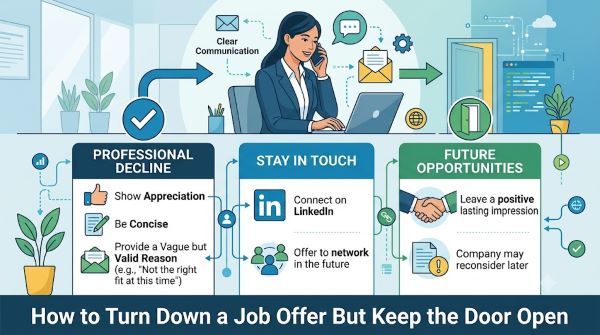
The message that accomplishes the goal of how to turn down a job offer but keep the door open has four components:
1. Express genuine gratitude. Thank them for the offer and for the time invested in the process. Be specific if you can. Mentioning something specific about the interview or the people you met signals that you were genuinely engaged rather than going through the motions.
2. Decline clearly. Do not bury the no in vague language. State directly that you will not be accepting the offer. Ambiguous declines create confusion and may require a follow-up conversation you do not need to have.
3. Give a brief, honest reason. You do not owe a detailed explanation, but a short reason makes the decline feel considered rather than dismissive. The most professionally safe reasons are: accepting another offer that aligns more closely with your current goals, deciding to stay in your current role, or a compensation or scope mismatch. You do not need to say anything negative about the company, the role, or the team.
4. Express genuine interest in staying connected. This is the part that keeps the door open. State that you respect the company and would welcome the chance to stay in touch for future opportunities. Mean it when you say it.
Word-for-Word Example: Email to Decline and Keep the Door Open
Here is a template you can adapt directly:
Subject: Re: [Job Title] Offer
Hi [Hiring Manager’s Name],
Thank you so much for offering me the [Job Title] position at [Company]. I genuinely enjoyed learning about the team and the work you are doing, and I have a lot of respect for how the process was handled.
After careful consideration, I have decided to decline the offer. I have accepted another opportunity that aligns more closely with where I am focusing my career right now.
This was not an easy decision, and I want to be clear that my respect for [Company] and the people I met is genuine. I hope we can stay connected, and I would welcome the chance to work together in the future if the right opportunity comes up.
Thank you again for the time and consideration. I wish you and the team continued success.
Best, [Your Name]
This email takes less than two minutes to read, gives a clear answer, provides a non-damaging reason, and ends on a forward-looking note. That is everything you need.
Adjusting the Reason Based on Your Situation
Knowing how to turn down a job offer but keep the door open also means knowing how to frame your reason based on your specific circumstances. Different situations call for slightly different language. Here is how to handle the most common scenarios.
You are accepting a competing offer: “I have decided to accept another opportunity that is a strong fit for where I am in my career right now.” This is the cleanest and most accepted reason in professional culture. No further detail is needed.
You are staying in your current role: “After reflecting on the opportunity, I have decided to remain in my current position.” You can add: “My situation has changed in ways that make this the right call for now.” This is honest without being overly detailed.
The compensation was the main issue: Avoid leading with money in the decline message unless you want to reopen negotiation. If you genuinely would have accepted at a higher salary and you want to keep the door open, you could say: “The offer was not quite where I needed it to be financially, but I have a lot of respect for the team and would be very open to reconnecting if a future role comes up.” This signals your interest without asking them to counter.
The role was not the right fit: “After reflecting carefully, I realized the scope of the role is not the right match for where I want to take my career at this stage.” Avoid saying anything negative about the role itself. Frame it as a self-knowledge issue rather than a critique.
What Not to Say
Avoiding these mistakes is just as important as getting the tone right when you need to turn down a job offer but keep the door open.
Do not over-explain. A long explanation sounds like you are trying to convince yourself or manage their feelings excessively. Keep the reason brief and move on.
Do not apologize excessively. One expression of regret is appropriate. Multiple apologies in the same message come across as anxious rather than professional.
Do not say anything negative about the company, the role, the team, or the process. Even if the interview experience was poor or the culture seemed like a mismatch, keep that to yourself. Feedback was not requested and will not land well in a decline message.
Do not make promises you will not keep. Saying “let’s definitely grab coffee soon” when you have no intention of following through is worse than saying nothing. If you mean it, say it. If you don’t, keep the future-connection language more general: “I hope our paths cross again.”
Following Up After the Decline
If you genuinely want to keep the door open after you turn down a job offer, follow through on it. Connect with the hiring manager on LinkedIn within a week of sending your decline. A short connection request note referencing the interview process is entirely appropriate and reinforces that you were sincere about staying in touch.
If you are interested in the company long-term, set a reminder to check their job postings in six to twelve months. Industries are smaller than they appear and the same hiring manager may be in a position to champion your candidacy for a future role that is a better fit.
Key Takeaways
- Knowing how to turn down a job offer but keep the door open requires speed, clarity, and genuine appreciation. Respond within 24 hours of making your decision.
- The four-part structure of an effective decline: thank them specifically, decline clearly, give a brief honest reason, and express genuine interest in staying connected.
- Do not bury the no in vague language. A clear decline gives the hiring team closure and lets them move forward with other candidates without delay.
- The safest reasons to give are: accepting another offer, staying in your current role, or a scope or compensation mismatch. None of these require detailed explanation.
- Avoid over-apologizing, over-explaining, or saying anything critical about the company or role. The message should be warm, direct, and brief.
- When you successfully turn down a job offer but keep the door open, following through on the connection matters just as much as the message itself. Connect on LinkedIn and check back on the company’s openings in six to twelve months if your interest is genuine.
- Hiring managers remember candidates who decline with grace. The professionalism you show in a decline is a direct signal of how you would handle difficult conversations as an employee.
- Do not ghost. A company that invested multiple rounds of interviews in you deserves a direct response. Silence is the one thing that reliably closes doors.