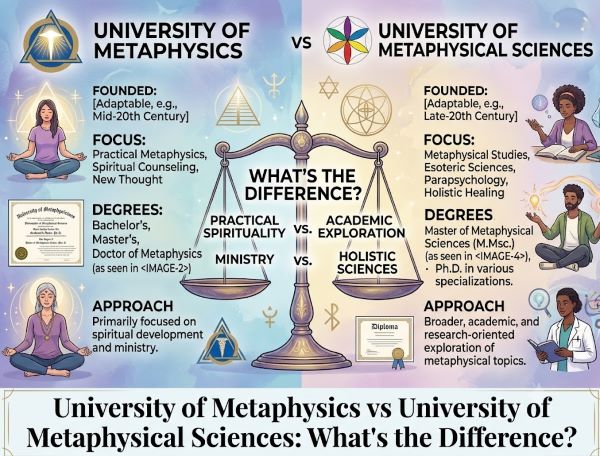
If you’re exploring alternative spiritual education or looking to earn credentials in metaphysics, you’ve likely encountered two names that sound almost identical: University of Metaphysics and University of Metaphysical Sciences. They are different institutions with different founders, different program structures, and different approaches to metaphysical education. The similarity in names causes confusion, and most online comparisons don’t go beyond surface-level observations.
This guide breaks down University of Metaphysics vs University of Metaphysical Sciences clearly so you know what you’re looking at before committing time or money to either. The University of Metaphysics vs University of Metaphysical Sciences question is more common than you’d think given how similar the names are.
What Is the University of Metaphysics?
The University of Metaphysics (UoM) was founded by Paul Leon Masters and is based in Sedona, Arizona. It operates alongside the International Metaphysical Ministry and offers degree programs ranging from bachelor’s through doctoral levels in metaphysics and metaphysical counseling.
The university focuses on practical and philosophical applications of metaphysical thought. Program content includes topics such as mind-body connection, spiritual psychology, consciousness studies, mysticism, and the integration of metaphysical principles into counseling and ministerial work. Students can earn credentials as metaphysical ministers or counselors through affiliated programs.
Courses are offered through distance learning, making the programs accessible to students regardless of location. The university has been operating for several decades and has a defined curriculum with a progression structure from introductory to advanced coursework.
What Is the University of Metaphysical Sciences?
The University of Metaphysical Sciences (UMS) was founded by Christine Breese and is headquartered in Arcata, California. Like UoM, it offers degree programs at multiple levels and operates primarily as a distance-learning institution.
UMS covers a broad range of subjects including quantum physics and consciousness, chakra systems, world religions, spiritual healing, meditation practices, and metaphysical philosophy. The curriculum draws from a wide variety of spiritual traditions and tends toward an eclectic, inclusive approach to metaphysical study.
UMS places emphasis on personal spiritual development alongside academic study of metaphysical topics. Students are encouraged to apply what they learn to their own lives and spiritual practices rather than focusing narrowly on professional credentialing.
University of Metaphysics vs University of Metaphysical Sciences: Key Differences
| Feature | University of Metaphysics | University of Metaphysical Sciences |
|---|---|---|
| Founded by | Paul Leon Masters | Christine Breese |
| Location | Sedona, Arizona | Arcata, California |
| Primary focus | Metaphysical counseling and ministry | Broad spiritual and metaphysical study |
| Degree levels | Bachelor’s, Master’s, Doctorate | Bachelor’s, Master’s, Doctorate |
| Format | Distance learning | Distance learning |
| Ministerial track | Yes, through International Metaphysical Ministry | Yes, ordination available |
| Curriculum style | Structured progression | Eclectic, tradition-spanning |
| Target student | Those pursuing ministerial or counseling credentials | Those focused on personal development and broad metaphysical study |
Accreditation: What You Need to Know
Neither the University of Metaphysics nor the University of Metaphysical Sciences holds regional or national accreditation recognized by the US Department of Education. This is a critical distinction for anyone considering these programs.
Regional accreditation is the standard that traditional colleges and universities hold. It determines whether credits transfer, whether degrees are recognized by employers in conventional fields, and whether federal financial aid applies.
Both institutions are recognized by various metaphysical and spiritual associations rather than mainstream academic accrediting bodies. If you are pursuing metaphysical credentials for ministry, private spiritual practice, or personal enrichment, the absence of conventional accreditation may not matter to your goals. If you are hoping the degree will transfer credits to a conventional university or satisfy an employer’s education requirements, it will not.
This is not unique to these two schools. Most metaphysical universities operate outside conventional accreditation frameworks by design, because their subject matter falls outside the scope of traditional academic accreditors.
Which One Is Right for You?
The University of Metaphysics vs University of Metaphysical Sciences comparison ultimately comes down to what you want from the program.
Choose University of Metaphysics if:
- You want a structured path toward metaphysical counseling or ministerial credentials
- You are interested in the philosophical and psychological applications of metaphysics
- You want a program with a defined progression from foundational to advanced coursework
Choose University of Metaphysical Sciences if:
- You want a broader exploration of spiritual traditions and metaphysical topics
- Personal spiritual development matters as much as academic content to you
- You prefer an eclectic curriculum that draws from multiple traditions without committing to one framework
Both schools are distance-learning programs, so location is not a deciding factor. Cost, program length, and specific course offerings are worth comparing directly on each school’s website before enrolling.
Student Experience and Community
One practical difference between the University of Metaphysics vs University of Metaphysical Sciences that rarely shows up in formal comparisons is the student community and support structure.
University of Metaphysics has ties to the International Metaphysical Ministry, which means graduates often plug into a network of ordained ministers and metaphysical counselors who share the same training background. This can be useful if you are building a practice or ministry and want to connect with others in the same tradition.
University of Metaphysical Sciences produces written and audio course materials authored primarily by Christine Breese, and the school has an active alumni presence in holistic wellness and spiritual counseling circles. UMS students tend to describe a strong sense of personal transformation as part of the educational experience, reflecting the school’s emphasis on applying metaphysical principles to daily life rather than purely academic study.
Neither school offers a traditional campus experience, so community interaction happens through online channels, webinars, and events organized by each institution separately.
Within the metaphysical and alternative spiritual community, degrees from both institutions carry weight among peers and clients who understand what they represent. Outside that community, neither degree carries the recognition of a conventionally accredited institution.
If your goal is to practice as a spiritual counselor, metaphysical minister, or holistic wellness practitioner working with a client base that values these credentials, the degree can be a meaningful credential in that context. If your goal is career advancement in a conventional professional setting, these degrees will not serve that purpose.
Key Takeaways
- The University of Metaphysics vs University of Metaphysical Sciences comparison comes down to focus: UoM emphasizes metaphysical counseling and ministry while UMS takes a broader, more eclectic approach to spiritual study.
- University of Metaphysics was founded by Paul Leon Masters and is based in Sedona, Arizona. University of Metaphysical Sciences was founded by Christine Breese and is based in Arcata, California.
- Both offer bachelor’s, master’s, and doctoral programs through distance learning. Neither holds regional or national accreditation recognized by the US Department of Education.
- The absence of conventional accreditation means degrees from either institution will not transfer credits to traditional universities or satisfy employer requirements in conventional fields.
- Within the metaphysical and spiritual practitioner community, credentials from both schools are recognized and used in private practice, ministry, and holistic counseling.
- Choose University of Metaphysics for a structured path toward counseling or ministerial credentials. Choose University of Metaphysical Sciences for a broader, tradition-spanning curriculum focused on personal and spiritual development.
- Compare tuition, program length, and specific course content directly on each school’s website before committing to either program.