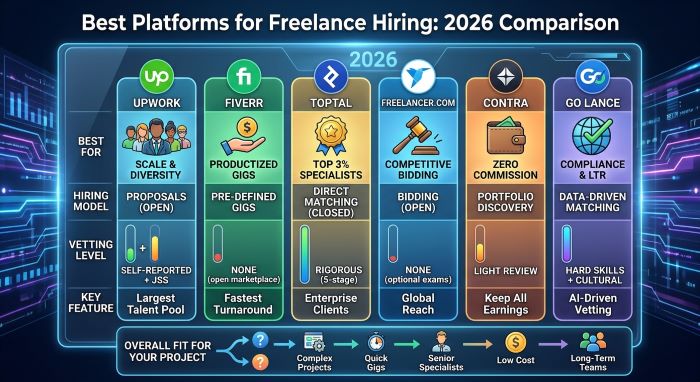
Best Platforms for Freelance Hiring in 2026
You need a logo by Friday. Or a developer for a three-month app build. Or a bookkeeper who can clean up last year’s mess before tax season. Each of these needs a different kind of freelancer, and the right marketplace depends on the job. There is no single winner among the best platforms for freelance hiring. Instead, each platform shines for a certain type of work, budget, and level of hand-holding.
This guide matches platforms to the jobs they suit best, explains what each one costs clients in general terms, and shares tips for hiring well no matter where you look.
A note on fees: platforms change their pricing often. The figures below reflect what has been reported in 2026, but always check each platform’s current fee page before you commit.
Quick Match: Which Platform for Which Job?
| If You Need | Start With |
|---|---|
| A wide range of skills, from writing to development | Upwork |
| A fixed-price task with a clear deliverable | Fiverr |
| Top-tier, pre-vetted developers, designers, or finance experts | Toptal |
| Creative and tech freelancers with no commission on their side | Contra |
| Design work, especially logos and branding | 99designs or Dribbble |
| Professional services from people in your network | |
| Long-term hires in other countries | A remote hiring or employer-of-record service |
Upwork: The Big Generalist
Upwork is one of the largest freelance marketplaces in the world and a fixture on any list of the best platforms for freelance hiring. You can find writers, developers, designers, marketers, virtual assistants, accountants, and much more.
How it works: Post a job and receive proposals, or search profiles and invite freelancers directly. You can hire hourly or for fixed-price projects with milestones.
Fees for clients: Upwork charges clients a marketplace fee on each payment, reported at about 5% on its basic plan, with lower rates for some U.S. clients paying by bank account. A one-time contract initiation fee also applies to new contracts. Upwork’s Business Plus plan costs about $49.99 a month and comes with its own fee structure. Freelancers pay a variable service fee, often around 10%, set per contract.
Best for: Ongoing projects, hourly work, and roles where you want to interview several candidates.
Watch out for: The sheer number of proposals. Write a clear, specific job post to filter applicants.
Fiverr: Fast, Fixed-Price Gigs
Fiverr built its name on packaged services called gigs. Freelancers list what they offer, such as “I will design a logo” or “I will edit a 1,000-word blog post,” with set prices and delivery times.
How it works: Browse gigs, compare packages and reviews, and buy. You can also message sellers for custom offers.
Fees for clients: Buyers pay a service fee, reported at 5.5% of the purchase, plus a small order fee on purchases under a certain amount. Sellers keep 80% of the order value, meaning Fiverr takes 20% from their side.
Best for: Small, well-defined tasks with a clear end result, like a logo, voiceover, short video edit, or product description.
Watch out for: Quality varies widely. Read reviews, check portfolios, and start with a small order before a big one. Fiverr Pro offers hand-vetted freelancers at higher prices.
Toptal: Pre-Vetted Top Talent
Toptal says it accepts only the top 3% of applicants after a multi-step screening process. It focuses on software developers, designers, finance experts, project managers, and product managers.
How it works: You describe your needs, and Toptal matches you with candidates, often within days. Many clients get a trial period before committing.
Fees for clients: Rates are higher than on open marketplaces, with Toptal’s margin built into the hourly rate. Expect to pay premium prices for premium talent.
Best for: Mission-critical projects, senior developers, and companies that want to skip the screening work.
Watch out for: Cost. Toptal is usually overkill for small or simple tasks.
Contra: Commission-Free for Freelancers
Contra is a newer platform popular with creative and tech freelancers. It is known for charging freelancers no commission, which helps attract independent professionals who dislike high platform fees.
How it works: Freelancers create portfolio-style profiles. Clients browse, message, and hire directly.
Best for: Startups and brands hiring designers, developers, writers, and marketers who work independently.
Watch out for: A smaller talent pool than the biggest marketplaces. Check how Contra charges clients before you hire, since its pricing model differs from older platforms.
Niche Platforms for Specific Skills
99designs (by Vista)
Run a design contest where many designers submit concepts and you pick a winner, or hire a designer directly. Best for logos, packaging, and branding.
Dribbble
A showcase for designers that also offers hiring tools. Great for finding illustrators, UI and UX designers, and brand designers with strong portfolios.
Many freelancers list services on their LinkedIn profiles. Searching your network often turns up trusted professionals with shared connections and visible work histories.
Freelancer.com
A large, global marketplace with contests and bidding. It offers a wide range of skills at competitive prices but can require more screening.
Malt and PeoplePerHour
Popular in Europe and the United Kingdom for finding local freelancers.
Comparing the Best Platforms for Freelance Hiring
| Platform | Talent Pool | Vetting | Price Level | Best Use |
|---|---|---|---|---|
| Upwork | Very large, global | Light, with ratings and badges | Low to high | Ongoing and hourly work |
| Fiverr | Very large, global | Light, with Pro option | Low to mid | Small fixed-price tasks |
| Toptal | Smaller, elite | Heavy | High | Senior tech and finance experts |
| Contra | Growing, creative and tech | Light | Mid | Independent creative work |
| 99designs | Design-focused | Moderate | Mid | Logos and branding |
| Huge professional network | Your own judgment | Varies | Trusted local or network hires |
How to Hire Well on Any Platform
- Write a clear brief. Describe the goal, deliverables, deadline, budget, and examples of what you like.
- Check portfolios and reviews. Look for work similar to your project.
- Ask a few targeted questions. How would they approach your project? What do they need from you?
- Start small. A paid test task or first milestone shows you how someone works before you commit to a large project.
- Use platform payments. Paying through the platform gives you protection and dispute options.
- Set milestones. Break bigger projects into stages with clear approvals.
- Agree on ownership. Make sure the contract says you own the final work once paid.
- Communicate often. Short weekly check-ins prevent surprises.
Freelancers vs Employees: Know the Line
If a freelancer works set hours, uses your equipment, and works only for you long term, they may legally count as an employee in many places. Misclassifying workers can lead to back taxes and penalties. For long-term, full-time roles, consider hiring as an employee directly or through an employer of record. When in doubt, check with an employment lawyer or accountant.
Common Questions
Which is cheapest? Fiverr and open bidding sites often have the lowest prices, but quality varies. Factor in client fees and the time you spend screening.
Which is best for developers? Upwork for a wide range of budgets, and Toptal for senior, pre-vetted engineers.
Can I hire freelancers outside the platform? Many platforms forbid moving clients off-platform for a set time after connecting. Read the terms.
How do I avoid bad hires? Start with a small paid test, check reviews, and use milestone payments.
Budgeting for Freelance Work
Price is often the first question when choosing among the best platforms for freelance hiring. Rates vary widely by skill, experience, and location. As a rough guide:
- Simple tasks like basic data entry or short edits can be very affordable.
- Mid-level work like blog writing, social media design, or website updates often falls in a moderate hourly range.
- Specialized work like software development, financial modeling, or senior design commands higher rates.
- Elite talent on curated platforms like Toptal often bills at premium rates.
When you budget, remember to add platform fees, any contract initiation fees, and a buffer of 10 to 20 percent for revisions or scope changes.
Fixed Price or Hourly?
Fixed price works best when the job has a clear end result, like a logo or a set number of articles. You know the total cost upfront.
Hourly works best for ongoing or open-ended work, like development or support, where the scope may shift. Use time tracking and weekly caps to control costs.
A Simple Job Post Template
A strong job post helps you get better proposals on any of the best platforms for freelance hiring. Try this structure:
Title: Clear and specific. “Shopify developer to build a custom product page” beats “Need help with website.”
About the project: Two or three sentences on your business and what you are trying to achieve.
Deliverables: A short list of exactly what you need, such as “One responsive product page template, tested on mobile and desktop.”
Requirements: Must-have skills, tools, and experience.
Timeline: Start date, key milestones, and final deadline.
Budget: A range, or your preferred hourly rate.
How to apply: Ask candidates to share two relevant examples and answer one question about how they would approach the project.
That final question quickly filters out generic, copy-paste proposals and shows you who actually read your post.
Choosing Your Platform
The best platforms for freelance hiring depend on the job in front of you. Upwork covers almost every skill for ongoing work, Fiverr handles fast fixed-price tasks, Toptal delivers elite pre-vetted talent at a premium, and Contra and niche sites like 99designs and Dribbble shine for creative work. Compare current fees, write a clear brief, start with a small paid test, and keep payments on the platform. Pick from the best platforms for freelance hiring with your project’s size and budget in mind, and you will find the right freelancer faster.
Key Takeaways
- There is no single winner among the best platforms for freelance hiring. Match the platform to the job.
- Upwork suits ongoing and hourly work across many skills, with client marketplace fees reported around 5% on its basic plan.
- Fiverr suits small fixed-price gigs. Buyers pay a reported 5.5% service fee, and sellers keep 80% of each order.
- Toptal offers pre-vetted top talent in tech and finance at premium rates.
- Contra charges freelancers no commission and is popular with creative and tech independents.
- 99designs, Dribbble, and LinkedIn are strong choices for design work and trusted network hires.
- Write a clear brief, start with a small paid test, use milestones, and pay through the platform.
- Fees change often, so check each platform’s current pricing, and avoid misclassifying long-term workers.