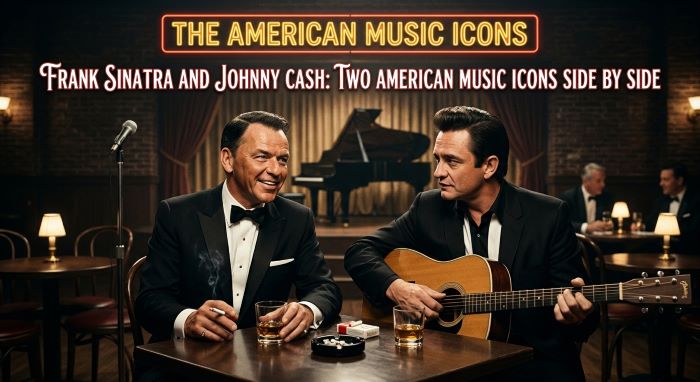
Frank Sinatra and Johnny Cash
One wore a tuxedo and sang love songs with a big band behind him. The other wore black and sang about trains, prisons, and hard times with just a guitar and a steady beat. Between them, Frank Sinatra and Johnny Cash covered much of the American songbook of the 20th century.
There’s no record of a duet or a close friendship between them, and they worked in very different scenes. Sinatra ruled nightclubs, Las Vegas, and Hollywood. Cash came out of Memphis and Nashville. Yet their careers ran on similar fuel: a voice nobody could copy, a strong personal image, and a habit of doing things their own way.
This article compares their backgrounds, careers, honors, and the threads that link them.
Quick Facts
| Frank Sinatra | Johnny Cash | |
|---|---|---|
| Full name | Francis Albert Sinatra | J. R. Cash (later John R. Cash) |
| Born | December 12, 1915 | February 26, 1932 |
| Birthplace | Hoboken, New Jersey | Kingsland, Arkansas |
| Died | May 14, 1998, age 82 | September 12, 2003, age 71 |
| Nickname | Ol’ Blue Eyes, the Chairman of the Board | The Man in Black |
| Known for | “My Way,” “New York, New York,” “Fly Me to the Moon” | “I Walk the Line,” “Ring of Fire,” “Hurt” |
| Big honor | Presidential Medal of Freedom (1985) | National Medal of Arts (2001) |
Is There a Connection Between Frank Sinatra and Johnny Cash?
There’s no documented collaboration. A few things link them, though:
- Columbia Records: Sinatra recorded for Columbia from 1943 to 1952. Cash signed with Columbia in 1958 and stayed for nearly 30 years. Their time there didn’t overlap, but both made some of their best-known early records for the label.
- Kennedy Center Honors: Sinatra received the honor in 1983, and Cash received it in 1996.
- Acting: Both worked in film and TV. Sinatra won an Oscar. Cash acted in Westerns and TV dramas, including a guest role on Columbo.
- Their own TV shows: Both hosted TV variety shows that brought music into American living rooms.
- Postage stamps: The US Postal Service honored Sinatra with a stamp in 2008 and Cash with one in 2013.
Frank Sinatra: Early Life and Education
Frank Sinatra was born on December 12, 1915, in Hoboken, New Jersey. He was the only child of Italian immigrants. His father was a boxer and firefighter, and his mother was active in local politics.
He attended A. J. Demarest High School but left without graduating. He later spent several months at Drake Business School. By then, he knew he wanted to sing, inspired by Bing Crosby.
Frank Sinatra: Career Timeline
- 1935: Won a talent contest on the Major Bowes Amateur Hour with the Hoboken Four.
- 1939: Sang with Harry James’s band, then joined Tommy Dorsey’s orchestra.
- 1943: Signed with Columbia Records as a solo singer. Teen fans, called bobby soxers, packed his shows.
- 1953: Won the Oscar for Best Supporting Actor for From Here to Eternity and signed with Capitol Records.
- 1955 to 1958: Released classic albums like In the Wee Small Hours and Come Fly with Me.
- 1960: Founded his own label, Reprise Records.
- 1966: “Strangers in the Night” won the Grammy for Record of the Year.
- 1969: Released “My Way,” which became his signature song.
- 1980: Recorded “Theme from New York, New York.”
- 1993: Released Duets, one of the best-selling albums of his career.
Johnny Cash: Early Life and Education
Johnny Cash was born on February 26, 1932, in Kingsland, Arkansas, and grew up in Dyess, a farming settlement created during the New Deal. His family picked cotton, and the music he heard on the radio and in church shaped his sound.
He sang on a local radio station in high school. He joined the US Air Force in 1950 and served as a Morse code operator in West Germany, where he bought his first guitar and began writing songs. He left the Air Force in 1954.
Johnny Cash: Career Timeline
- 1955: Signed with Sun Records in Memphis.
- 1956: Released “I Walk the Line.”
- 1958: Moved to Columbia Records.
- 1963: Released “Ring of Fire.”
- 1968: Released At Folsom Prison and married June Carter.
- 1969 to 1971: Hosted The Johnny Cash Show on ABC.
- 1980: Entered the Country Music Hall of Fame.
- 1985: Formed The Highwaymen with Waylon Jennings, Willie Nelson, and Kris Kristofferson.
- 1992: Entered the Rock and Roll Hall of Fame.
- 1994 to 2003: Recorded the American Recordings albums with Rick Rubin, ending with his cover of “Hurt.”
How Their Careers Compare
| Category | Frank Sinatra | Johnny Cash |
|---|---|---|
| Genre | Traditional pop, jazz, swing | Country, rockabilly, folk, gospel |
| Career start | 1935 | 1955 |
| Signature look | Tailored suit and fedora | All black clothing |
| Famous live setting | Las Vegas and the Sands | Folsom and San Quentin prisons |
| Own record label | Reprise Records | House of Cash publishing |
| Comeback | From Here to Eternity (1953) | American Recordings (1994) |
What Frank Sinatra and Johnny Cash Have in Common
- Unmistakable voices: Sinatra’s smooth phrasing and Cash’s deep baritone are known within a few notes.
- Big comebacks: Sinatra’s career slumped in the early 1950s before his Oscar win. Cash’s sales dropped in the 1980s before Rick Rubin helped him win a new, younger audience.
- Their own rules: Sinatra started his own label so he could control his music. Cash recorded in prisons when his label had doubts.
- Long careers: Both made records for about 50 years.
- Signature songs about life: Sinatra had “My Way.” Cash had “Man in Black.” Both songs explain who they were.
The Art of the Concept Album
Both men helped shape how albums are made. Sinatra’s Capitol records of the 1950s, such as In the Wee Small Hours, were built around a single mood. Many critics call them some of the first concept albums.
Cash did something similar with At Folsom Prison and his albums of story songs about American history and Native Americans, such as Bitter Tears. For fans of Frank Sinatra and Johnny Cash, those records still show how an album can tell one connected story.
Their Legacies Today
Frank Sinatra remains one of the most famous singers in history. “Fly Me to the Moon,” “My Way,” and “New York, New York” still play at weddings, ball games, and on film soundtracks.
Johnny Cash remains a symbol of rebel spirit and honesty. His “Hurt” video is still called one of the best music videos ever made, and the Johnny Cash Museum in Nashville is a major attraction.
Where to Start
For Frank Sinatra, listen to In the Wee Small Hours, Songs for Swingin’ Lovers!, and Sinatra at the Sands. For Johnny Cash, start with At Folsom Prison, then American IV: The Man Comes Around. Playing Frank Sinatra and Johnny Cash side by side is a quick lesson in two very different American sounds.
In Short
Sinatra brought elegance and swing to American pop. Cash brought grit, faith, and stories of working people to country music. Both built careers on voices and personalities that nobody could copy.
Fun Facts
- Sinatra was famous for his blue eyes, which gave him the nickname “Ol’ Blue Eyes.”
- Cash wore black, he said, to stand for the poor, the hungry, and the prisoner, as he sang in “Man in Black.”
- Sinatra won the Grammy for Album of the Year three times, for Come Dance with Me!, September of My Years, and A Man and His Music.
Final Thoughts
Frank Sinatra and Johnny Cash never shared a stage that we know of, but they share a place at the top of American music. Sinatra was the voice of the nightclub and the big band. Cash was the voice of the open road and the prison yard. Comparing Frank Sinatra and Johnny Cash shows how one country produced two very different legends.
Key Takeaways
- Frank Sinatra was born December 12, 1915, in Hoboken, New Jersey, and died in 1998. Johnny Cash was born February 26, 1932, in Kingsland, Arkansas, and died in 2003.
- There’s no documented duet or friendship between Frank Sinatra and Johnny Cash.
- Both recorded for Columbia Records at different times, both received Kennedy Center Honors, and both were honored with US postage stamps.
- Sinatra won an Oscar for From Here to Eternity, founded Reprise Records in 1960, and made “My Way” his signature song.
- Cash served in the Air Force, recorded At Folsom Prison in 1968, and revived his career with Rick Rubin in the 1990s.
- Both had famous comebacks and long careers built on unique voices.