Quantum computing spent years as a topic confined mostly to research papers and university labs. That changed noticeably in 2024. The latest breakthroughs in quantum computing 2024 marked the point where the field moved from theoretical promise toward genuine engineering progress, with results that changed how researchers think about the path to practical quantum machines. This guide breaks down what actually happened, why it mattered, and what is still standing between today’s quantum computers and widespread real-world use.
Why 2024 Was a Turning Point
For most of quantum computing’s development, the central obstacle was a frustrating pattern: adding more qubits to a system also added more errors. Qubits are extremely sensitive to outside disturbance, a problem known as decoherence, and scaling up a quantum processor historically meant scaling up the noise along with it. This created a kind of ceiling that made it difficult to imagine quantum computers ever becoming reliable enough for serious computation.
The latest breakthroughs in quantum computing 2024 broke that pattern in a meaningful way. Researchers demonstrated, for the first time, that adding more qubits could actually reduce the overall error rate rather than increase it. That single shift in direction is why many in the field describe 2024 as the year the path toward fault-tolerant quantum computing started to look achievable rather than purely theoretical.
Google’s Willow Chip and Below-Threshold Error Correction
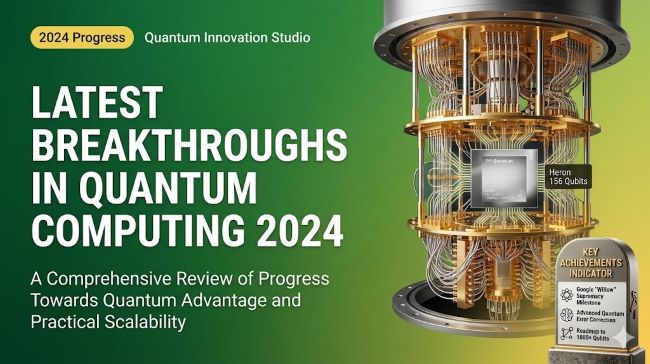
The most widely covered of the latest breakthroughs in quantum computing 2024 was Google’s Willow processor, a 105-qubit superconducting chip unveiled in December 2024. Willow became the first quantum processor to demonstrate what researchers call “below-threshold” error correction, meaning that as more physical qubits were added to form each logical qubit, the error rate actually went down instead of climbing.
This result reversed the trend that had defined the field for years. Willow also completed a benchmark computational task in a matter of minutes that would take a classical supercomputer an amount of time vastly longer than the age of the universe under standard estimates, a result Google used to argue the chip had crossed into genuine quantum advantage territory for that specific class of problem.
The significance of Willow goes beyond a single benchmark. It demonstrated, in hardware rather than simulation, that the error correction approach researchers had been theorizing about for years actually scales the way the math predicted. That validation is part of why so much of the year’s other progress builds directly on Willow’s result.
Progress in Logical Qubits and Error Correction
Among the latest breakthroughs in quantum computing 2024, advances in logical qubits stand out as foundational. A logical qubit is built by combining many physical qubits together in a way that allows errors in individual qubits to be detected and corrected in real time, without disrupting the overall computation. This redundancy is what makes fault-tolerant computing possible in principle.
In 2024, several research groups and companies reported systems with dozens of stable logical qubits, including configurations reaching 48 logical qubits built from larger arrays of physical qubits. These results matter because a fault-tolerant quantum computer, one capable of running long and complex programs without errors accumulating and destroying the result, depends entirely on reliable logical qubits at scale. Without consistent progress here, none of the other applications people imagine for quantum computing, from drug discovery to cryptography, become realistic.
Topological Qubits and the Quantinuum-Harvard-Caltech Result
Another one of the latest breakthroughs in quantum computing 2024 came from a collaboration between Quantinuum, Harvard, and Caltech. The team reported one of the first convincing experimental demonstrations of a topological qubit using a trapped-ion system, working with qutrits (three-level quantum systems) to carry out operations consistent with long-standing theoretical predictions about topological quantum computing.
Topological qubits are appealing because, in theory, they could encode logical qubits using far fewer physical resources than the current standard surface-code error correction approach. If that theoretical advantage holds up at scale, it could make large, fault-tolerant quantum computers significantly cheaper and easier to build than current architectures allow. The 2024 experiment was small in scale, but it gave researchers real experimental footing for an approach that had previously existed mostly on paper.
Quantum Networking and Long-Distance Entanglement
Among the latest breakthroughs in quantum computing 2024, advances in quantum networking received less mainstream attention than Willow but carry significant long-term implications. Researchers achieved long-distance entanglement between qubits separated by meaningful physical distance, a result that lays groundwork for what is sometimes called the quantum internet.
A functioning quantum network would allow quantum computers in different locations to share entangled qubits and work together on problems too large for any single machine, while also enabling forms of communication that are fundamentally more secure than classical encryption because of the physical properties of entangled particles. This remains an early-stage capability, but the 2024 progress moved it from a pure research curiosity toward something with a visible, if distant, practical roadmap.
Hybrid Quantum-Classical Computing
One of the more practically minded latest breakthroughs in quantum computing 2024 was the increased focus on hybrid systems that combine classical computing, AI, and quantum hardware so that each handles the part of a problem it is best suited for. Rather than waiting for quantum computers capable of solving entire problems independently, research groups in 2024 increasingly built systems where quantum processors handle the specific subproblems where quantum mechanics offers a genuine advantage, while classical systems manage everything else.
This hybrid approach reflects a more realistic short-term path to useful quantum computing. Full, general-purpose, fault-tolerant quantum computers remain years away by most expert estimates, but hybrid systems let researchers extract real value from current-generation quantum hardware today, even with its remaining limitations.
Post-Quantum Cryptography Standards
A development connected to but distinct from quantum hardware progress was the finalization of post-quantum cryptography (PQC) standards by NIST (the National Institute of Standards and Technology) in 2024. These standards are designed to resist attacks from future quantum computers capable of breaking current encryption methods.
This is a notable shift in how governments and institutions are treating quantum computing’s risks. Rather than treating quantum-capable code-breaking as a distant theoretical threat, the finalization of PQC standards signals that organizations now consider it a near-term engineering reality that requires action today, well before quantum computers capable of breaking current encryption actually exist.
Remaining Challenges
Despite the progress, the latest breakthroughs in quantum computing 2024 did not eliminate the field’s core obstacles. Qubit stability remains an active area of research, even with below-threshold error correction now demonstrated. Scaling up to the thousands or millions of physical qubits that fault-tolerant, general-purpose quantum computers will eventually require remains a substantial engineering challenge.
Algorithm development is also still maturing. Quantum computers excel at very specific classes of problems, and writing algorithms that take genuine advantage of quantum mechanics, rather than simply running classical logic on quantum hardware, is an ongoing area of research. Decoherence, the tendency of qubits to lose their quantum properties from environmental interference, continues to limit how long computations can run, even with improved error correction.
What This Means Going Forward
The latest breakthroughs in quantum computing 2024 did not produce a quantum computer capable of solving arbitrary real-world problems immediately, and no credible researcher claimed otherwise. What changed is the field’s trajectory. The demonstration that more qubits can mean fewer errors, rather than more, removed a barrier that many in the field had treated as a fundamental limitation rather than an engineering problem waiting to be solved.
Researchers and industry analysts increasingly describe the period following 2024 as a “Quantum Spring” rather than the long-feared “Quantum Winter,” a term used to describe a potential stall in funding and progress similar to past AI winters. The practical effect is that quantum computing is increasingly treated as a specialized but real tool in the broader high-performance computing landscape, rather than a purely speculative technology.
Key Takeaways
- The latest breakthroughs in quantum computing 2024 centered on a fundamental reversal: more qubits began producing fewer errors rather than more, breaking a barrier that had limited the field for years.
- Google’s Willow chip achieved the first below-threshold error correction in a 105-qubit superconducting processor and completed a benchmark task in minutes that would take classical supercomputers far longer.
- Logical qubit systems reaching 48 stable logical qubits demonstrated meaningful progress toward fault-tolerant quantum computing, which depends on reliable error correction at scale.
- A Quantinuum, Harvard, and Caltech collaboration produced one of the first experimental demonstrations of topological qubits, an approach that could eventually reduce the physical resources needed for large-scale quantum computers.
- Quantum networking advances achieved long-distance entanglement between qubits, laying early groundwork for a future quantum internet and distributed quantum computing.
- Hybrid quantum-classical computing approaches gained traction as a realistic near-term path to extracting value from current quantum hardware while full fault-tolerant systems remain years away.
- NIST finalized post-quantum cryptography standards in 2024, treating the threat of quantum-capable code-breaking as a near-term engineering concern rather than a distant theoretical risk.
- Significant challenges remain in qubit scaling, algorithm development, and decoherence, meaning the latest breakthroughs in quantum computing 2024 represent a shift in trajectory rather than a finished technology.