Nelson Mandela and Barack Obama
In 1981, a 19-year-old college student named Barack Obama stood up at Occidental College in Los Angeles and gave his first political speech. The topic was apartheid in South Africa. At that moment, Nelson Mandela was in his 18th year behind bars. Neither man could have known that both would one day become the first Black president of his country, win the Nobel Peace Prize, and share a bond that lasted until Mandela’s death. This guide looks at Nelson Mandela and Barack Obama: who they were, how their lives compare, and how they were connected.
Quick Facts
| Nelson Mandela | Barack Obama | |
|---|---|---|
| Full name | Nelson Rolihlahla Mandela | Barack Hussein Obama II |
| Born | July 18, 1918, Mvezo, South Africa | August 4, 1961, Honolulu, Hawaii |
| Died | December 5, 2013, at 95 | Living (age 65) |
| Education | University College of Fort Hare; University of London; University of the Witwatersrand; law degree from the University of South Africa (1989) | Occidental College; Columbia University (BA); Harvard Law School (JD) |
| Office | President of South Africa (1994 to 1999) | 44th President of the United States (2009 to 2017) |
| Nobel Peace Prize | 1993, shared with F. W. de Klerk | 2009 |
| Known for | Ending apartheid; 27 years in prison | First Black US president; Affordable Care Act |
| Nickname | Madiba (his clan name) | Barry (as a youth) |
Early Lives
Mandela in the Eastern Cape
Nelson Mandela was born in the village of Mvezo in what is now the Eastern Cape. His father was a local chief and adviser to the Thembu royal family. His birth name, Rolihlahla, is often translated as “troublemaker.” A teacher gave him the English name Nelson on his first day of school.
After his father died, Mandela was raised in the royal household. He studied at Fort Hare, the leading university for Black students in southern Africa, but was expelled after joining a student protest. He moved to Johannesburg, worked as a clerk, and studied law.
Obama in Hawaii and Indonesia
Barack Obama was born in Honolulu to a Kenyan father and an American mother from Kansas. His parents separated when he was young. He lived in Indonesia from age 6 to 10, then returned to Hawaii, where his grandparents helped raise him.
He studied at Occidental College and then Columbia University in New York. He worked as a community organizer in Chicago before going to Harvard Law School, where he became the first Black president of the Harvard Law Review.
Paths to Power
Mandela’s Long Struggle
Mandela joined the African National Congress (ANC) in 1944 and helped found its Youth League. In 1952, he and Oliver Tambo opened South Africa’s first Black-run law firm.
After the government banned the ANC in 1960, Mandela helped form its armed wing. He was arrested in 1962. At the Rivonia Trial in 1964, he gave a famous speech from the dock, saying he was prepared to die for the ideal of a free society. He was sentenced to life in prison.
He spent 27 years in prison, 18 of them on Robben Island. He was released on February 11, 1990. He then negotiated with President F. W. de Klerk to end apartheid. In 1994, in South Africa’s first fully democratic election, he became president.
Obama’s Rapid Rise
Obama taught constitutional law at the University of Chicago and served in the Illinois State Senate from 1997 to 2004. His speech at the 2004 Democratic National Convention made him a national figure. He won a US Senate seat that year.
In 2008, he defeated John McCain to become the first Black president of the United States. He won reelection in 2012 and served two terms.
Careers Compared
| Category | Nelson Mandela | Barack Obama |
|---|---|---|
| Early career | Lawyer and activist | Community organizer, lawyer, law lecturer |
| Before the presidency | 27 years in prison | Illinois State Senate; US Senate |
| Time in office | One term, 1994 to 1999 | Two terms, 2009 to 2017 |
| Major achievements | Peaceful end to apartheid; new constitution; Truth and Reconciliation Commission | Affordable Care Act; economic recovery; Paris climate agreement |
| Books | Long Walk to Freedom (1994) | Dreams from My Father; The Audacity of Hope; A Promised Land |
| After office | Nelson Mandela Foundation; global peace work | Obama Foundation; books; podcast and film projects |
How Their Lives Connected
Inspiration From Afar
Obama has often said that Mandela’s struggle inspired his own interest in politics. His 1981 speech at Occidental urged the college to divest from companies doing business with apartheid South Africa. At that time, campus divestment campaigns were spreading across the United States.
Meeting in 2005
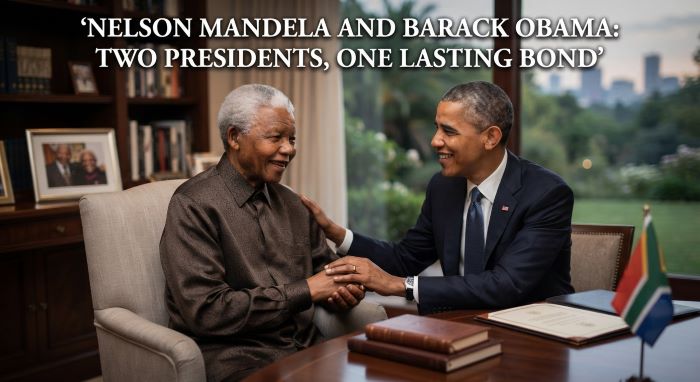
The two men met in 2005, when Obama, then a new US senator, visited Washington, where Mandela was traveling. A photo of the meeting later hung in Obama’s Senate office. Obama said Mandela’s example of forgiveness and leadership shaped him.
Phone Calls and Visits
After Obama became president in 2009, he spoke with Mandela by phone. In June 2013, Obama visited South Africa while Mandela was in the hospital. He did not visit him there out of respect for the family, but he met with Mandela’s relatives and toured Robben Island with his family. He stood in Mandela’s old cell.
The 2013 Eulogy
Mandela died on December 5, 2013, at age 95. On December 10, Obama spoke at the memorial service at FNB Stadium in Johannesburg, before tens of thousands of people and world leaders. He called Mandela “a giant of history” and said that he was one of the countless people inspired by Mandela’s life.
The 2018 Mandela Lecture
In July 2018, to mark what would have been Mandela’s 100th birthday, Obama delivered the annual Nelson Mandela Lecture in Johannesburg. He spoke about democracy, equality, and the need to defend the values Mandela stood for.
Comparing Their Leadership Styles
The leadership styles of Nelson Mandela and Barack Obama show some clear patterns.
Reconciliation. Mandela focused on bringing together a divided nation. He wore the jersey of South Africa’s rugby team, long seen as a symbol of white South Africa, at the 1995 Rugby World Cup final. Obama often spoke about finding common ground across party lines.
Calm under pressure. Both men were known for their calm public manner. Mandela stayed composed through decades of prison. Obama was nicknamed “No Drama Obama” during his 2008 campaign.
Speaking skill. Both were powerful speakers. Mandela’s Rivonia speech and his release speech in 1990 are studied today. Obama’s speeches, including his 2004 convention address and his 2008 “A More Perfect Union” speech, helped define his career.
Nobel Peace Prizes
Mandela shared the 1993 Nobel Peace Prize with F. W. de Klerk for their work to end apartheid peacefully.
Obama received the Nobel Peace Prize in 2009, less than a year into his presidency. The committee cited his efforts to strengthen international diplomacy. Obama himself said at the time that he felt he did not yet deserve to be in the company of past winners like Mandela.
Families
Mandela married three times: to Evelyn Mase, Winnie Madikizela, and Graça Machel, whom he married on his 80th birthday in 1998. He had six children.
Obama married Michelle Robinson in 1992. They have two daughters, Malia and Sasha.
Timeline at a Glance
| Year | Milestone |
|---|---|
| 1918 | Nelson Mandela is born |
| 1944 | Mandela joins the ANC |
| 1961 | Barack Obama is born |
| 1964 | Mandela is sentenced to life at the Rivonia Trial |
| 1981 | Obama gives his first political speech, on apartheid |
| 1990 | Mandela is released from prison |
| 1993 | Mandela wins the Nobel Peace Prize |
| 1994 | Mandela becomes president of South Africa |
| 2005 | Obama and Mandela meet |
| 2008 | Obama is elected president of the United States |
| 2009 | Obama wins the Nobel Peace Prize |
| 2013 | Mandela dies; Obama speaks at his memorial |
| 2018 | Obama gives the Nelson Mandela Lecture |
Why People Compare Nelson Mandela and Barack Obama
People often study Nelson Mandela and Barack Obama together because:
- Both were the first Black presidents of their countries.
- Both won the Nobel Peace Prize.
- Obama was directly inspired by Mandela, and said so many times.
- Both became global symbols of hope and change.
The two men also had real differences. Mandela led a liberation movement and spent decades in prison. Obama rose through elected office in a long-standing democracy. Their challenges, and the systems they worked in, were very different.
Words That Endured
Many lines from Nelson Mandela and Barack Obama are still quoted around the world. Mandela’s speech at the Rivonia Trial ended with his statement that a free society was an ideal for which he was prepared to die. Obama’s 2008 speeches on hope and unity drew millions of new voters. Teachers often use the words of Nelson Mandela and Barack Obama to help students learn about leadership, justice, and the power of speech.
FAQ
Did Nelson Mandela and Barack Obama meet? Yes. They met in 2005, when Obama was a US senator.
Did Obama speak at Mandela’s funeral? He spoke at the national memorial service at FNB Stadium in Johannesburg on December 10, 2013.
How long was Mandela in prison? 27 years, from 1962 to 1990.
When did each win the Nobel Peace Prize? Mandela in 1993 and Obama in 2009.
What was Obama’s first political speech about? Apartheid in South Africa, at Occidental College in 1981.
A Legacy Passed Forward
Nelson Mandela and Barack Obama lived in different countries and different times, but their stories crossed in meaningful ways. Mandela’s courage inspired a young American student. That student grew up to lead his own country and later honored Mandela before the world. The bond between Nelson Mandela and Barack Obama shows how one person’s example can shape another’s life across oceans and generations.
Key Takeaways
- Nelson Mandela was born July 18, 1918, and died December 5, 2013, at 95.
- Barack Obama was born August 4, 1961, in Honolulu.
- Mandela spent 27 years in prison and became South Africa’s first Black president in 1994.
- Obama became the first Black US president in 2009 and served two terms.
- Obama’s first political speech, in 1981, was against apartheid.
- The two men met in 2005.
- Obama spoke at Mandela’s memorial in 2013 and gave the Mandela Lecture in 2018.
- Both won the Nobel Peace Prize, in 1993 and 2009.