Greg Hayes and David Swensen
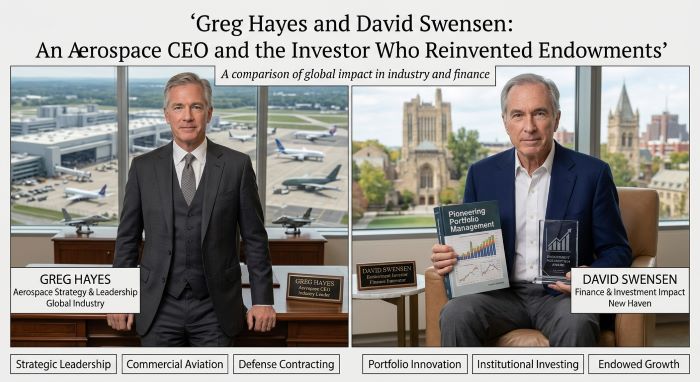
When David Swensen took over Yale University’s endowment in 1985, it was worth about $1 billion. By the time he died in 2021, it had grown past $31 billion, and his approach had been copied by universities and foundations around the world. Greg Hayes built his name in a very different arena. A trained accountant, he rose through the finance ranks of an aerospace parts company and ended up running RTX, one of the largest defense and aerospace firms on Earth. Both men were numbers people at heart, and both shaped how huge pools of money are managed. That is why business readers compare Greg Hayes and David Swensen.
Side by Side
| Greg Hayes | David Swensen | |
|---|---|---|
| Full name | Gregory J. Hayes | David Frederick Swensen |
| Born | 1960 or 1961 | January 26, 1954, River Falls, Wisconsin |
| Status | Living | Died May 5, 2021, at 67 |
| Education | Purdue University (BS, economics, 1982); certified public accountant | University of Wisconsin-River Falls (BA); Yale University (PhD, economics, 1980) |
| Main role | CEO of United Technologies (2014 to 2020) and RTX (2020 to 2024) | Chief Investment Officer of Yale University (1985 to 2021) |
| Known for | Leading the 2020 merger of UTC and Raytheon | Creating the “Yale model” of endowment investing |
| Books | None widely known | Pioneering Portfolio Management (2000); Unconventional Success (2005) |
Greg Hayes’ Story
Early Life
Hayes studied at Purdue University, where he earned a bachelor’s degree in economics in 1982. He later became a certified public accountant.
Rising Through Finance
After college, Hayes joined Sundstrand, a maker of aerospace parts. When United Technologies bought Sundstrand in 1999, he moved into UTC’s finance ranks. He became UTC’s chief financial officer, then its CEO in November 2014. He added the chairman title in 2016.
The Big Merger
In April 2020, UTC merged with Raytheon to form Raytheon Technologies, now RTX. Before the deal, UTC spun off its Otis elevator and Carrier heating and cooling businesses. The new company combined jet engines from Pratt & Whitney, aircraft systems from Collins Aerospace, and missiles and radar from Raytheon.
Hayes led RTX through the pandemic collapse in air travel, supply chain problems, and a costly engine inspection program. He retired as CEO in May 2024, when Christopher Calio took over.
David Swensen’s Story
Early Life
Swensen grew up in River Falls, Wisconsin, where his father was a chemistry professor. He studied at the local university, then went to Yale for a doctorate in economics, studying under Nobel Prize winner James Tobin.
Wall Street
After Yale, Swensen worked at Lehman Brothers and Salomon Brothers. At Salomon, he helped structure one of the first currency swaps, a 1981 deal between IBM and the World Bank. That deal helped launch a market now worth trillions of dollars.
Running Yale’s Money
In 1985, at just 31, Swensen returned to Yale to run its endowment. At the time, most universities kept their money mainly in stocks and bonds. Swensen took a different path. He moved large amounts into less traditional investments, including:
- Private equity and venture capital
- Real estate and natural resources
- Hedge funds and absolute return strategies
- Foreign stocks for wider diversification
This approach became known as the Yale model. Over his tenure, Yale’s endowment earned strong returns and grew from about $1 billion to more than $31 billion. Universities, foundations, and pension funds around the world copied his method.
Advice for Everyday Investors
Swensen’s second book, Unconventional Success, gave very different advice to ordinary people. He argued that most individual investors should avoid expensive funds and choose simple, low-cost index funds instead. He was a strong critic of high fees in the mutual fund industry.
His Final Years
Swensen was diagnosed with cancer in 2012 and kept working for nearly a decade. He died on May 5, 2021, at 67. Yale said he had worked until the final days of his life.
How Their Work Compared
| Factor | Greg Hayes | David Swensen |
|---|---|---|
| Money managed | A company with tens of billions in yearly sales | A university endowment worth tens of billions |
| Goal | Profit and growth for shareholders | Long-term funding for Yale’s mission |
| Style | Disciplined operator and dealmaker | Patient, long-term investor |
| Signature move | Creating RTX through a merger | Shifting endowments into alternative assets |
| Time horizon | Multiyear defense and aerospace programs | Decades, even forever |
Common Threads
Even though their jobs were different, Greg Hayes and David Swensen shared a few key traits:
- Financial training. Hayes was an accountant and CFO. Swensen was a PhD economist.
- Long-term thinking. Hayes managed programs that last decades. Swensen invested for an institution meant to last forever.
- Willingness to make big changes. Hayes split up and merged major businesses. Swensen broke with how universities had invested for generations.
- Respect for discipline. Both believed in careful analysis over hype.
Legacy
Hayes’ legacy is RTX, one of the largest aerospace and defense companies in the world, built through one of the biggest mergers in the industry’s history.
Swensen’s legacy reaches far beyond Yale. Many of the people he trained went on to run endowments at other top universities and foundations. His ideas still shape how institutions invest. Comparing Greg Hayes and David Swensen shows how two finance minds can leave a lasting mark in very different settings.
Timeline at a Glance
| Year | Milestone |
|---|---|
| 1980 | Swensen earns his PhD at Yale |
| 1981 | Swensen helps structure the IBM and World Bank currency swap |
| 1982 | Hayes graduates from Purdue |
| 1985 | Swensen becomes Yale’s chief investment officer |
| 1999 | UTC buys Sundstrand, bringing Hayes into UTC |
| 2000 | Swensen publishes Pioneering Portfolio Management |
| 2005 | Swensen publishes Unconventional Success |
| 2014 | Hayes becomes CEO of United Technologies |
| 2020 | UTC and Raytheon merge to form Raytheon Technologies |
| 2021 | Swensen dies at 67 |
| 2024 | Hayes retires as CEO of RTX |
Why People Compare Greg Hayes and David Swensen
There is no known working relationship between Greg Hayes and David Swensen. People compare them because both are finance experts who rose to lead massive pools of capital, one in industry and one in academia. Students of business often study both: Hayes as a model of corporate leadership through mergers, and Swensen as the father of modern endowment investing.
Lessons for Everyday Investors
Swensen’s ideas reached far beyond universities. In his second book, Unconventional Success (2005), he gave advice to regular investors. He argued that most people should not try to copy the Yale model, since they lack access to top private funds. Instead, he suggested low-cost index funds spread across different types of assets. He was also a sharp critic of high fees charged by many mutual funds.
Hayes offers a different kind of lesson. As a CFO and then CEO, he focused on cash flow, the money a business actually brings in after paying its bills. He often told investors that strong cash flow was the best sign of a healthy company. That focus guided his choices when he split UTC and merged with Raytheon.
How Each Measured Success
Swensen measured success over decades. He judged Yale’s results over 10 and 20 years, not one quarter or one year. That long view let him invest in assets that might take years to pay off.
Hayes had to balance the long term with the short term. Public companies report results every three months, and shareholders expect steady progress. Building jet engines and defense systems takes many years, so he had to plan for both at once.
Business students who study Greg Hayes and David Swensen often focus on this contrast. Both cared about the long run, but they worked under very different pressures. The careers of Greg Hayes and David Swensen show that patience is valuable in any setting, but how much of it you can use depends on who you answer to.
Quick Questions
Who was David Swensen? Yale’s chief investment officer from 1985 to 2021 and the creator of the “Yale model” of investing.
Who is Greg Hayes? The former CEO of United Technologies and RTX, who led the 2020 merger with Raytheon.
How much did Yale’s endowment grow under Swensen? From about $1 billion to more than $31 billion.
What did Swensen recommend for individual investors? Low-cost index funds, rather than expensive actively managed funds.
When did Greg Hayes retire as CEO? In May 2024.
Two Kinds of Stewardship
Greg Hayes and David Swensen spent their careers as stewards of enormous resources. Hayes managed a company that builds jet engines, missiles, and aircraft systems. Swensen managed an endowment that pays for scholarships, research, and teaching. Both showed that careful, long-term thinking can produce remarkable results. That is the lesson at the heart of the Greg Hayes and David Swensen comparison.
Key Takeaways
- Greg Hayes earned an economics degree from Purdue in 1982 and became a CPA.
- David Swensen was born January 26, 1954, and died May 5, 2021, at 67.
- Swensen ran Yale’s endowment from 1985 to 2021, growing it from about $1 billion to more than $31 billion.
- Swensen created the “Yale model,” which shifted endowments toward private equity, real estate, and other alternatives.
- Hayes became CEO of United Technologies in 2014 and led its 2020 merger with Raytheon.
- Hayes retired as CEO of RTX in May 2024.
- Swensen advised individual investors to use low-cost index funds.
- There is no known working link between the two men.