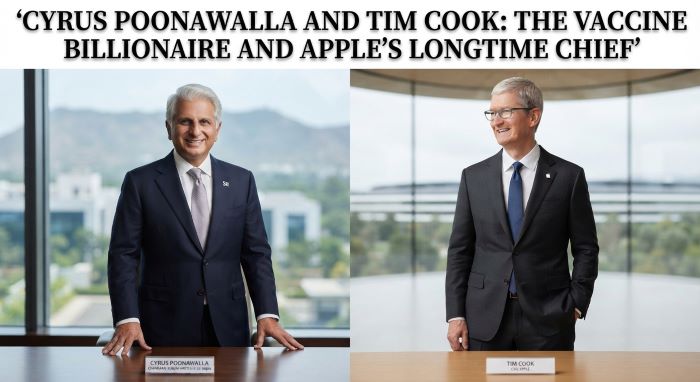
Cyrus Poonawalla and Tim Cook
Billions of children around the world have received a vaccine made by one company in Pune, India. Billions of people carry a device designed by one company in Cupertino, California. The first company, Serum Institute of India, was founded and built by Cyrus Poonawalla. The second, Apple, was run for 15 years by Tim Cook, who turned it into one of the most valuable companies ever. In 2026, both men had handed day-to-day control to a successor while staying close to the business. This guide compares Cyrus Poonawalla and Tim Cook, from their early years to their legacies.
Profiles Side by Side
| Cyrus Poonawalla | Tim Cook | |
|---|---|---|
| Full name | Cyrus Soli Poonawalla | Timothy Donald Cook |
| Born | May 11, 1941, Pune, India | November 1, 1960, Mobile, Alabama |
| Age | 85 | 66 |
| Education | Brihan Maharashtra College of Commerce, Pune | Auburn University (BS, industrial engineering); Duke University (MBA) |
| Company | Serum Institute of India | Apple |
| Role | Founder and chairman | CEO (2011 to 2026); executive chairman from September 2026 |
| Known for | World’s largest vaccine maker by doses | Growing Apple to about $4 trillion in value |
| Successor | Son, Adar Poonawalla, as CEO | John Ternus as CEO |
| Wealth | About $27 billion (Forbes, 2026) | Over $2 billion (estimates vary) |
Early Lives
Poonawalla in Pune
Cyrus Poonawalla was born into a Parsi family in Pune. His family bred horses and ran a well-known stud farm. He studied commerce in Pune. The family sold retired horses to a government lab in Mumbai, which used them to make serums and antitoxins. That gave him an idea. He realized India could produce its own vaccines instead of importing expensive ones.
Cook in Alabama
Tim Cook grew up in Robertsdale, a small town in southern Alabama. His father worked at a shipyard, and his mother worked at a pharmacy. He studied industrial engineering at Auburn University, graduating in 1982, and later earned an MBA from Duke University’s Fuqua School of Business.
Building Their Careers
Founding Serum Institute
In 1966, Poonawalla founded the Serum Institute of India with a small amount of money from the family horse business. The company began by making tetanus antitoxin and then expanded into vaccines for diseases like measles, diphtheria, and polio.
Serum Institute grew by producing vaccines at very low cost and selling them to governments and global health groups, including UNICEF. Today, it is the world’s largest vaccine maker by number of doses. Its vaccines are used in about 170 countries.
Covishield
During the COVID-19 pandemic, Serum Institute partnered with AstraZeneca and Oxford University to make Covishield, its version of the Oxford vaccine. The company produced well over a billion doses, many for India and for lower-income countries.
Cook at IBM, Compaq, and Apple
Cook spent 12 years at IBM, then worked at Intelligent Electronics and Compaq. In 1998, Steve Jobs recruited him to Apple, which was then struggling. Cook took charge of operations. He closed warehouses, cut inventory, and built a global supply chain, mainly with manufacturing partners in Asia.
He became chief operating officer in 2005 and filled in for Jobs during his medical leaves. In August 2011, Cook became CEO. Jobs died weeks later.
The Cook Era at Apple
Under Cook, Apple’s market value grew from about $350 billion in 2011 to about $4 trillion. Key moves included:
- New products: Apple Watch, AirPods, and the Vision Pro headset.
- Services: Growing the App Store, Apple Music, iCloud, Apple Pay, and Apple TV+ into a huge business.
- Apple silicon: Moving the Mac to Apple’s own chips starting in 2020.
- Privacy: Making user privacy a core part of Apple’s brand.
On April 20, 2026, Apple announced that John Ternus, its head of hardware engineering, would become CEO on September 1, 2026. Cook became executive chairman.
Careers Compared
| Category | Cyrus Poonawalla | Tim Cook |
|---|---|---|
| Path to the top | Founded his own company | Hired executive who rose to CEO |
| Core strength | Low-cost manufacturing at huge scale | Supply chain and operations |
| Industry | Vaccines and health | Consumer technology |
| Big moment | Covishield during COVID-19 | Leading Apple after Steve Jobs |
| Handover | Son Adar runs the company | John Ternus took over as CEO in 2026 |
| Honors | Padma Shri (2005), Padma Bhushan (2022) | Named to TIME 100 list; many business awards |
Leadership Styles
Both Cyrus Poonawalla and Tim Cook built their reputations on making things at enormous scale.
Poonawalla’s style was entrepreneurial and bold. He bet that an Indian company could compete with Western drug makers on price and quality. He kept his company private, which let him make long-term choices without pressure from shareholders.
Cook’s style is calm and steady. He is known for detailed questions in meetings, early mornings, and a focus on operations. He took over from a famous founder and kept Apple growing for more than a decade.
Wealth
Forbes ranked Poonawalla #6 in India in 2026, with about $27 billion. Most of his wealth comes from his family’s ownership of Serum Institute.
Cook’s wealth comes mainly from Apple stock he earned as CEO. Estimates put it above $2 billion. He has said he plans to give most of his money away during his lifetime.
Giving Back
The Poonawalla family has funded hospitals, schools, and public health programs in Pune and beyond. Serum Institute’s low-cost vaccines are also seen as a major public health contribution.
Cook has donated to causes including education, human rights, and environmental work. In 2014, he publicly came out as gay, becoming the first openly gay CEO of a Fortune 500 company. He said he hoped it would help others.
Families
Cyrus Poonawalla married Villoo Poonawalla, who died in 2010. Their son, Adar, became CEO of Serum Institute in 2011.
Tim Cook is private about his personal life and has no children.
Timeline at a Glance
| Year | Milestone |
|---|---|
| 1941 | Cyrus Poonawalla is born in Pune |
| 1960 | Tim Cook is born in Mobile |
| 1966 | Poonawalla founds Serum Institute of India |
| 1982 | Cook graduates from Auburn |
| 1998 | Cook joins Apple |
| 2005 | Poonawalla receives the Padma Shri |
| 2011 | Cook becomes Apple CEO; Adar Poonawalla becomes Serum CEO |
| 2014 | Cook publicly comes out |
| 2020 | Serum Institute begins making Covishield |
| 2022 | Poonawalla receives the Padma Bhushan |
| 2026 | Apple names John Ternus CEO; Cook becomes executive chairman |
Why People Compare Cyrus Poonawalla and Tim Cook
There is no known business deal between Cyrus Poonawalla and Tim Cook. People compare them because:
- Both lead companies whose products reach billions of people.
- Both are masters of manufacturing at scale.
- Both have passed day-to-day control to a successor.
- Both show two different ways to the top: founding a company and rising through one.
How Their Companies Make Money
The business models behind Cyrus Poonawalla and Tim Cook are almost opposites.
Serum Institute makes money through volume. It sells vaccines at very low prices, often a few dollars or less per dose, to governments and global health groups. Because it makes so many doses, small profits per dose add up to a large business. This model helped make vaccines affordable in many lower-income countries.
Apple makes money through premium products and services. The iPhone sells at a high price, and Apple keeps a large share of each sale as profit. Its services business, including the App Store, iCloud, and Apple Music, adds steady income from more than two billion active devices.
Planning for the Next Generation
Both men put careful thought into who would follow them. Poonawalla handed day-to-day control to his son, Adar, keeping the company in family hands. Cook worked with Apple’s board for years on a plan that led to John Ternus taking over in 2026. One path kept leadership in the family, while the other kept it inside the company’s own ranks. Comparing Cyrus Poonawalla and Tim Cook on this point shows two common ways large companies handle a change at the top. In both cases, Cyrus Poonawalla and Tim Cook stayed involved after stepping back, as chairman and executive chairman. For students of business, Cyrus Poonawalla and Tim Cook offer a useful case study in handing over power smoothly.
FAQ
Who is Cyrus Poonawalla? The founder and chairman of the Serum Institute of India, the world’s largest vaccine maker by doses.
Is Tim Cook still the CEO of Apple? No. John Ternus became CEO on September 1, 2026. Cook is now executive chairman.
How much is Cyrus Poonawalla worth? Forbes estimated about $27 billion in 2026.
What is Covishield? Serum Institute’s version of the Oxford-AstraZeneca COVID-19 vaccine.
Who is older? Poonawalla, born May 11, 1941. Cook was born November 1, 1960.
Scale as a Superpower
Cyrus Poonawalla and Tim Cook came from very different places, a horse farm in Pune and a small town in Alabama. Yet both learned how to make huge numbers of products reliably and at the right price. Poonawalla’s vaccines protect children around the world. Cook’s leadership put iPhones and Apple services in billions of hands. The story of Cyrus Poonawalla and Tim Cook shows that great operators can change the world as much as great inventors.
Key Takeaways
- Cyrus Poonawalla was born May 11, 1941, in Pune; Tim Cook was born November 1, 1960, in Mobile.
- Poonawalla founded Serum Institute of India in 1966.
- Serum Institute is the world’s largest vaccine maker by doses and made Covishield.
- Cook joined Apple in 1998 and became CEO in August 2011.
- Apple’s value grew from about $350 billion to about $4 trillion under Cook.
- John Ternus became Apple CEO on September 1, 2026; Cook became executive chairman.
- Poonawalla’s son Adar runs Serum Institute as CEO.
- Forbes estimated Poonawalla’s wealth at about $27 billion in 2026.