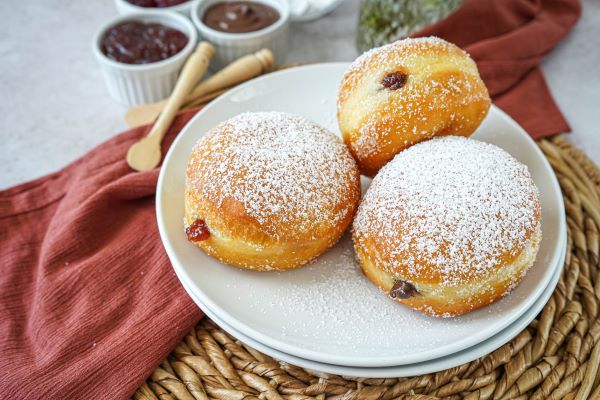
A Berliner is not just a filled doughnut with a different name. It is a specific German pastry with a distinct dough, a precise frying technique, and a filling and finishing tradition that goes back centuries. The dough is enriched with eggs and butter, slightly sweet, and yeasted to produce a light, pillow-like interior that is completely different from the denser, chewier texture of an American cake doughnut or the airy brittleness of a French beignet. When it is made properly, a Berliner doughnut has a golden, slightly shiny exterior from frying, a soft, yielding interior that springs back when pressed, a generous filling of jam or pastry cream that reaches into every bite, and a finishing of powdered sugar or a light glaze that completes the pastry without overwhelming it.
If you have been searching for the best Berliner doughnut near me and finding only American jelly doughnuts that are not quite what you are looking for, this guide helps you find the real thing.
What a Berliner Doughnut Actually Is
The Berliner, sometimes called Berliner Pfannkuchen in its home city and known as Krapfen in Bavaria and Austria, is a deep-fried yeasted dough pastry filled with jam or cream. Despite being named after Berlin, the traditional Berliner is actually considered a foreign concept in Berlin itself, where the pastry is more commonly called Pfannkuchen. In most of the rest of Germany and in international contexts, Berliner refers to this round, filled, fried pastry.
The dough uses wheat flour, eggs, butter, sugar, yeast, milk, and sometimes a small amount of rum or vanilla. The enrichment from the eggs and butter produces a dough that is soft and slightly rich, similar in character to a brioche but structured for frying rather than baking. The dough is proofed twice, once as a bulk dough and once after shaping into rounds, ensuring a light, airy interior with a fine, even crumb.
The frying is done in neutral oil or lard at a specific temperature, typically around 170 to 175 degrees Celsius. This moderate temperature allows the dough to cook through completely without the exterior browning too quickly. A properly fried Berliner has an even, golden-brown color across the entire surface, often with a slightly lighter ring around the middle called the weissring, which marks where the dough sat at the surface of the oil during frying. This white ring is a traditional quality marker in German bakery culture and indicates the Berliner was proofed properly and fried at the correct temperature.
The filling is injected after frying through a small hole in the side, using a pastry bag with a narrow tip. Traditional fillings include plum jam, rose hip jam, or apricot jam. Pastry cream, vanilla cream, or chocolate cream are common contemporary variations. The filling should be generous enough to reach throughout the interior of the pastry and should be present in every bite from the first to the last.
The finishing is typically powdered sugar dusted over the warm pastry, sometimes a light sugar glaze, and in some regional traditions a thin coating of fondant.
When you search for the best Berliner doughnut near me, the light yeasted dough with a fine interior crumb, the generous filling that reaches through the pastry, and the characteristic weissring around the middle are the quality markers of an authentic German-style preparation.
Where to Find It
German bakeries are the most reliable source. A dedicated German bakery operating in the German bakery tradition will carry Berliners as a standard item, typically freshly made daily. German bakeries are not as common as in decades past but exist in cities with established German immigrant communities, including Milwaukee, Cincinnati, Chicago, Philadelphia, and parts of Texas.
Austrian and Swiss bakeries carry the same pastry under different names, typically Krapfen in Austrian and Fasnachtskrapfen or Berliner in Swiss German tradition. These are equivalent products and a quality Austrian or Swiss bakery will produce an excellent version.
European-style bakeries that draw from German, Austrian, or Central European baking traditions sometimes carry Berliners alongside other European pastries. A bakery that also carries pretzels, strudel, and other Central European items is more likely to make Berliners properly.
German delis and specialty food stores sometimes carry Berliners as a prepared item, particularly around Carnival and New Year’s when the pastry is most traditionally consumed in Germany.
Artisan doughnut shops in many cities have embraced European doughnut styles alongside American varieties and sometimes carry a genuine yeasted filled doughnut in the Berliner tradition. A doughnut shop that describes its filled options as Berlin-style or Berliner is worth checking, particularly if the shop makes yeasted dough rather than cake dough.
How to Search More Effectively
A direct search for the best Berliner doughnut near me will return limited specific results in most cities. Here is how to search more productively:
Search Google Maps for German bakery in your city. Browse photo sections for pastry displays. A bakery that shows round, golden, filled pastries with the characteristic pale ring around the middle and powdered sugar on top is making the Berliner style. Contact them directly to confirm they carry Berliners regularly and what fillings are available.
Search Instagram with “Berliner doughnut” or “Berliner Pfannkuchen” plus your city name. German bakery accounts and artisan doughnut shops that make the yeasted filled version post photos, and the round, golden, slightly glossy exterior with visible powdered sugar is identifiable in a close-up photo.
Search Yelp for German bakery or European bakery in your area and read reviews that mention filled doughnuts, Berliners, or Krapfen. Reviewers who know the pastry will describe the lightness of the dough, the generosity of the filling, and the quality of the jam or cream used.
Contact German cultural organizations in your city. German-American clubs, the German-American Heritage Center chapters, and German cultural societies sometimes host events where Berliners are made and sold, and members will know which local bakery makes the most authentic version.
What Good Berliner Doughnut Should Look Like
Once you find a source, a few things confirm the quality.
The weissring. The pale ring around the equator of the Berliner where the pastry sat at the oil surface during frying. This ring is a traditional quality marker indicating proper proofing and correct frying temperature. A uniformly brown Berliner without the pale middle ring was either not proofed sufficiently or was fried at too high a temperature, which causes the exterior to brown before the interior can fully cook.
The exterior color. Even, golden-brown above and below the weissring, slightly shiny from the frying oil. A pale exterior means underfrying. A dark brown or splotchy surface means the oil temperature was uneven or too high.
The interior when bitten. Light, soft, and slightly pillowy, springing back when pressed gently. The crumb should be fine and even, similar to a good brioche. Dense or doughy interior means either the dough was not proofed long enough or the frying temperature was too low, causing the dough to absorb oil rather than fry properly.
The filling. Generous and present throughout the pastry, not concentrated only at the injection point. When you bite into the Berliner, filling should appear from the first bite and be present in the center of the pastry. A Berliner with filling only near the injection hole has an inadequate amount of filling. The jam should be a quality fruit preserve with real flavor, not a thin, overly sweet commercial filling.
The powdered sugar. Evenly distributed across the surface, not clumped or absent. Powdered sugar should be applied while the Berliner is still warm enough for it to adhere lightly to the surface.
Ordering and Eating Tips
Eat a Berliner doughnut while it is fresh, ideally within a few hours of frying. Yeasted fried doughnuts are at their best when the interior is still slightly warm and soft. A Berliner that has been sitting for most of the day will have lost the pillowy interior quality that makes it worth eating over a generic filled doughnut.
Ask what fillings are available before ordering. Traditional jam fillings like plum, rose hip, or apricot are the classic German options. Contemporary options like pastry cream, vanilla cream, or chocolate are legitimate and often excellent variations. Knowing what is available helps you choose the version you will enjoy most.
Pair with a cup of coffee or hot chocolate. The Berliner is a morning or afternoon pastry in German tradition and the combination of the slightly sweet, oil-fried dough with a bitter coffee is the intended pairing context.
Hold the Berliner carefully when eating. The jam filling is under slight pressure from the closed pastry and can squirt from the opposite side when bitten. Biting from the side nearest the injection hole gives more control over the filling direction.
Pricing Expectations
Individual Berliner doughnuts at a German bakery or artisan doughnut shop typically run between $3 and $6 depending on the filling and the market. Specialty fillings like pastry cream or chocolate ganache tend to be priced at the higher end. Traditional jam-filled versions are typically priced at the lower end of that range. German bakeries in cities with established German communities tend to price them lower due to higher production volume.
Key Takeaways
- The best Berliner doughnut near me is most reliably found at German bakeries, Austrian bakeries, and artisan doughnut shops that specifically make yeasted filled doughnuts in the German tradition rather than cake doughnuts with jam added.
- A Berliner is a yeasted, deep-fried pastry made from an enriched dough similar to brioche, filled with jam or cream after frying, and finished with powdered sugar or glaze. It is lighter and more pillowy than an American jelly doughnut.
- The weissring, the pale ring around the middle of the pastry from the oil surface, is the traditional quality marker of a properly proofed and correctly fried Berliner. A uniformly brown pastry without this ring was not made to the traditional standard.
- The filling should be generous and present throughout the pastry from the first bite to the last. A Berliner with filling only near the injection hole has an inadequate amount.
- Search Instagram with “Berliner doughnut” plus your city name and contact German cultural organizations for recommendations of which local bakery produces the most authentic version.
- Eat within a few hours of frying. The pillowy interior quality of a properly yeasted Berliner diminishes as the pastry sits and the crumb firms up.
- Traditional fillings are plum, rose hip, or apricot jam. Contemporary cream fillings are legitimate variations worth trying at bakeries that make them well.
- Expect to pay $3 to $6 per Berliner at a German bakery or artisan doughnut shop.