You’re at a cookout, a cabin, or just standing in your kitchen, and the one thing nobody thought to bring is a bottle opener. It happens more often than it should. The good news is that you can open bottle without bottle opener using several reliable methods. Knowing how to open bottle without bottle opener is a practical skill with more options than most people realize. Some methods take a bit of force, some require good leverage, and one just takes a firm surface. None of them require special equipment.
This guide covers the methods that actually work, ranked by how reliable and low-risk they are.
The Belt Buckle Method
A metal belt buckle lets you open bottle without bottle opener without setting anything down. It is one of the most useful and underappreciated options available. If you’re wearing a belt with a standard metal buckle, you already have what you need.
Hold the bottle in your non-dominant hand with a firm grip. Tilt the buckle upward and hook the underside of the bottle cap onto the inner edge of the buckle’s frame. Apply downward pressure on the bottle while using the buckle as a lever point, pushing the cap upward and away. The cap should pop off cleanly with moderate force.
This method works best with a wider buckle frame. Small, decorative buckles don’t provide enough leverage.
The Counter Edge Method
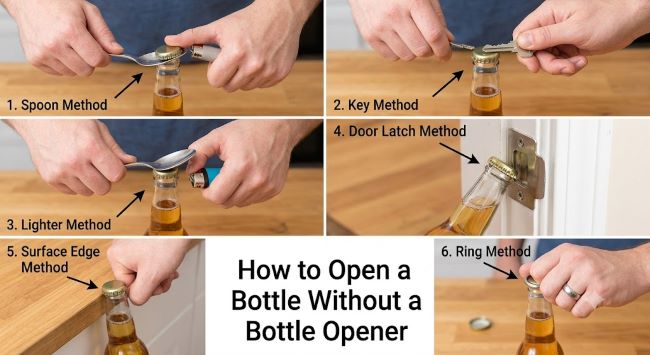
The counter edge is the fastest way to open bottle without bottle opener when you are near a kitchen. This is probably the most well-known technique and it works reliably when done correctly. You need a solid edge at roughly waist height, like a countertop or a sturdy table.
Place the edge of the bottle cap against the corner of the counter so the lip of the cap hooks on the edge. Hold the bottle firmly with one hand. With your other hand, hit the top of the bottle cap sharply downward with a flat palm. The leverage from the counter edge pops the cap off.
A few important notes: this only works on a solid edge, not a rounded one. Granite and wood counters work well. Laminate can chip. If the cap does not come off on the first try, reposition it so more of the cap’s inner rim is catching the edge before trying again.
This method can scratch or chip the surface you’re using, so pick your edge with that in mind.
The Spoon or Fork Method
The spoon or fork is a reliable way to open bottle without bottle opener at home. A metal spoon or fork handle gives you the same basic lever action as a bottle opener. This is useful because it is low risk for both you and whatever surface is nearby.
Hold the bottle in your non-dominant hand. Position the handle of a metal spoon under the lip of the bottle cap with your thumb providing the fulcrum point. Pry upward on the handle with your fingers while pushing down with your thumb. Work around the cap gradually if it doesn’t come off in one motion, loosening one side and then the other.
This takes more patience than a single-pop method but it rarely fails and it does not damage anything in the process.
The Lighter Method
A lighter is a classic bartender fallback when you need to open bottle without bottle opener, and it works well once you understand the mechanics.
Hold the bottle near the neck with a tight grip. Position the bottom edge of the lighter under the cap’s lip with your index finger acting as the fulcrum underneath the cap. Push down on the top of the lighter with your palm while pushing up with your index finger. The cap pops off from the lever action.
The technique here is identical to a bottle opener. The lighter is just an object with a flat, rigid edge at the right height. Any similar object (a coin, a key) can substitute if you use the same grip and fulcrum approach.
The Key Method
A standard house key works as a lever in the same way a lighter does. Hook the teeth or the shoulder of the key under the edge of the bottle cap. Position your index finger under the cap to act as a fulcrum and push down on the top of the key. The cap bends up and off.
One pass rarely removes the cap entirely. Rotate the bottle slightly and repeat around the cap until it pops free. It takes about five or six repositions on average.
The Two-Bottle Method
If you have two bottles of the same type, you can open bottle without bottle opener by using one cap against the other. This sounds impractical but it works.
Grip one bottle normally. Flip the second bottle upside down and hook its cap under the lip of the first bottle’s cap. Use the upside-down bottle as a lever, pushing down so the second bottle’s cap pries up the first cap. This requires a firm grip and a bit of practice but it avoids using any other surface or object at all.
What to Avoid
Teeth. Using your teeth to pry a bottle cap is a common enough impulse but it is a reliable way to chip a tooth. No bottle is worth a dental bill.
Thin metal like scissors or a knife blade. Thin edges flex under pressure and either slip off the cap or bend. This also creates a cutting risk if your hand slips. Avoid using anything sharp as a lever.
Glass surfaces. Do not use the edge of a glass or a glass table as a lever point. Glass can shatter under the sudden impact load.
The Flat Surface and Palm Method
This one requires no objects at all, just a hard flat surface and some confidence. It works best on a tile or concrete floor.
Place the bottle cap flat against the floor surface. Cover the cap with your palm and give it a single firm downward strike. The hydraulic pressure from the liquid inside combined with the impact can unseat the cap. This method does not work every time and it can dent the cap without removing it, so it’s a last resort more than a first choice.
Key Takeaways
- Knowing how to open bottle without bottle opener comes down to understanding leverage. Every reliable method uses the same principle as a bottle opener: a rigid edge, a fulcrum point, and upward pressure on the cap.
- A metal belt buckle provides solid leverage and is almost always on hand. Hook the cap’s inner rim on the buckle frame and push.
- The counter edge method works fast but can scratch surfaces. Use a granite or solid wood edge, not laminate or glass.
- A metal spoon handle is the lowest-risk tool available. Pry around the cap gradually rather than expecting a single motion to remove it.
- A lighter or a key works using the same mechanics as a bottle opener. Your index finger is the fulcrum and the object provides the lever arm.
- Two bottles of the same kind can open each other by hooking caps.
- Avoid using teeth, knife blades, or glass surfaces. The risk of injury or damage is not worth it.
- When none of the above works, a firm palm strike against a flat floor surface is the final option, though it is less reliable than any tool-based method.