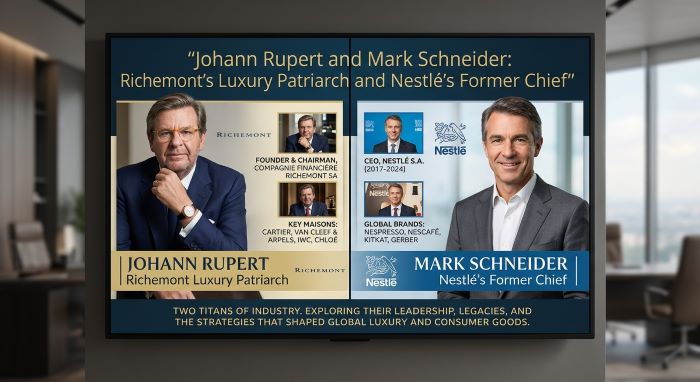
Johann Rupert and Mark Schneider
Two of the biggest companies headquartered on the shores of Lake Geneva could hardly be more different. One sells Cartier rings and Van Cleef & Arpels necklaces. The other sells Nescafé, KitKat, and Purina pet food. Johann Rupert built and still leads the first, Compagnie Financière Richemont. Mark Schneider ran the second, Nestlé, for nearly eight years before the board replaced him in 2024. Comparing Johann Rupert and Mark Schneider is a look at two very different models of leadership: a founder who controls his company and an outside CEO hired to transform a giant.
Profiles at a Glance
| Johann Rupert | Mark Schneider | |
|---|---|---|
| Born | June 1, 1950, Stellenbosch, South Africa | 1965, Germany |
| Nationality | South African | German and American |
| Education | Studied economics and company law at Stellenbosch University | Harvard Business School (MBA); University of St. Gallen (doctorate) |
| Company | Richemont | Nestlé (formerly Fresenius) |
| Role | Founder and chairman of Richemont | CEO of Nestlé (2017 to 2024); CEO of Fresenius (2003 to 2016) |
| Headquarters | Bellevue, near Geneva, Switzerland | Vevey, Switzerland |
| Known for | Building a luxury empire including Cartier and Van Cleef & Arpels | First outside CEO of Nestlé in nearly a century |
| Wealth | Close to $20 billion in mid-2026 estimates; South Africa’s richest person | Not publicly reported |
Johann Rupert’s Story
Family Roots
Johann Rupert is the son of Anton Rupert, who built the Rembrandt Group, a tobacco and industrial business, in South Africa. Johann studied economics and company law at Stellenbosch University but left before finishing his degree.
Early Career
He started his career in banking, working at Chase Manhattan Bank and Lazard Frères in New York. In 1979, he returned to South Africa and co-founded Rand Merchant Bank. He later joined his family’s business.
Building Richemont
In 1988, Rupert created Richemont by spinning off the international assets of the Rembrandt Group. Over time, Richemont became one of the world’s largest luxury goods companies. Its brands include:
- Cartier
- Van Cleef & Arpels
- IWC Schaffhausen
- Jaeger-LeCoultre
- Panerai
- Montblanc
Rupert serves as Richemont’s chairman. He has led the group for most of the years since he founded it, though he stepped back from the chairman role for a short time in 2013 before returning a year later. He also chairs Remgro, the South African investment company that grew out of his family’s business. He owns a stake in the Rupert & Rothschild winery and is a major figure in golf, supporting events like the Alfred Dunhill Links Championship.
Wealth
Rupert is regularly ranked as South Africa’s richest person. In mid-2026, estimates put his fortune close to $20 billion, driven mainly by his stake in Richemont.
Mark Schneider’s Story
Education
Schneider was born in Germany and later became an American citizen as well. He earned an MBA from Harvard Business School and a doctorate from the University of St. Gallen in Switzerland.
Fresenius
Schneider became CEO of Fresenius, the German healthcare company, in 2003, when he was in his late 30s. Over 13 years, he grew the company through acquisitions in dialysis, hospitals, and medical products. Fresenius’ value rose sharply during his tenure.
Nestlé
In January 2017, Schneider became CEO of Nestlé, the world’s largest food company. He was the first person from outside the company to lead Nestlé in nearly 100 years. His key moves included:
- Portfolio changes: Selling the U.S. confectionery business and buying brands in coffee, pet food, and health.
- Starbucks deal: A 2018 agreement to sell Starbucks coffee products in stores worldwide.
- Health science: Expanding into vitamins, supplements, and medical nutrition.
In August 2024, Nestlé replaced Schneider with Laurent Freixe, a longtime company veteran, after the company’s sales growth slowed and its share price fell.
Leadership Styles Compared
| Factor | Johann Rupert | Mark Schneider |
|---|---|---|
| Type of leader | Founder and controlling shareholder | Professional CEO hired from outside |
| Industry | Luxury goods | Food, beverages, and health |
| Style | Long-term, family-controlled | Strategic, acquisition-driven |
| Time horizon | Generations | Multiyear turnarounds |
| Public profile | Outspoken at times, often private | Lower profile, data-focused |
Swiss Ties
The main link between Johann Rupert and Mark Schneider is Switzerland. Richemont is headquartered near Geneva, and Nestlé is based in Vevey, both on Lake Geneva. Switzerland’s lakeside region is home to several of the world’s most important consumer companies. Both leaders shaped how Swiss-based firms compete globally.
Challenges
Rupert has steered Richemont through cycles in luxury demand, including a slowdown in China and swings in watch sales. He has also faced investor pressure over strategy at times.
Schneider faced pressure over Nestlé’s slowing growth after the pandemic. Higher prices helped profits for a time, but volume growth weakened, and investors became impatient.
Timeline at a Glance
| Year | Milestone |
|---|---|
| 1950 | Johann Rupert is born in Stellenbosch |
| 1979 | Rupert co-founds Rand Merchant Bank |
| 1988 | Rupert creates Richemont |
| 2003 | Schneider becomes CEO of Fresenius |
| 2017 | Schneider becomes CEO of Nestlé |
| 2018 | Nestlé signs its global coffee deal with Starbucks |
| 2024 | Nestlé replaces Schneider with Laurent Freixe |
| 2026 | Rupert’s fortune nears $20 billion |
Why People Compare Johann Rupert and Mark Schneider
There is no known business deal between Johann Rupert and Mark Schneider. People compare them because:
- Both led giant Swiss-based companies on Lake Geneva.
- They represent two models of leadership: founder control versus outside professional CEO.
- Both made big portfolio moves, buying and selling major brands.
- Both faced investor pressure during tough markets.
How Richemont and Nestlé Differ
Richemont and Nestlé are both Swiss giants, but they run on very different business models.
Richemont sells luxury goods. Its products are expensive and made in limited numbers. A Cartier bracelet or a Van Cleef & Arpels necklace can cost thousands of dollars or more. Its profits depend on wealthy shoppers in places like China, the United States, Europe, and the Middle East. Jewelry has become its strongest business, while watches have had more ups and downs.
Nestlé sells everyday products in huge numbers. Its brands include Nescafé, Nespresso, KitKat, Maggi, Gerber, and Purina. Its products are sold in nearly every country. Its profits depend on steady demand, efficient factories, and strong brands that shoppers trust.
Ownership and Control
Ownership is one of the biggest differences between Johann Rupert and Mark Schneider. Richemont has a share structure that gives the Rupert family strong voting control. That lets Rupert plan for the long term and resist outside pressure.
Schneider worked for Nestlé’s board and shareholders. He did not control the company, so he had to deliver results that investors accepted. When growth slowed, the board decided to make a change.
Key Deals
Both men made major deals. Under Rupert, Richemont bought and sold many brands over the years. In 2025, Richemont completed the sale of its stake in the online fashion seller Yoox Net-a-Porter to Mytheresa.
Under Schneider, Nestlé sold its skin health business in 2019 for about 10 billion Swiss francs. It bought the core brands of The Bountiful Company, including Nature’s Bounty, in 2021. It also paid Starbucks about $7 billion in 2018 for the right to sell Starbucks coffee products worldwide.
What Happened After Schneider
Nestlé’s leadership changes did not stop with Schneider. Laurent Freixe, who replaced him in 2024, was dismissed in September 2025 after an investigation into an undisclosed relationship with a subordinate. Philipp Navratil was named the new CEO. The rapid changes showed how hard it is to lead a company of Nestlé’s size. For investors following Johann Rupert and Mark Schneider, the contrast is sharp: steady founder control at Richemont and frequent change at the top of Nestlé. Many analysts use Johann Rupert and Mark Schneider as examples of how ownership shapes stability. The story of Johann Rupert and Mark Schneider is, in many ways, a story about who holds the votes.
FAQ
Who is Johann Rupert? The founder and chairman of Richemont, owner of Cartier and Van Cleef & Arpels, and South Africa’s richest person.
Who is Mark Schneider? The former CEO of Nestlé (2017 to 2024) and Fresenius (2003 to 2016).
Why did Mark Schneider leave Nestlé? Nestlé’s board replaced him in August 2024 amid slowing growth and a falling share price.
How much is Johann Rupert worth? Estimates in mid-2026 put his fortune close to $20 billion.
What brands does Richemont own? Cartier, Van Cleef & Arpels, IWC, Jaeger-LeCoultre, Panerai, Montblanc, and others.
Founder Versus Hired Hand
Johann Rupert and Mark Schneider both shaped some of the most famous brands in the world from bases on Lake Geneva. Rupert built Richemont and still guides it as a founder. Schneider was brought in to transform Nestlé and made bold moves before the board changed course. The comparison of Johann Rupert and Mark Schneider shows how ownership shapes leadership, and how even the biggest companies depend on the people at the top.
Key Takeaways
- Johann Rupert was born June 1, 1950, in South Africa and founded Richemont in 1988.
- Mark Schneider was born in Germany in 1965 and earned degrees from Harvard and St. Gallen.
- Rupert chairs Richemont, owner of Cartier, Van Cleef & Arpels, and Montblanc.
- Schneider ran Fresenius from 2003 to 2016 and Nestlé from 2017 to 2024.
- Schneider was Nestlé’s first outside CEO in nearly a century.
- Nestlé replaced Schneider with Laurent Freixe in August 2024.
- Rupert’s fortune was estimated close to $20 billion in mid-2026.
- Both companies are based on Lake Geneva in Switzerland.