Tom Kennedy and Winston Churchill
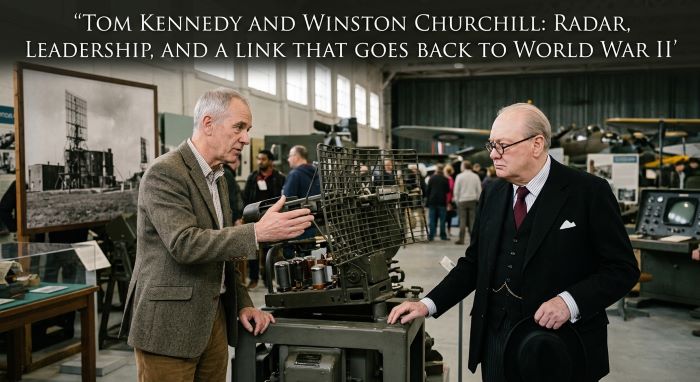
In September 1940, as German bombs fell on London, Winston Churchill’s government sent a team of scientists across the Atlantic with a small black box. Inside was the cavity magnetron, a device that made powerful, compact radar possible. American firms soon began building magnetrons in huge numbers, and one company at the center of that effort was Raytheon. Four decades later, a young engineer named Tom Kennedy joined Raytheon to work on radar. He went on to run the company. That thread through history is why Tom Kennedy and Winston Churchill make an unexpected but meaningful pair.
This article refers to Thomas A. Kennedy, the former chairman and CEO of Raytheon, not the game show host of the same name.
Profiles Side by Side
| Tom Kennedy | Winston Churchill | |
|---|---|---|
| Full name | Thomas A. Kennedy | Sir Winston Leonard Spencer Churchill |
| Born | 1955 | November 30, 1874, Blenheim Palace, England |
| Status | Living | Died January 24, 1965, at 90 |
| Education | BS, Electrical Engineering, Rutgers; MS, Air Force Institute of Technology; Doctorate in Engineering, UCLA | Harrow School; Royal Military College, Sandhurst |
| Main role | Chairman and CEO of Raytheon (2014 to 2020) | Prime Minister of the United Kingdom (1940 to 1945; 1951 to 1955) |
| Field | Engineering and defense industry | Politics, military, writing |
| Major honors | Industry and academic honors | Nobel Prize in Literature (1953) |
Winston Churchill: The Wartime Leader
Early Life
Churchill was born into an aristocratic family at Blenheim Palace. His father, Lord Randolph Churchill, was a leading politician, and his mother, Jennie Jerome, was American. He struggled at school but graduated from Sandhurst and joined the cavalry.
Soldier, Reporter, Politician
As a young man, Churchill served in India and Sudan and worked as a war correspondent. During the Boer War in South Africa, he was captured and made a daring escape that made him famous at home. He entered Parliament in 1900.
His career had dramatic highs and lows. As First Lord of the Admiralty in World War I, he backed the failed Gallipoli campaign and resigned. He spent much of the 1930s warning about the rise of Nazi Germany while few listened.
Prime Minister in World War II
In May 1940, Churchill became prime minister as Germany swept across Europe. His speeches, including “We shall fight on the beaches” and “Their finest hour,” rallied Britain during its darkest days. He built close ties with U.S. President Franklin D. Roosevelt and later with Soviet leader Joseph Stalin.
After the war, he lost the 1945 election but returned as prime minister from 1951 to 1955. In 1946, he gave his famous “Iron Curtain” speech in Fulton, Missouri. He won the Nobel Prize in Literature in 1953 for his historical writing and speeches.
Tom Kennedy: The Engineer CEO
Education and Early Career
Tom Kennedy earned a bachelor’s degree in electrical engineering from Rutgers University, a master’s degree from the Air Force Institute of Technology, and a doctorate in engineering from UCLA. His training at the Air Force Institute of Technology reflects early service in the U.S. Air Force.
He joined Raytheon in 1983, working in radar development. Over the next three decades, he held a range of technical and business leadership roles.
Leading Raytheon
Kennedy became Raytheon’s executive vice president and chief operating officer in 2013. He was elected to the board in January 2014 and became chairman and CEO in March 2014, succeeding William Swanson.
Under his leadership, Raytheon was known for missile defense systems, radars, and precision weapons. In April 2020, Raytheon merged with United Technologies to form Raytheon Technologies, now known as RTX. Kennedy became executive chairman of the combined company, working alongside CEO Greg Hayes. He later joined the board of Textron.
The Radar Link
The connection between Tom Kennedy and Winston Churchill runs through radar.
- 1940: Churchill’s government approved the Tizard Mission, which shared Britain’s secret cavity magnetron with the United States.
- World War II: Raytheon became one of the largest producers of magnetrons for Allied radar, which helped detect enemy aircraft and submarines.
- 1983: Tom Kennedy joined Raytheon to work on radar development.
- 2014 to 2020: Kennedy led a company whose radar business traced back to that wartime partnership.
Radar helped Britain win the Battle of Britain and later helped the Allies win the Battle of the Atlantic. Churchill called the scientific war “the wizard war,” and radar was at its heart.
Leadership Styles Compared
| Factor | Tom Kennedy | Winston Churchill |
|---|---|---|
| Background | Engineering and technical management | Military, journalism, politics |
| Style | Steady, data-driven, operations focused | Bold, rhetorical, inspirational |
| Biggest challenge | Leading a major merger and defense programs | Leading a nation through world war |
| Communication | Investor calls and industry speeches | Radio broadcasts and Parliament speeches |
| Legacy | Shaping a modern defense giant | Saving Britain in 1940 and shaping the postwar world |
Churchill led through words and will. Kennedy led through engineering knowledge and steady execution. Both understood that technology could decide the outcome of conflict.
Personal Lives
Churchill married Clementine Hozier in 1908. They had five children. He was also a talented painter, producing hundreds of works, and a prolific writer of history and memoirs.
Kennedy has kept his personal life private, as many defense executives do. He has supported engineering education at the universities he attended.
What Leaders Can Learn From Tom Kennedy and Winston Churchill
Students of leadership often draw lessons from Tom Kennedy and Winston Churchill:
- Invest in technology. Churchill backed radar research when it was still unproven. Kennedy built his career on advancing it.
- Know your field deeply. Kennedy rose from radar engineer to CEO. Churchill studied military history and strategy for decades.
- Stay steady in crisis. Churchill held firm in 1940. Kennedy guided Raytheon through a major merger.
- Build alliances. Churchill’s partnership with the United States was vital. Kennedy’s merger built a larger, stronger company.
Radar’s Role in Victory
Radar changed the course of World War II. During the Battle of Britain in 1940, Britain’s radar network, known as Chain Home, gave early warning of German bombers. That allowed the Royal Air Force to send fighters exactly where they were needed.
The cavity magnetron made radar smaller and more powerful, allowing it to fit into aircraft and ships. American production of magnetrons, including Raytheon’s, helped the Allies hunt German submarines in the Atlantic and spot enemy aircraft at night. Many historians say radar was one of the most important technologies of the war.
This history is why the link between Tom Kennedy and Winston Churchill is more than a coincidence. The technology Churchill’s government shared became the foundation of the company Kennedy later led.
From Wartime to Modern Defense
After the war, Raytheon grew into one of the largest defense companies in the United States. It built missiles, radars, and missile defense systems used by the U.S. and its allies. By the time Kennedy joined in 1983, radar remained central to its business. The thread linking Tom Kennedy and Winston Churchill runs from the dark days of 1940 to the modern defense systems that protect nations today.
Timeline at a Glance
| Year | Milestone |
|---|---|
| 1874 | Churchill is born |
| 1940 | Churchill becomes prime minister; the Tizard Mission shares radar secrets |
| 1965 | Churchill dies |
| 1983 | Kennedy joins Raytheon |
| 2014 | Kennedy becomes Raytheon’s CEO |
| 2020 | Raytheon merges with United Technologies |
Quick Answers
Which Tom Kennedy is this about? Thomas A. Kennedy, former chairman and CEO of Raytheon.
How are Tom Kennedy and Winston Churchill connected? Through radar. Churchill’s government shared the cavity magnetron with the U.S. in 1940, and Raytheon mass-produced it. Kennedy later led Raytheon, starting his career there in radar.
When was Churchill prime minister? From 1940 to 1945 and from 1951 to 1955.
When did Tom Kennedy lead Raytheon? He was chairman and CEO from 2014 to 2020, then executive chairman of Raytheon Technologies after the merger.
Did Churchill win a Nobel Prize? Yes, the Nobel Prize in Literature in 1953.
From the Wizard War to the Boardroom
Tom Kennedy and Winston Churchill lived in different centuries and held very different jobs. One led a nation through its greatest test. The other led a company whose roots reach back to that same struggle. The cavity magnetron that Churchill’s scientists carried to America in 1940 helped build Raytheon into a radar powerhouse, and Tom Kennedy spent his career carrying that work forward. The story of Tom Kennedy and Winston Churchill shows how one wartime decision can echo for generations.
Key Takeaways
- This article covers Thomas A. Kennedy, former Raytheon chairman and CEO, and Sir Winston Churchill.
- Churchill was born November 30, 1874, and died January 24, 1965, at 90.
- Kennedy earned engineering degrees from Rutgers, the Air Force Institute of Technology, and UCLA.
- Kennedy joined Raytheon in 1983 in radar and was its chairman and CEO from 2014 to 2020.
- Churchill led Britain as prime minister from 1940 to 1945 and again from 1951 to 1955.
- In 1940, Churchill’s government shared the cavity magnetron with the U.S., and Raytheon mass-produced it for Allied radar.
- Churchill won the Nobel Prize in Literature in 1953.
- Both men show the value of backing technology and staying steady under pressure.