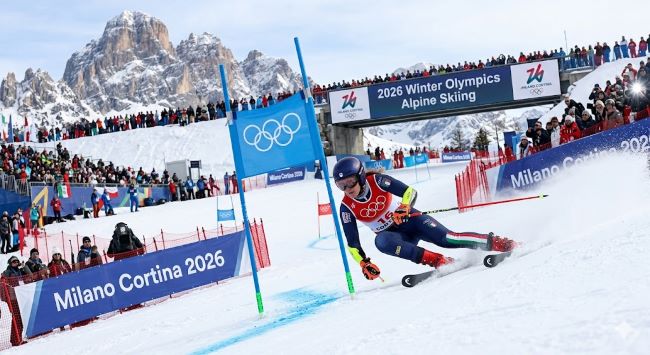
The 2026 Winter Olympics alpine skiing competition delivered drama, triumph, and stunning performances across the storied slopes of Cortina d’Ampezzo and Bormio in Italy. From February 6 to 22, the world’s best skiers raced down some of Europe’s most challenging mountains, and the 2026 winter olympics alpine skiing results rewrote records and restored legacies.
If you missed the action or want to understand what happened across the 10 alpine skiing events, this guide covers the schedule, key results, and the athletes who made this olympiad unforgettable.
Overview: 2026 Winter Olympics Alpine Skiing
The 2026 winter olympics featured alpine skiing at two legendary venues. Women competed on the Olympia delle Tofane course in Cortina d’Ampezzo, while men battled the Stelvio in Bormio, one of the most technically demanding tracks in the sport.
The Olympic Winter Games Milano Cortina 2026 featured 16 different sport disciplines, and alpine skiing was one of the headline events. A total of 10 medal events unfolded across different disciplines, and this was a watershed moment for alpine skiing’s Olympic presence. Alpine skiing achieved gender parity for the first time, with 149 skiers per gender competing, and saw a record number of countries participating with 84 nations entered.
The 2026 winter olympics alpine skiing competition spanned multiple disciplines: downhill, slalom, giant slalom, super-G, and combined events. Weather and snow conditions tested every competitor’s skill, and the results showed which athletes had prepared best.
2026 Winter Olympics Schedule and Results: Women’s Events
Women’s Downhill
Breezy Johnson won downhill gold for the United States in a race marred by the crash of teammate Lindsey Vonn. Johnson’s victory marked her first Olympic medal and came four years after a training crash at the same venue threatened her career. The downhill was held at Bormio’s Stelvio course, and Johnson’s time of 1:46.36 secured gold. Johnson’s triumph was emotional. She’d spent years rehabilitating from previous injuries, training hard to return to the form that made her one of the world’s top downhill skiers. Standing atop the podium in Cortina, the same location where her career nearly ended, gave her a redemption narrative that resonated with fans worldwide. Her gold medal set the tone for the entire 2026 winter olympics alpine skiing schedule and results, proving that American skiers remained competitive against the dominant European programs.
Women’s Super-G
Federica Brignone of Italy won the women’s super-G competition on February 12, with Romane Miradoli of France second and Cornelia Hütter of Austria third. Brignone’s victory was stunning given her comeback from injury. Ten months, two surgeries and extensive rehabilitation later, she managed to rally for the super-G, becoming the oldest gold medalist in Alpine skiing’s Olympic history.
Women’s Giant Slalom
In the giant slalom, Brignone claimed her second gold medal of the Games. She broke her own Olympic record in the GS, giving her five total Olympic medals and cementing her status as one of Alpine skiing’s all-time greats at age 35.
Women’s Slalom
Mikaela Shiffrin of the United States won the women’s slalom on February 18, with Camille Rast of Switzerland earning silver and Anna Swenn-Larsson of Sweden taking bronze. Shiffrin won the event 12 years after her gold medal in 2014 as a teenager.
This was Shiffrin’s defining moment at the Games. Mikaela Shiffrin won her 3rd Olympic gold medal in the Women’s Slalom, the most Olympic alpine gold medals won by any American skier. After a disappointing Beijing 2022 where she struggled with multiple DNFs (Did Not Finish), Shiffrin returned to prove she remained one of the sport’s greatest competitors. She first run showed poise in the challenging conditions. In run two, facing down the world’s best slalom skiers, she delivered clean technique and speed that reminded everyone why she’d won so many World Cup titles. Her victory wasn’t just a medal. For Shiffrin, it was a restoration of her Olympic legacy and a personal statement about resilience at age 29.
Women’s Team Combined
Ariane Rädler and Katharina Huber of Austria won the women’s team combined on February 10, in the inaugural edition of this event at the Olympics. Team USA women Jacqueline Wiles and Paula Moltzan won the first bronze medal in this event, as it made its official debut at the 2026 Winter Olympic Games.
2026 Winter Olympics Schedule and Results: Men’s Events
Men’s Downhill
The men’s downhill took place on February 7 at the Stelvio, one of the most demanding technical courses in skiing. The steep vertical drop and numerous gates challenged the world’s fastest skiers. At 1,023 meters of vertical drop and 3,442 meters of length, the Stelvio is a course that separates champions from contenders. Racers must manage extreme speed while navigating technically complex terrain. Results varied based on snow conditions and racer execution, with top Alpine skiers from Switzerland, Austria, and France competing for medals. The course reputation meant that any downhill medal at the 2026 winter olympics alpine skiing men’s event carried special significance.
Men’s Super-G
The men’s super-G tested skier versatility across a medium-length course with high speeds. Top finishers came from the traditional skiing nations, with Swiss and Austrian skiers showing strength throughout the 2026 winter olympics alpine skiing super-G event.
Men’s Giant Slalom
The first run’s snow condition was icy in the men’s giant slalom, with the air temperature 0.4 degrees Celsius at the starting gate. A skier from Brazil won the men’s giant slalom, marking a historic moment. With Lucas Pinheiro Braathen (BRA) winning the men’s giant slalom for Brazil, an Olympic Alpine skiing gold medal went to the Southern hemisphere for the first time.
Men’s Slalom
Loïc Meillard was crowned Milano Cortina 2026 Alpine skiing men’s slalom champion after a stellar performance on February 16. The Swiss finished in a time of 1:53.61 to take gold at the Stelvio Ski Centre, with Austria’s Fabio Gstrein claiming silver (1:53.96) and Norway’s Henrik Kristoffersen winning bronze (1:54.74).
The race was dramatic and delivered exactly the kind of compelling moment that defines Olympic alpine skiing. The opening run took place in blizzard conditions with more than half the field failing to finish. Atle Lie McGrath led after the morning’s first run in blizzard conditions and was fully expected to challenge Meillard for gold. The Norwegian was strong, fast, and looking every bit like a gold medal contender heading into the final run.
But in a dramatic twist, the Norwegian straddled a gate midway through Run 2 to scupper his chances of a place on the podium. When a racer straddles a gate (touches both the inside and outside pole at once), the run is disqualified immediately. McGrath, who had been in contention for the top step, was eliminated from medal contention in an instant. Meillard claimed his first gold for Milano Cortina 2026 after the 29-year-old won silver in the team combined and bronze in the giant slalom, making him one of the competition’s most successful Swiss skiers.
Men’s Team Combined
The men’s team combined brought together downhill and slalom specialists for a head-to-head competition. Teams from Switzerland, Austria, and France competed at the highest level in this format.
Notable Comebacks and Performances
The 2026 winter olympics alpine skiing schedule and results featured several remarkable comeback stories that captured global attention.
Federica Brignone’s redemption arc was one of the Games’ most inspiring narratives. The Italian superstar came back from major injury in under a year to win two gold medals at age 35, an age when most skiers are retired. Her performances in the super-G and giant slalom demonstrated not just physical recovery but the competitive drive that defines Olympic champions.
Lindsey Vonn, another American legend, attempted an Olympic return after retiring in 2019. She trained and competed to make the 2026 Games despite injuring herself weeks before the event. Though her Olympic run ended in a crash during the women’s downhill, her presence reminded fans why she’s one of the greatest alpine skiers ever.
Petra Vlhová of Slovakia also returned after nearly two years away from competition due to injury. The fact that such accomplished athletes would risk everything to compete at the 2026 winter olympics alpine skiing demonstrated the sport’s pull on its greatest competitors.
International Performance and Medal Standings
Alpine skiing at the 2026 Olympics saw dominant performances from traditional skiing nations. Switzerland won multiple medals across men’s and women’s events. Austria continued its status as a skiing powerhouse. Italy, the host nation, had strong showings with Federica Brignone’s dominant performances.
The United States came away from the 2026 Winter Olympics with four medals in Alpine skiing, a number that matched the total Americans earned in 2018 and 2022 combined. This represented a significant improvement and suggested renewed strength in American alpine programs.
One historic breakthrough came when Lucas Pinheiro Braathen from Brazil won the men’s giant slalom. This was the first Olympic alpine gold medal for a Southern Hemisphere nation, marking a breakthrough moment for a country working to build a competitive alpine program despite geographic and climate limitations.
United States at the Winter Olympics Schedule and Results
Looking at the united states at the winter olympics schedule and results for alpine skiing shows a strong performance. Beyond the medal count, the story was about redemption and breakthrough. Breezy Johnson set the tone early, winning downhill gold on the opening weekend. For Johnson, this was a return to the site where she’d crashed four years earlier. Mikaela Shiffrin’s gold in slalom answered every critic who questioned whether she could still compete at the highest level.
2026 Winter Olympics Freestyle Skiing
While alpine skiing got top billing, 2026 winter olympics freestyle skiing also delivered memorable moments. Freestyle events including moguls, aerials, halfpipe, and slopestyle showcased a different discipline but shared the same slopes and athlete dedication.
Alpine Skiing Milano Cortina 2026: The Venues
The 2026 winter olympics alpine skiing venues reflected Italy’s storied skiing heritage. Cortina d’Ampezzo hosted women’s events on the Olympia delle Tofane, a course beautiful and unforgiving. Bormio’s Stelvio served as the men’s venue, sitting at 2,268 meters elevation with a 1,023-meter vertical drop.
These courses are World Cup staples, familiar to the world’s best skiers. The 2026 winter olympics alpine skiing competed on courses that had tested the world’s best skiers for decades, adding prestige to every medal.
Key Takeaways
- 2026 winter olympics alpine skiing ran from February 6 to 22 across 10 medal events.
- Breezy Johnson’s women’s downhill gold marked her first Olympic medal and the US team’s opening medal.
- Mikaela Shiffrin won her third Olympic alpine gold in women’s slalom, the most by any American skier.
- Federica Brignone of Italy won two gold medals (super-G and giant slalom) despite returning from serious injury just months before.
- Loïc Meillard of Switzerland won the men’s slalom gold with a dramatic victory over Norway’s Henrik Kristoffersen.
- 2026 winter olympics alpine skiing achieved gender parity for the first time, with equal numbers of men and women competing.
- A record 84 nations competed in alpine skiing at the 2026 winter olympics, a significant increase from previous Games.
- The United States earned four alpine medals, equaling the combined total from 2018 and 2022 Olympics.
- Alpine skiing milano cortina 2026 venues included Cortina d’Ampezzo (women) and Bormio (men), both legendary World Cup sites.
- Lucas Pinheiro Braathen of Brazil won men’s giant slalom gold, marking the first Olympic alpine gold medal for the Southern Hemisphere.
- The women’s team combined and men’s team combined were featured events at the 2026 winter olympics alpine skiing competition.
- Austria dominated the all-time alpine skiing medal count with 129 total medals, followed by Switzerland with 75 and the United States with 48.