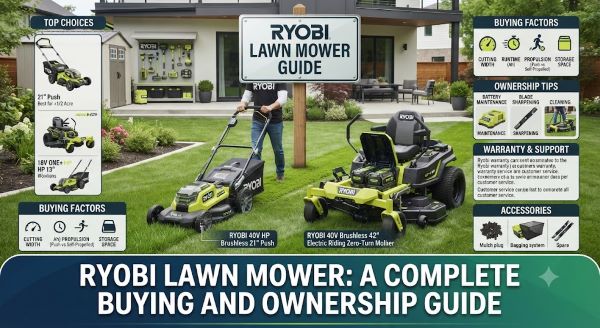
Ryobi has become one of the most popular brands in the battery-powered lawn equipment category, and a Ryobi lawn mower is frequently the first electric mower many homeowners consider when moving away from gas-powered equipment. This guide covers what makes Ryobi’s mower lineup distinctive, which models are worth considering, and what to expect in terms of performance, maintenance, and overall value compared to traditional gas mowers.
Why Ryobi Lawn Mowers Have Become So Popular
Ryobi built its reputation in the power tool space through its extensive 18V ONE+ battery ecosystem, which allows a single battery platform to power dozens of different tools, from drills to leaf blowers to, more recently, a full line of outdoor power equipment including lawn mowers. A Ryobi lawn mower that uses this shared battery system offers a meaningful advantage for anyone already invested in Ryobi’s tool ecosystem, since the same batteries that power a drill or trimmer can often power the mower as well, depending on the specific model and battery voltage required.
Beyond the battery compatibility, Ryobi mowers have earned a reputation for solid performance at a more accessible price point than some premium battery mower competitors, making them a frequently recommended entry point for homeowners curious about switching from gas to battery-powered lawn care.
Battery Voltage Options Explained
Ryobi lawn mowers come in several different battery voltage configurations, and understanding the differences matters significantly for choosing the right model for your specific yard size and mowing needs.
40V models are Ryobi’s most common and widely available mower voltage, offering a solid balance of runtime and cutting power suitable for most standard residential yards. These models typically use one or two 40V batteries depending on the specific mower.
80V models represent Ryobi’s higher-performance tier, designed for larger yards or more demanding cutting conditions, including thicker grass or larger overall lawn square footage where extended runtime and more cutting power become more important factors.
Riding mowers, including Ryobi’s battery-powered riding mower line, use significantly larger battery systems designed specifically for substantial lawn acreage where a push mower of any kind would be impractical.
Choosing the correct voltage tier for your specific yard size prevents the frustration of either overpaying for capacity you don’t need or underpowering a mower for a yard larger than the model is designed to handle efficiently.
Top Ryobi Lawn Mower Models Worth Considering
Ryobi 40V HP Brushless Walk-Behind Mower is one of the most highly regarded models in the lineup, featuring a brushless motor (which offers better efficiency and longer motor lifespan compared to brushed motor designs) along with strong cutting performance suitable for most mid-sized residential lawns.
Ryobi 40V Self-Propelled Mower adds self-propulsion to the standard 40V platform, reducing physical effort during mowing, particularly valuable for larger yards or yards with any significant slope or uneven terrain where pushing an unpowered mower becomes more tiring.
Ryobi 80V HP Brushless Mower is positioned as a premium option within the lineup, offering extended runtime and more cutting power for larger properties, often marketed as a genuine gas mower replacement for yards that might otherwise require a gas mower’s extended runtime capacity.
Ryobi 80V Crossover Riding Mower extends the battery-powered approach to riding mowers specifically, offering an electric alternative for larger properties that would traditionally require a gas-powered riding mower, with the added benefits of quieter operation and no gas, oil, or routine engine maintenance.
How a Ryobi Lawn Mower Compares to Gas Mowers
Noise level is one of the most immediately noticeable differences. A Ryobi lawn mower, like most battery-powered mowers, operates significantly quieter than a gas mower, which matters both for the person mowing and for neighbors, particularly in denser residential areas with closer property lines.
Maintenance is substantially reduced with battery power. There’s no oil to change, no gas to purchase and store, no spark plug to replace, and no annual carburetor or fuel system issues that commonly plague gas mowers left with old fuel sitting in the tank over winter months.
Runtime is the primary trade-off compared to gas mowers, which can run continuously as long as fuel is available. A Ryobi lawn mower runs on battery charge, which means runtime is finite per charge and depends on the specific battery and mower model, lawn conditions, and grass height and density at the time of mowing.
Cutting power has improved significantly in recent battery mower generations, including Ryobi’s lineup, narrowing the performance gap with gas mowers considerably compared to early-generation battery mowers from several years ago, though very thick or tall grass can still present more of a challenge for battery mowers than for a comparably sized gas engine.
Environmental impact favors battery mowers significantly, since gas mower engines are a notable source of small-engine emissions, and eliminating gas and oil entirely removes both direct emissions and the environmental impact of fuel storage and disposal.
Maintenance Tips for a Ryobi Lawn Mower
While battery mowers require less maintenance overall than gas equivalents, a few habits keep a Ryobi lawn mower performing well over its lifespan. Clean grass clippings and debris from the mower deck after each use, since accumulated debris can affect cutting performance and airflow over time. Sharpen or replace the mower blade regularly, typically once or twice per mowing season depending on usage frequency, since a dull blade tears grass rather than cutting it cleanly, which affects both lawn appearance and overall mower efficiency. Store batteries at room temperature when possible rather than in extreme heat or cold, since battery lifespan and performance are affected by temperature extremes during storage. Fully charge batteries before extended storage periods, such as over winter, following Ryobi’s specific storage charge recommendations to maintain battery health.
Is a Ryobi Lawn Mower Worth It?
For homeowners with small to mid-sized lawns who value lower maintenance, quieter operation, and reduced environmental impact, a Ryobi lawn mower represents strong value, particularly for anyone already invested in Ryobi’s broader battery tool ecosystem who can share batteries across multiple tools. For very large properties or particularly demanding mowing conditions, the higher-voltage 80V models or Ryobi’s riding mower options extend the brand’s viability into larger-scale use cases, though gas mowers may still offer an edge in raw, unlimited runtime for the largest properties or most demanding commercial-adjacent use cases.
Key Takeaways
- A Ryobi lawn mower benefits from the brand’s extensive ONE+ battery ecosystem, allowing battery compatibility across many other Ryobi tools depending on the specific voltage and model.
- 40V models suit most standard residential yards, while 80V models and riding mowers extend Ryobi’s lineup to larger properties with more demanding mowing requirements.
- The Ryobi 40V HP Brushless Walk-Behind Mower and 40V Self-Propelled Mower are among the most consistently recommended models for typical residential use.
- Compared to gas mowers, a Ryobi lawn mower offers significantly quieter operation, drastically reduced maintenance, and no need for gas or oil, though runtime per charge is the primary trade-off.
- Regular blade sharpening, deck cleaning after use, and proper battery storage at moderate temperatures extend both cutting performance and overall mower lifespan.
- Battery-powered mowers including Ryobi’s lineup have closed much of the cutting power gap with gas mowers in recent years, though very thick or tall grass remains more challenging for battery power.
- A Ryobi lawn mower offers strong value for small to mid-sized residential lawns, particularly for households already using other Ryobi battery tools.
- For very large properties, Ryobi’s 80V models and battery-powered riding mower options extend the brand’s viability, though gas equipment may still hold an edge for the most demanding large-scale mowing needs.