There is something satisfying about turning a piece of trash into something intentional. A gum wrapper is exactly the right size and stiffness for origami-style folding, and a heart is one of the most rewarding shapes to land on because it actually looks like what it’s supposed to be. Once you know how to make a heart out of a gum wrapper, you’ll find yourself doing it at restaurants, in waiting rooms, and anywhere else a wrapper finds its way into your hands.
This guide walks through the process clearly, step by step, with notes on where most people get tripped up.
What You Need
The only requirement is a standard stick of gum wrapper. The classic foil-lined paper wrappers that come with brands like Wrigley’s or Doublemint work best. The foil layer gives the fold more structure and helps the heart hold its shape.
Wrappers that are too thin or made of plain paper without the foil backing are harder to work with because they don’t hold creases as cleanly. If the wrapper has already been partially crinkled, try to flatten it by running your thumbnail along the surface before you start.
Step-by-Step: How to Make a Heart Out of a Gum Wrapper
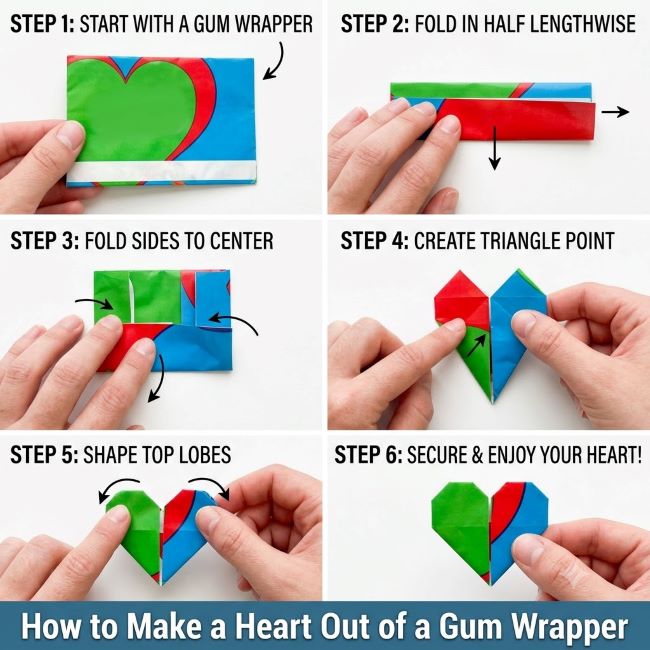
Step 1: Orient the wrapper
Lay the wrapper flat with the long side running left to right, printed or foil side facing down if you want the plain white side to show on the finished heart.
Step 2: Fold in half lengthwise
Bring the top long edge down to meet the bottom long edge. Press the fold flat with your fingernail. Unfold it. You now have a center crease running horizontally across the wrapper.
Step 3: Fold each long edge to the center crease
Fold the top edge down to the center crease and press it flat. Then fold the bottom edge up to the center crease and press it flat. You now have a long, narrow strip that is one quarter of the original height. This four-layer strip is the base for the rest of the folds.
Step 4: Fold the strip in half widthwise
Bring the right end of the strip over to meet the left end, creating a shorter rectangle. Press this fold flat. Then unfold it. You now have a vertical center crease dividing the strip into two equal halves.
Step 5: Fold the top corners down
On the right half of the strip, fold the top-right corner diagonally down toward the vertical center crease, so the top edge of that section now runs diagonally. Repeat on the left half by folding the top-left corner diagonally down toward the center crease. These two diagonal folds create the top curves of the heart shape.
Step 6: Fold the bottom corners up
Take the bottom-right corner of the right half and fold it diagonally upward. Take the bottom-left corner of the left half and fold it diagonally upward. These folds form the bottom point of the heart.
Step 7: Bring the two halves together
Fold the right half behind the left half along the vertical center crease, tucking one side behind the other so the shape closes. Adjust the top lobes and the bottom point until the heart looks symmetrical.
Step 8: Fine-tune the shape
Press all the edges flat and use your thumbnail to sharpen any soft corners. The top of the heart should have two rounded bumps and the bottom should come to a clean point. If either side looks uneven, gently pull the layers apart slightly and re-press them into position.
Where People Get Stuck
The strip is too wide. If you skip the lengthwise fold in Step 3 or don’t press it down tight, the strip ends up thicker than it should be and the later folds become imprecise. Take your time on Steps 2 and 3.
The diagonal folds don’t match. The top and bottom diagonal folds need to be mirror images of each other. If one side is angled differently than the other, the heart comes out lopsided. Unfold and redo the diagonal rather than trying to force the shape into symmetry later.
The bottom point is blunt. This usually happens when the diagonal folds in Step 6 don’t go far enough. The two bottom corners need to meet close to the center point of the strip to create a sharp tip at the bottom.
The wrapper tears. Old or dry wrappers crack along the folds. If you are working with a wrapper that has been in a pocket for a while, warm it slightly between your palms before folding, which softens the foil layer.
Variations Worth Trying
Once you have the basic method down, a few small adjustments change the result noticeably.
Two-tone heart. Some gum wrappers have a silver foil interior and a colored outer paper. If you start with the foil side facing up and adjust the fold direction in Step 1, the finished heart shows silver rather than white.
Linked chain of hearts. Knowing how to make a heart out of a gum wrapper opens the door to making linked chains. Each heart can interlock with the next by threading a corner of one heart through the folded layers of another before closing it. This takes practice but produces a chain that holds together without glue.
Miniature size. Cut a standard wrapper in half lengthwise before starting, and the finished heart comes out exactly half the size. Smaller hearts work well as earring-sized keepsakes or tiny decorations.
Why Gum Wrappers Work So Well
The structure of a gum wrapper (thin foil bonded to thin paper) gives the finished fold a combination of stiffness and pliability that plain paper and foil alone can’t match. The foil holds a crease permanently while the paper backing prevents tearing. That combination is why learning how to make a heart out of a gum wrapper produces a result that holds its shape and looks intentional rather than accidental.
Origami artists have used foil-backed papers for decades for exactly this reason. The gum wrapper is just a conveniently available version of the same material.
Key Takeaways
- Learning how to make a heart out of a gum wrapper only requires a standard foil-lined stick gum wrapper and a few minutes.
- Foil-backed wrappers work best because the foil holds creases firmly without tearing the way plain paper does.
- The foundation of the fold is a four-layer strip created by folding both long edges to the center crease twice.
- Diagonal folds at the top create the two lobes of the heart, and diagonal folds at the bottom create the point.
- Lopsided results almost always come from uneven diagonal folds. Unfold and redo rather than trying to correct a misaligned fold after closing the shape.
- The bottom point sharpens when the two lower diagonal folds meet close to the center of the strip.
- Once you know how to make a heart out of a gum wrapper, you can extend the skill to linked heart chains or scaled-down miniature versions.
- Old or dry wrappers crack on folds. Warming them between your palms before starting softens the foil and prevents tearing.