Gnats have a way of multiplying faster than you can swat them, and once they establish themselves in a kitchen, bathroom, or houseplant, the problem tends to get worse rather than better on its own. Knowing how to get rid of gnats requires understanding what type you are dealing with, since fruit flies, fungus gnats, and drain flies all require slightly different approaches despite looking similar at a glance. This guide covers identification, elimination, and prevention so the problem actually stays solved.
Identifying the Type of Gnat You Have
Before treating an infestation, identifying which type of gnat is present makes the difference between a fix that works and one that does not.
Fruit flies are small, tan or brown insects with red eyes, typically found around ripening fruit, vegetables, and sugary spills in the kitchen. They breed quickly in fermenting organic material.
Fungus gnats are small, dark, mosquito-like insects most commonly found around houseplants. They breed in damp soil, particularly soil that stays consistently moist or contains decaying organic matter.
Drain flies (sometimes called moth flies) have a fuzzy, moth-like appearance and are usually found near drains, where they breed in the organic buildup inside pipes.
Identifying the type narrows down where the infestation is coming from, which is the single most important step in actually solving the problem rather than just reducing the visible population temporarily.
How to Get Rid of Gnats: Eliminate the Source First
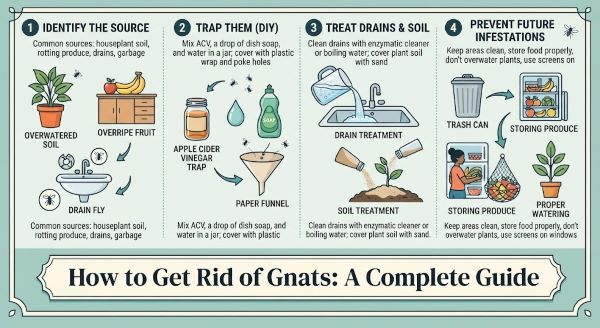
Traps and sprays only address the adult gnats you can see. If the breeding source is not eliminated, new gnats continue hatching regardless of how many adults you kill. This is the most overlooked step when people try to figure out how to get rid of gnats and find that the problem keeps returning.
For fruit flies: Remove all ripening fruit from open countertops, take out the trash regularly, and clean any sticky spills on counters or inside cabinets. Check the garbage disposal and recycling bins, both of which are common breeding sites.
For fungus gnats: Let the top inch or two of soil in affected houseplants dry out completely between waterings. Fungus gnat larvae cannot survive in dry soil, so adjusting your watering habits often resolves the infestation within one to two weeks without any additional treatment.
For drain flies: Clean the inside of drains thoroughly using a drain brush or a bottle brush to physically remove the organic film where larvae develop. Pouring boiling water or a baking soda and vinegar mixture down the drain helps but is less effective than physical scrubbing for established infestations.
Effective Traps for Killing Adult Gnats
While addressing the source is essential, traps help reduce the existing adult population and prevent further breeding while the source elimination takes effect.
Apple cider vinegar trap. Fill a small bowl or jar with apple cider vinegar, add a drop of dish soap, and cover with plastic wrap secured with a rubber band. Poke several small holes in the top. Gnats are attracted to the vinegar, enter through the holes, and the dish soap breaks the surface tension so they cannot escape. This works particularly well for fruit flies.
Yellow sticky traps. These adhesive cards, widely available at garden centers, are particularly effective for fungus gnats. Insert them directly into the soil of affected houseplants. The bright yellow color attracts the adult gnats, which then become stuck to the adhesive surface.
Red wine trap. Similar to the vinegar trap, a small amount of red wine left in an open glass with a few drops of dish soap attracts and traps fruit flies effectively, often working faster than vinegar alone.
Light traps. Some commercial gnat traps use UV light to attract gnats into an enclosed space with a sticky surface or electric grid. These work well for larger infestations or as a passive ongoing solution in problem areas.
How to Get Rid of Gnats in Houseplants Specifically
Houseplant fungus gnat infestations require a slightly more targeted approach beyond just adjusting watering.
Repot with fresh soil if the infestation is severe. Remove the plant from its container, gently shake off as much old soil as possible, and repot using fresh, sterile potting mix. This removes the larvae directly along with the soil they were developing in.
Apply a thin layer of sand or diatomaceous earth on top of the soil. This creates a barrier that prevents adult gnats from laying eggs in the soil surface and can also help dry out the top layer faster.
Use a BTI-based soil drench. Bacillus thuringiensis israelensis (BTI) is a naturally occurring bacteria that specifically targets fungus gnat larvae without harming plants, pets, or people. It is available in granular or liquid form designed for soil application and is one of the more effective targeted treatments available.
Preventing Gnats From Coming Back
Once you have addressed an active infestation, a few consistent habits prevent gnats from returning.
Store ripening fruit in the refrigerator rather than on the counter, particularly bananas, which are a common attractant. Take kitchen trash out daily rather than letting it accumulate, and rinse recyclables before placing them in bins. Clean drains periodically even without an active infestation, since organic buildup accumulates gradually over time. Avoid overwatering houseplants, and consider switching to a watering schedule based on checking soil dryness rather than a fixed calendar schedule.
When to Call Pest Control
Most gnat infestations resolve within one to two weeks using the methods above for how to get rid of gnats, particularly once the breeding source is identified and eliminated. If an infestation persists beyond several weeks despite consistent effort, or if the gnats appear to be coming from a source inside walls, under flooring, or from a location you cannot access and treat directly, professional pest control may be necessary to locate and address the source.
Key Takeaways
- Knowing how to get rid of gnats starts with identifying the type: fruit flies, fungus gnats, and drain flies each have different breeding sources and require different treatment approaches.
- Eliminating the breeding source is more important than killing visible adult gnats. Traps alone will not solve an infestation if the source remains active.
- Apple cider vinegar traps work well for fruit flies, while yellow sticky traps placed directly in soil are most effective against fungus gnats.
- For houseplant fungus gnats, allowing the top inch or two of soil to dry out between waterings often resolves the infestation without any additional product.
- Drain flies require physical scrubbing of the inside of drains to remove organic buildup, since pouring liquids down the drain alone is rarely sufficient for established infestations.
- A BTI-based soil drench is one of the most effective targeted treatments for fungus gnat larvae in houseplant soil and is safe for plants, pets, and people.
- Consistent prevention habits, including refrigerating ripening fruit, taking out trash daily, and adjusting watering schedules, keep gnats from returning after an infestation is resolved.
- If an infestation persists for several weeks despite consistent treatment, or the source cannot be located and accessed directly, professional pest control may be needed.