Choosing a mattress is one of those decisions that affects every single day of your life, yet most people make it with limited information and a tight budget. The two most popular categories right now are memory foam and hybrid mattresses, and they are genuinely different in ways that matter depending on how you sleep, whether you run hot at night, and what you expect a mattress to do for your back.
This guide breaks down the memory foam vs hybrid mattress debate across every factor worth comparing, from feel and temperature to price and durability.
What Each Type Actually Is
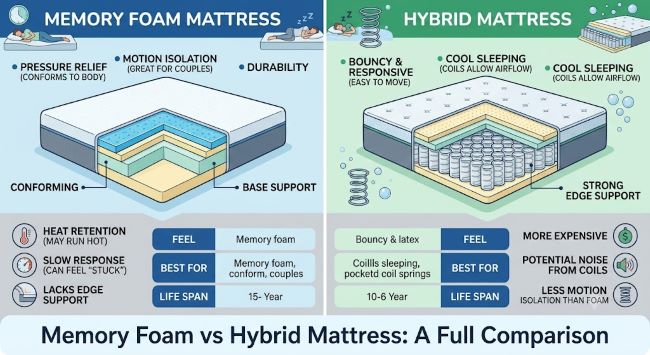
Memory foam mattresses are made entirely from foam layers. The top layers use viscoelastic foam, which responds to body heat and pressure by contouring closely to your shape. Lower layers use denser support foam to prevent sinking too far into the mattress. There are no springs, no coils, and no internal movement.
Hybrid mattresses combine a coil support system with foam comfort layers on top. The coils are typically individually wrapped pocket coils, which move independently of each other. The foam layers above them can be memory foam, latex, or other foam types. The result is a mattress that uses the bounce and airflow of a spring system while still offering the pressure relief of foam on top.
Comparison Table: Memory Foam vs Hybrid Mattress
| Feature | Memory Foam | Hybrid |
|---|---|---|
| Feel | Slow-response, contouring, “hugging” | Bouncier, more responsive, less sink |
| Pressure Relief | Excellent | Good to very good |
| Motion Isolation | Excellent | Good (pocket coils help, but less than foam) |
| Temperature | Tends to sleep warmer | Cooler due to coil airflow |
| Edge Support | Weak to moderate | Strong (coil perimeter) |
| Bounce / Responsiveness | Low | Moderate to high |
| Durability | 7–10 years | 8–12 years |
| Price Range | $400–$2,000+ | $700–$3,000+ |
| Noise | Silent | Minimal (pocket coils are near-silent) |
| Best For | Side sleepers, couples, light sleepers | Combination sleepers, hot sleepers, back/stomach sleepers |
Comfort and Feel
Memory foam has a distinctive feel that many people either love or dislike. It cradles the body and distributes weight, which takes pressure off hips and shoulders. The response is slow, meaning the foam doesn’t spring back immediately when you shift position. Some sleepers describe it as sleeping “in” the mattress rather than “on” it.
A hybrid mattress feels more like a traditional spring mattress but with better cushioning on top. It has more pushback, which makes it easier to move around in bed. If you tend to change positions during the night or sleep on your stomach, that responsiveness is a practical advantage.
Temperature and Sleeping Hot
This is where memory foam vs hybrid mattress comparisons become the clearest. Memory foam traps body heat because the dense foam layers limit airflow. Many people who naturally run warm at night find all-foam mattresses uncomfortable by morning.
Hybrid mattresses address this problem structurally. The coil layer creates open space inside the mattress where air circulates continuously. Heat dissipates rather than accumulating. Even if the foam top layer retains some warmth, the coil base keeps the overall sleep surface cooler.
Some memory foam brands add cooling gel or copper-infused foam to reduce heat retention, and these genuinely help. But if sleeping hot is a consistent issue, a hybrid typically outperforms even gel-infused memory foam in real-world use.
Motion Transfer and Partner Disturbance
Memory foam absorbs motion rather than spreading it, which is why it performs so well for couples with different sleep schedules. A partner getting up at 5 a.m. or shifting positions is absorbed by the foam before it reaches your side of the bed.
Hybrid mattresses with individually wrapped pocket coils also handle motion well, better than older interconnected spring systems. But some motion transfer is inevitable with coils. For couples where one partner is a very light sleeper, memory foam still holds an edge in this category.
Edge Support
Edge support is one area where the memory foam vs hybrid mattress comparison clearly favors hybrids. The coil perimeter of a hybrid mattress creates a firm boundary that supports sitting on the edge of the bed or sleeping near the side without the mattress collapsing underneath you.
Memory foam has poor edge support by default. The foam compresses under edge pressure without the structural reinforcement a coil system provides. Some memory foam mattresses include higher-density foam around the perimeter, which helps, but rarely matches a well-built hybrid in this area.
This matters more than it sounds. Poor edge support effectively reduces the usable sleeping surface, since most people avoid rolling near the edge of a soft mattress.
Durability and Longevity
Quality memory foam mattresses typically last 7 to 10 years before they begin to show noticeable sagging or loss of support. Cheaper foam degrades faster, particularly in areas that receive concentrated pressure like the hip and shoulder zones.
Hybrids generally last slightly longer, 8 to 12 years for a well-made version, because the coil system maintains structural support even as the foam comfort layers soften over time. The coils themselves rarely fail; it’s the foam on top that degrades first.
In both cases, quality matters more than mattress type. A budget hybrid from an unknown brand will underperform a high-quality memory foam mattress every time.
Price
Memory foam mattresses are available at more entry-level price points. A decent all-foam mattress can cost $400 to $800. Hybrids are more expensive to manufacture due to the coil system and typically start around $700 to $1,000 for a reliable model.
At the premium end, both types reach similar prices. A high-end memory foam and a high-end hybrid can both run $2,000 to $3,000 or more.
Who Should Choose Each
Memory foam is a better fit if you:
- Sleep on your side and need pressure relief at the shoulder and hip
- Share a bed and want minimal motion transfer
- Sleep alone and don’t have issues with heat retention
- Are working with a limited budget
A hybrid mattress is a better fit if you:
- Sleep hot or wake up sweating
- Change positions throughout the night
- Sleep on your back or stomach and want more pushback
- Sit on the edge of the bed regularly
- Prefer a more traditional mattress feel with modern foam comfort
Key Takeaways
- The memory foam vs hybrid mattress decision comes down to feel, temperature, and how you sleep more than price.
- In any memory foam vs hybrid mattress comparison, neither type wins across the board.
- Memory foam contours closely to the body, reduces motion transfer well, and suits side sleepers and light sleepers.
- Hybrid mattresses use coil systems that promote airflow, making them the better choice for people who sleep hot.
- Hybrids have stronger edge support and more responsiveness, which benefits combination sleepers and stomach sleepers.
- Memory foam typically costs less at entry-level price points. Hybrids cost more due to the coil construction but last slightly longer.
- Motion isolation favors memory foam, though hybrid pocket coil systems are a genuine improvement over traditional interconnected springs.
- Quality matters more than type. A well-made memory foam mattress outperforms a budget hybrid in durability and comfort every time.
- If you share a bed and one partner sleeps hot while the other is a light sleeper, a hybrid with gel-infused foam comfort layers is often the best compromise.