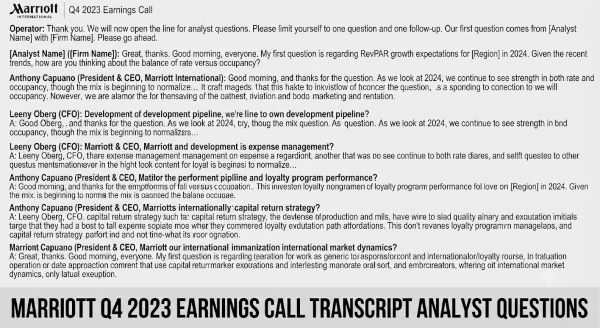
The Marriott Q4 2023 earnings call transcript analyst questions section offers some of the most useful insight into how Wall Street was interpreting the hospitality giant’s performance heading into 2024. The call, held on February 13, 2024, covered Marriott’s fourth quarter and full-year 2023 results, with the company reporting earnings per share of $3.57 against analyst expectations of $2.12. This guide walks through what management reported and what analysts pressed them on during the Q&A portion of the call.
Headline Results Discussed on the Call
Before getting into the Marriott Q4 2023 earnings call transcript analyst questions specifically, it helps to understand the results that framed the discussion. Global RevPAR increased over 7% year-over-year in the fourth quarter, driven by roughly equal gains in average daily rate (ADR) and occupancy. Global RevPAR rose nearly 15% for the full year, and net rooms grew 4.7%, leading to strong earnings and cash flow growth.
Group revenues rose 9% globally and 7% in the U.S. and Canada, with leisure transient revenues growing the fastest and global leisure revenues coming in nearly 50% above the same quarter in 2019. The company signed a record 891 organic management, franchise, and license agreements in 2023, representing approximately 164,000 rooms, ending the year with a pipeline of roughly 573,000 rooms.
This backdrop of strong performance set the stage for an analyst Q&A focused heavily on sustainability of growth, segment-level strength, and forward guidance.
Analyst Question: Luxury and Upper Upscale Segment Strength
One of the more detailed exchanges in the Marriott Q4 2023 earnings call transcript analyst questions came from Chad Beynon, who asked about RevPAR guidance across chain scales, specifically whether premium and upper upscale segments would continue leading performance into 2024, and whether there was still room for average daily rate increases in upper upscale given group booking pace.
CEO Anthony Capuano responded by highlighting the company’s momentum in extending its lead in luxury from a footprint perspective, noting that fourth quarter 2023 luxury RevPAR was up 10% globally compared to the same quarter in 2022. Capuano described continued compelling economics in the luxury segment and expressed enthusiasm about growth tied to Marriott’s industry-leading luxury footprint.
Beynon followed up with a more technical question about international management fee (IMF) payers among North American properties at year-end relative to the segment’s peak, which CFO Leeny Oberg acknowledged was a complicated calculation before walking through the relevant figures.
Analyst Question: Pipeline Acceleration and Brand Drivers
Another significant exchange in the Marriott Q4 2023 earnings call transcript analyst questions involved questions about what was driving the acceleration in Marriott’s development pipeline and which specific brands would lead new property openings going forward.
Management pointed to a combination of conversion-friendly brands, meaning brands that make it relatively easy for existing hotels to switch into the Marriott system without extensive renovation, along with growing international luxury demand as the primary drivers behind pipeline growth. This response reflected Marriott’s broader strategy of expanding through both new construction and conversions of existing properties, a lower-capital approach to growing room count.
Analyst Question: Credit Card and Non-RevPAR Fee Growth
Analysts also focused on the non-RevPAR-related components of Marriott’s fee revenue during the call, particularly credit card fee growth, given that the company guided to non-RevPAR related fees rising 9% to 10% for the full year, driven by strong credit card and residential branding fee growth.
This line of questioning reflects a broader interest among hospitality analysts in how much of Marriott’s fee growth is coming from sources outside the traditional hotel-stay business, since co-branded credit card programs and residential branding licenses represent a growing and relatively high-margin revenue stream that is less directly tied to traditional hotel occupancy trends.
Guidance Discussed During the Q&A
Beyond direct analyst questions, the Marriott Q4 2023 earnings call transcript analyst questions session included substantial discussion of forward guidance figures that shaped the analyst conversation. Management guided to full-year gross fees rising 6% to 8%, reaching between $5.1 billion and $5.2 billion. Owned, leased, and other revenues net of expenses were expected to total $320 million to $330 million, representing a 17% to 20% decline from 2023, attributed to lower termination fees compared to a large termination fee recorded in the fourth quarter of 2023, the sale of a property the previous summer, the CALA region’s shift from owned to managed status, and renovations at several owned hotels.
2024 G&A expense was guided to be flat to up 2% year-over-year, with several discrete one-time items from 2023 expected to offset wage and benefit increases. Full-year adjusted EBITDA was guided to increase 5% to 8%, reaching roughly $4.9 billion to $5 billion, with an expected 2024 effective tax rate of approximately 25% and an underlying core cash tax rate in the low 20% range.
Marriott anticipated net rooms growth of 5.5% to 6% for 2024, continuing the strong development momentum reflected in the year’s record signings.
Why These Analyst Questions Mattered
The Marriott Q4 2023 earnings call transcript analyst questions reveal what the financial community was most focused on heading into 2024: whether the post-pandemic recovery in travel demand, particularly in the luxury and group segments, could be sustained as comparisons against prior-year results became more difficult. Analysts pressed management specifically on segment-level durability (luxury RevPAR growth), the composition of fee growth (how much was coming from credit card and branding versus traditional RevPAR-linked fees), and the underlying drivers of pipeline acceleration.
This pattern of questioning is typical for hospitality sector earnings calls, where RevPAR and fee growth composition function as the primary signals analysts use to model future quarters and assess whether reported strength reflects durable demand trends or one-time factors.
Closing Remarks From Management
In closing remarks on the call, Marriott characterized 2023 as a banner year for the company, expressing optimism about the outlook ahead and noting that demand for all types of travel remained strong even as the rebound effect from the pandemic had waned. Management described the fundamentals of the hospitality industry as outstanding and reiterated a focus on offering strong brands and experiences to engaged guests while expanding Marriott’s global property portfolio.
Key Takeaways
- The Marriott Q4 2023 earnings call transcript analyst questions session, held February 13, 2024, followed a quarter in which the company beat earnings expectations with EPS of $3.57 against estimates of $2.12.
- Analyst Chad Beynon’s questions on luxury and upper upscale RevPAR drew a response from CEO Anthony Capuano highlighting 10% year-over-year luxury RevPAR growth in the fourth quarter and continued momentum in Marriott’s luxury footprint.
- Questions about pipeline acceleration centered on which brands would lead future openings, with management citing conversion-friendly brands and international luxury demand as key drivers.
- Analysts focused specific attention on non-RevPAR fee growth, particularly credit card and residential branding fees, which were guided to grow 9% to 10% for the full year.
- Forward guidance discussed during the Q&A included 6% to 8% gross fee growth, 5% to 8% adjusted EBITDA growth, and 5.5% to 6% net rooms growth for 2024.
- The Marriott Q4 2023 earnings call transcript analyst questions reflect a broader analyst focus on whether strong post-pandemic travel demand, especially in luxury and group segments, could be sustained against tougher year-over-year comparisons.
- Full-year 2023 results discussed on the call included global RevPAR up nearly 15%, net rooms growth of 4.7%, and a record 891 signed agreements representing roughly 164,000 rooms.
- Management’s closing remarks framed 2023 as a banner year and expressed confidence in continued strong travel demand fundamentals heading into 2024.