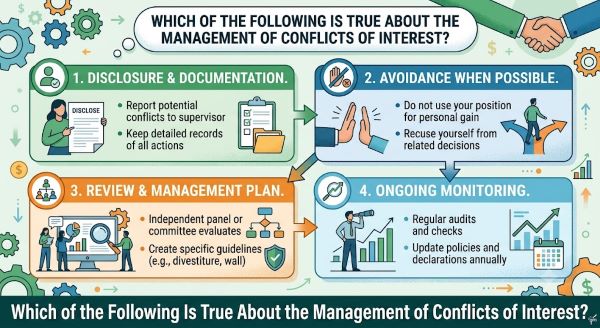
Conflicts of interest are a fixture of professional life. They appear in finance, healthcare, law, government, research, and corporate governance. Knowing which of the following is true about the management of conflicts of interest is not just an exam question. It is a practical literacy issue for anyone in a position of responsibility or trust.
This guide covers what conflicts of interest actually are, the core principles that govern their management, and the statements that are generally true versus false in both professional training and real-world practice.
What Is a Conflict of Interest?
A conflict of interest exists when a person’s personal interests, financial relationships, or outside obligations could influence (or appear to influence) their professional judgment or decision-making. The key word is “could.” An actual outcome does not need to occur for a conflict to exist. The potential alone is sufficient.
Conflicts can be:
- Financial: Holding stock in a company you are advising, auditing, or regulating.
- Personal: Making decisions that favor a family member, friend, or romantic partner.
- Organizational: Serving on the boards of two competing entities simultaneously.
- Research-related: Receiving funding from a company whose products you are evaluating.
Core Principles of Conflict of Interest Management
The following principles are broadly true across nearly every professional and institutional framework for managing conflicts of interest.
Disclosure is the foundational requirement.
The first obligation in any conflict of interest situation is disclosure. You identify the potential conflict and report it to the appropriate person or body: a supervisor, ethics board, compliance officer, or governing committee. Non-disclosure is almost always treated more seriously than the conflict itself, because concealment suggests intent to benefit improperly.
Disclosure alone does not resolve the conflict.
This is a point many people get wrong. Disclosing a conflict does not automatically mean you can proceed as normal. The organization or oversight body then decides how to handle it, which may involve recusal, independent review, or termination of the conflicting relationship. Disclosure is the start of the process, not the end.
Recusal is the standard remedy when bias cannot be eliminated.
When a conflict cannot be resolved by restructuring or disclosure alone, the affected person withdraws from the decision-making process entirely. This is called recusal. It is the default remedy in judicial, governmental, and many corporate contexts. The logic is that the integrity of the decision matters more than the participation of any individual.
Apparent conflicts are treated the same as actual conflicts.
A conflict does not need to produce biased results to require management. If a reasonable observer would perceive a conflict, that perception itself is a problem for institutional trust and must be addressed. This is why judges recuse themselves from cases involving former employers even when they believe they can be impartial.
Management policies must be systemic, not ad hoc.
Effective conflict of interest management is not handled case by case in the moment. Organizations that manage conflicts well have written policies, regular disclosure processes, independent review mechanisms, and training. Relying on individuals to self-regulate without structural support is not considered adequate under most professional standards.
Confidentiality of disclosed conflicts is not absolute.
Information disclosed through a conflict of interest reporting process may need to be shared with oversight bodies, regulators, or auditors. Employees who report conflicts through internal compliance channels should not assume that disclosure is permanently private.
What Is Generally False About Conflict of Interest Management
To answer the question “which of the following is true about the management of conflicts of interest,” it helps to know the common false statements that appear in training materials and exams.
False: A conflict only exists if it actually affects a decision. A conflict exists when the potential for bias exists, not only when bias has been demonstrated.
False: Disclosure fully resolves a conflict. Disclosure is the required first step but not the resolution. The conflict requires active management after disclosure.
False: Conflicts only involve financial relationships. Personal, organizational, and research-related conflicts are equally recognized and equally required to be managed.
False: Minor conflicts don’t need to be disclosed. Most professional standards do not set a materiality threshold for disclosure. If a conflict could reasonably affect judgment, it requires disclosure regardless of its apparent significance.
False: You can manage your own conflict without involving anyone else. Self-management of conflicts without external oversight or disclosure is not accepted practice. Independent review is a core feature of legitimate conflict management.
How Different Sectors Handle Conflicts of Interest
Financial services: Advisors and fund managers are required by securities regulators to disclose material conflicts in writing to clients. Firms maintain policies requiring pre-approval of outside business activities and personal trading.
Healthcare: Physicians who receive payments or gifts from pharmaceutical or device companies must disclose these relationships to patients and, in the US, to the Open Payments database maintained by CMS.
Government and public service: Public officials are often prohibited from participating in matters in which they or their families have a financial interest. Many jurisdictions require public financial disclosure filings annually.
Academic research: Researchers with financial ties to companies whose products they study are required to disclose those ties in published papers. Institutional review boards evaluate whether conflicts require independent oversight of the research.
Corporate governance: Board directors with conflicts on specific votes are expected to recuse. Many governance codes require independent directors to constitute a majority of audit and compensation committees specifically to reduce conflicts.
Common Exam and Training Scenarios
In professional certification exams and compliance training, the question “which of the following is true about the management of conflicts of interest” appears regularly. The correct answers consistently reflect the principles above. Here are the statements that are always true in these contexts:
- Conflicts must be disclosed to the appropriate authority as soon as they are identified.
- Disclosure alone is not sufficient. Active management is required.
- Apparent conflicts carry the same weight as actual conflicts.
- Recusal is the standard remedy when impartiality cannot be assured.
- Organizational policies, not personal judgment alone, govern how conflicts are handled.
Understanding which of the following is true about the management of conflicts of interest in an exam context requires knowing that professional standards are stricter than everyday intuition suggests. What feels minor to the person involved often carries significant weight from an institutional and regulatory standpoint.
- When asking which of the following is true about the management of conflicts of interest, the answer is almost always grounded in one principle: disclosure is required, but it does not resolve the conflict by itself.
- A conflict of interest exists when personal interests could influence professional judgment, whether or not they actually do.
- Disclosure is the foundational step. After disclosure, the organization determines the appropriate remedy, which may include recusal, restructuring, or ending the conflicting relationship.
- Apparent conflicts require the same management as actual conflicts. Perceived bias undermines institutional trust even when no biased outcome occurs.
- Effective conflict management requires systemic policies, not individual self-regulation. Organizations need written procedures, regular disclosure requirements, and independent review mechanisms.
- Recusal is the standard remedy when a conflict cannot be resolved any other way. It prioritizes the integrity of the decision over the participation of the individual.
- The common false statements include: conflicts only matter if they affect outcomes, disclosure fully resolves a conflict, and minor conflicts don’t require reporting.
- Which of the following is true about the management of conflicts of interest depends on the professional context, but the core principle (disclose, then manage with oversight) holds across finance, healthcare, law, government, and research.