If you have ever ridden along with a police officer, a driving instructor, or a Formula 1 driver learning a new track, you may have noticed them narrating what they see as they drive. That narration has a name, and understanding what is commentary driving explains a technique that has quietly become one of the most effective tools for building driving confidence and awareness, whether you are a brand-new learner or someone who has been driving for decades.
What Is Commentary Driving, Exactly?
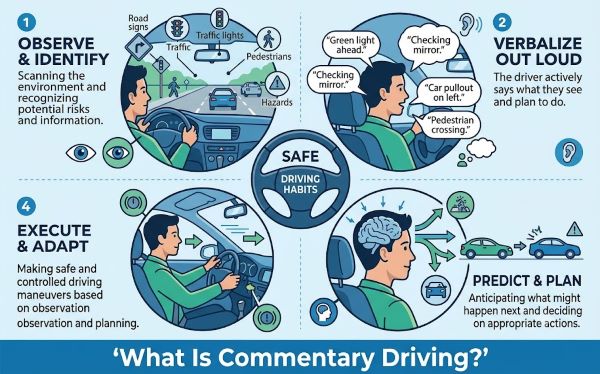
Commentary driving is the practice of speaking out loud, in real time, everything you see, think, and plan while operating a vehicle. It is the ability to verbally express and describe what you are thinking and seeing when driving. Rather than processing hazards, signs, and other road users silently, the driver narrates that mental process continuously from the moment they start the vehicle to the moment they park.
A commentary drive is where you describe what you are doing as you are driving, and it is a technique used by advanced drivers such as police officers. The same approach applies to Formula 1 drivers learning a new circuit, where they talk through every step they take behind the controls and describe every change in conditions or potential distractions and dangers.
The technique is not about narrating mechanical actions like “turning the wheel” or “pressing the brake.” Comments should be specific, since general terms such as “checking conditions” provide little value. Instead, the driver describes what they observe in the environment and the reasoning behind upcoming actions before those actions happen.
What Does Commentary Driving Actually Sound Like?
Things a driver might verbalize include vehicles at junctions or intersections and whether they appear to be turning into the road or waiting, side junctions where vehicles might be trying to join the road, and approaching hazards like traffic lights, roundabouts, stop signs, or parked cars. A driver might also comment on road surface conditions, such as noticing polished asphalt that suggests reduced grip on an upcoming corner, or skid marks that hint at a hazard ahead.
The comments are meant to be spoken before the driver performs a maneuver, since this demonstrates that the driver has identified the hazard and is responding to it rather than reacting after the fact. This forward-looking structure is central to what is commentary driving and what separates it from simply describing actions after they have already happened.
In dense urban environments, the volume of information can be overwhelming at first. Drivers eventually develop a shorter way of describing what is happening, such as saying simply “mirror” or “left mirror” rather than a full sentence like “checking my mirrors now.” This shorthand develops naturally with practice.
Why Driving Instructors and Coaches Use It
Understanding what is commentary driving in an instructional context explains why it has become a standard tool in driver education. It is a particularly effective tool for students who have difficulty multi-tasking or become confused in complex situations such as a busy intersection, because it enables them to identify situations that would require a change in speed or direction before that change becomes urgent.
In commentary driving, instructors ask the student to verbalize their thoughts while driving rather than responding to direct questions, which gets the same information about what the student sees, hears, and anticipates, but allows the student to share their immediate thoughts instead of pausing to formulate an answer to a question. This distinction matters significantly for certain learners. For students who become distracted trying to answer a direct question and lose focus on the actual task of driving, commentary driving solves that problem by letting them talk about what is already prominent in their mind, which reduces distraction and helps them more fully process the driving experience.
The technique provides a calm forum for each lesson, improves the confidence of student drivers by easing their nerves and reducing their tendency to second-guess themselves, and gives both the student and the instructor insight into the student’s decision-making abilities and how well they are paying attention to the road.
How Commentary Driving Helps With Confidence and Anxiety
Commentary driving is widely considered one of the best techniques for building confidence in drivers who struggle with anxiety, and once learned and practiced regularly, it tends to stay with a driver for life. The verbalization process works by occupying the part of the brain that might otherwise spiral into anxious or intrusive thoughts. By verbalizing observations and movements simultaneously, the technique helps the brain process potential issues while also preventing overthinking or intrusive thoughts from taking over during the drive.
This benefit is not limited to anxious drivers. Commentary driving is useful for all drivers regardless of experience level, and for newly qualified drivers or those driving alone for the first time, it helps enormously with confidence by interrupting the tendency to overthink every decision.
What Is Commentary Driving Used For Beyond Learner Training?
While commentary driving is closely associated with driving instruction, its applications extend well beyond new drivers. It is the same technique used by police officers conducting high-speed pursuits, where the officer describes everything they see, are doing, and the reasoning connecting those observations to the situation unfolding around them.
It is also used by those who spend a lot of time driving in genuinely high-risk situations, in addition to its value for learner and newly solo drivers. The underlying purpose is consistent across all of these contexts. The purpose of a commentary drive is to train the driver to take in and process significantly more information than usual and to anticipate danger before it materializes.
How to Start Practicing Commentary Driving
Getting started with commentary driving can feel awkward initially. Many people find that getting over the self-consciousness of talking out loud when nobody else is in the car is the hardest part of starting the technique. It can feel quite odd and lead to self-consciousness at first, especially with another person present in the vehicle, but it is worth persisting through that initial discomfort.
A practical way to begin is to start small. Starting gradually and paying attention to the weather, road conditions, road signs, and markings will help make commentary driving easier as you build the habit. Rather than attempting to narrate everything at once, begin by verbalizing observations only at specific points, such as approaching an intersection, and gradually expand the practice to cover more of the drive.
The only way to get good at commentary driving is to practice it consistently. When you first start, it will seem like you are overwhelmed with things to describe, but over time you become fluent at it, similar to learning a new language.
For parents coaching new teen drivers, timing matters. Supervisors can practice commentary driving themselves in the weeks leading up to a teen’s first lessons, which helps create an awareness of the many challenges involved in driving. However, when a teen first gets behind the wheel, it is best to retire the commentary technique for a little while because it is too much to think about during the earliest stages of learning the physical mechanics of driving. Once the teen is comfortable with basic maneuvering, commentary driving can be reintroduced, with the teen taking over the role of running the commentary themselves.
What Commentary Driving Reveals to Instructors and Coaches
Beyond building the driver’s own awareness, commentary driving gives instructors and supervisors direct insight into a student’s thought process in real time. It helps develop a student’s judgment of how far ahead they should be looking and how early to begin taking action, helps reset a distracted or stressed mindset by bringing focus back onto the act of driving, and helps supervisors understand whether the student is using their scanning and vision effectively, recognizing risk in time, and making sound judgments.
This visibility into the student’s reasoning means that if a supervisor understands what the learner is thinking and planning at any given moment, they tend to remain calmer and less inclined to jump in with last-minute corrective instructions, which itself contributes to a calmer and more productive learning environment.
Key Takeaways
- What is commentary driving comes down to one core practice: verbalizing in real time everything you observe, anticipate, and plan to do while operating a vehicle, before you act on it.
- The technique is used by driving instructors, police officers, and advanced drivers including Formula 1 competitors learning new circuits, all for the same underlying purpose of processing more information and anticipating hazards sooner.
- Effective commentary driving relies on specific observations rather than vague statements, and comments are spoken before a maneuver rather than after, demonstrating that the driver identified the hazard in advance.
- For learner drivers, commentary driving solves a common problem with traditional question-based instruction by letting the student share their own immediate thoughts rather than pausing to answer a direct question, which reduces distraction.
- The technique is particularly effective for building confidence in anxious drivers and newly licensed drivers, since verbalizing observations helps prevent overthinking and intrusive thoughts from taking over during a drive.
- Initial self-consciousness while talking out loud is the most common barrier to starting commentary driving, but it tends to resolve quickly with consistent practice, similar to becoming fluent in a new language.
- For teen drivers, commentary driving is most effective once basic vehicle handling has been mastered. Introducing it too early can overwhelm a beginner still focused on the physical mechanics of driving.
- Commentary driving gives instructors and parents real-time insight into a student’s scanning habits, risk recognition, and decision-making, which leads to calmer coaching and fewer last-minute corrective interruptions during lessons.