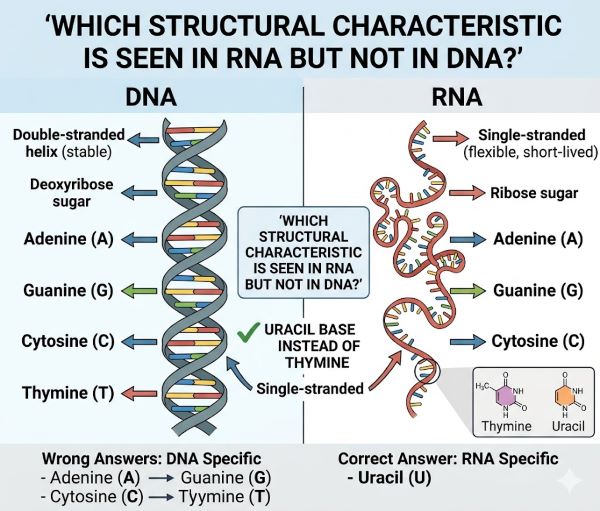
Understanding the differences between RNA and DNA is fundamental to biology. When asked which structural characteristic is seen in RNA but not in DNA, the primary answer is the sugar type: RNA contains ribose sugar while DNA contains deoxyribose sugar.
These structural differences between the two molecules reflect their different functions in cells. DNA stores genetic information long-term, while RNA is more temporary and used for various cellular functions.
DNA vs RNA: The Basic Difference
DNA vs RNA comparison starts with understanding what each molecule does. DNA vs RNA molecular structure differs in several ways.
DNA stands for deoxyribonucleic acid. RNA stands for ribonucleic acid. The difference in their names hints at a key structural difference: the sugar component.
Both molecules are made of nucleotides consisting of a sugar, a phosphate group, and a nitrogenous base. The differences lie in details of each component.
The Sugar Component: Ribose vs Deoxyribose
The primary which structural characteristic is seen in RNA but not in DNA answer involves the sugar molecule. RNA contains ribose sugar, while DNA contains deoxyribose sugar.
The difference is small but significant. Deoxyribose lacks one oxygen atom compared to ribose. This missing oxygen atom is why it’s called “deoxy” (meaning without oxygen).
This single oxygen difference affects how these molecules fold, interact with proteins, and function in cells. It’s a crucial structural distinction that enables different cellular roles.
Nitrogenous Bases
Another difference between DNA and RNA involves the nitrogenous bases. While both contain adenine, guanine, and cytosine, RNA contains uracil instead of thymine, which DNA contains.
DNA contains: Adenine (A), Thymine (T), Guanine (G), Cytosine (C) RNA contains: Adenine (A), Uracil (U), Guanine (G), Cytosine (C)
This base difference is significant. Uracil replaces thymine in RNA. The structural difference between uracil and thymine is a single methyl group.
Structure and Stability
The dna vs RNA structure differences affect stability. DNA’s deoxyribose sugar and thymine bases make it more stable, suited for long-term genetic storage.
RNA’s ribose sugar and uracil bases make it less stable. This suits RNA’s temporary roles in cells. Its instability means RNA messages don’t persist long, which is actually helpful for controlling cellular processes.
How Is RNA Different from DNA?
How is RNA different from DNA goes beyond just sugar and bases. The physical shape differs too.
DNA typically exists as a double helix, two complementary strands wound together. This structure protects the genetic information and makes it stable.
RNA usually exists as a single strand. This allows it to fold into various shapes and interact with proteins to perform different functions. Some RNA can form secondary structures, but it doesn’t typically form a complete double helix like DNA.
What Is the Difference Between DNA and RNA?
The what is the difference between DNA and RNA question encompasses multiple characteristics:
Sugar: DNA has deoxyribose, RNA has ribose. Bases: DNA has thymine, RNA has uracil. Structure: DNA is typically double-stranded, RNA is typically single-stranded. Stability: DNA is more stable, RNA is less stable. Function: DNA stores genetic information long-term, RNA has temporary roles. Location: DNA is primarily in the nucleus, RNA is throughout the cell.
The 3 Differences Between DNA and RNA
The major 3 differences between DNA and RNA are:
1. Sugar type: Deoxyribose (DNA) vs Ribose (RNA). 2. Nitrogenous bases: Thymine (DNA) vs Uracil (RNA). 3. Structure: Double-stranded (DNA) vs Single-stranded (RNA).
These three differences define the molecules structurally.
How Does RNA Differ from DNA?
How does RNA differ from DNA functionally and structurally relates to its different roles. RNA being single-stranded and less stable makes it perfect for temporary cellular messages.
DNA being double-stranded and more stable makes it perfect for storing genetic information that must last the cell’s lifetime.
Different structures enable different functions.
DNA vs RNA Structure
The DNA vs RNA structure comparison shows how form follows function. The double helix protects DNA’s information. The flexible single strand allows RNA to assume various shapes for different tasks.
Similarities Between DNA and RNA
Despite differences, similarities between DNA and RNA exist. Both are made of nucleotides. Both contain phosphate groups and sugar-base combinations.
Both carry genetic information through base sequences. Both involve A, G, and C bases. Both are essential for life processes.
RNA and DNA: Working Together
In cells, RNA and DNA work together. DNA stores genetic instructions. RNA reads those instructions and carries them out through various roles.
Messenger RNA (mRNA) copies DNA instructions. Transfer RNA (tRNA) brings amino acids for protein building. Ribosomal RNA (rRNA) helps assemble proteins.
Without both molecules, cells couldn’t function.
Testing RNA and DNA Knowledge
When asked which structural characteristic is seen in RNA but not in DNA, remember the sugar difference is most direct. Some variations ask about the base difference (uracil vs thymine) or structural difference (single vs double-stranded).
Any of these answers could be correct depending on the specific question format.
RNA Types and Their Functions
Messenger RNA (mRNA): Carries genetic information from DNA to ribosomes. Transfer RNA (tRNA): Brings amino acids to ribosomes during protein synthesis. Ribosomal RNA (rRNA): Part of ribosomes, helps assemble proteins. Small nuclear RNA (snRNA): Processes mRNA in the nucleus. Small nucleolar RNA (snoRNA): Modifies other RNAs.
Each RNA type uses the same basic ribose-uracil-containing structure for different purposes.
Structural Consequences
The structural differences have real consequences. DNA’s stability allows it to be faithfully replicated billions of times. RNA’s instability limits how long messages last, giving cells control over when genes are expressed.
Single-stranded RNA can fold into complex three-dimensional shapes that DNA rarely achieves. These shapes enable RNA to have enzymatic properties, which DNA lacks.
Key Takeaways
- Which structural characteristic is seen in RNA but not in DNA: RNA contains ribose sugar while DNA contains deoxyribose sugar.
- DNA vs RNA includes differences in sugar type, nitrogenous bases, physical structure, and stability.
- Rna vs DNA comparison shows RNA has single-stranded structure while DNA is typically double-stranded.
- Difference between DNA and RNA: Sugar type (ribose vs deoxyribose), bases (uracil vs thymine), and structure (single vs double-stranded).
- Differences between DNA and RNA also include location and function, with DNA in the nucleus and RNA throughout the cell.
- How is RNA different from DNA: In stability, structure, base composition, and roles within the cell.
- What is the difference between DNA and RNA: Multiple differences exist at both structural and functional levels.
- The 3 differences between DNA and RNA: Sugar type, nitrogenous bases, and physical structure are the primary ones.
- How does RNA differ from DNA: Through its temporary nature, flexibility in shape, and roles in gene expression and protein synthesis.
- DNA vs RNA structure: DNA’s double helix protects information; RNA’s single strand allows functional flexibility.
- Similarities between DNA and RNA: Both contain nucleotides, phosphate groups, and carry genetic information through bases.
- RNA and DNA: Work together with DNA storing instructions and RNA executing them through various temporary cellular functions.
- DNA’s thymine base and deoxyribose sugar make it stable for long-term storage; RNA’s uracil and ribose suit it for temporary roles.