Most people outside of Catalonia have never heard of coca de recapte. That is not surprising. It does not have the international profile of paella or tapas, and it rarely makes it onto the menus of Spanish restaurants that cater to a broad audience. But among Catalans, it is everyday food. Flatbread topped with roasted vegetables, salt cod, and sardines or anchovies, baked until the edges crisp and the toppings concentrate. Simple, direct, and deeply satisfying when made properly.
If you have been searching for the best coca de recapte near me and coming up short, you are dealing with a dish that has a small but dedicated following outside its home region. Finding it takes more targeted searching than most dishes, but it is worth the effort.
What Coca de Recapte Actually Is
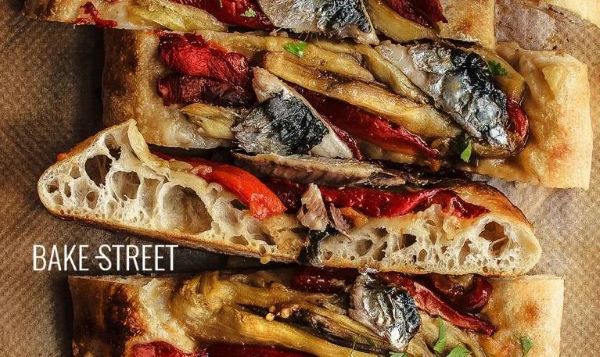
Coca is the Catalan word for a flatbread or savory tart. The dough is thin, similar to a focaccia but less pillowy and often crisper along the bottom. Recapte means “gathered” or “collected,” referring to the tradition of using whatever preserved or roasted ingredients were on hand. Historically that meant salt cod, sardines, roasted peppers, eggplant, and onions. Today the combination varies but the core logic stays the same: slow-roasted or preserved ingredients on a thin base.
The vegetables are always cooked before they go on the dough. Roasted red peppers and slow-cooked eggplant are standard. The salt cod, called bacalla in Catalan, is desalted and usually added raw on top of the vegetables before baking, where it finishes cooking in the oven. Sardines or anchovies go on last, sometimes before baking, sometimes after. A drizzle of olive oil finishes it.
This is not pizza. The toppings are denser, less saucy, and the overall flavor is more savory and mineral than anything tomato-based. When you search for the best coca de recapte near me, that distinction matters because a kitchen that treats it like a Spanish pizza is not making coca de recapte.
Where to Look First
Catalan restaurants are the most direct source, but they are genuinely rare outside of a handful of cities. New York, Miami, Los Angeles, and Chicago have a small number of restaurants specifically focused on Catalan cuisine rather than generalized Spanish food. These are your best starting points.
Spanish restaurants with regional menus sometimes carry coca as a starter or shared dish. A restaurant that specifies Catalan, Valencian, or northeastern Spanish cooking on its menu is more likely to have it than a general tapas bar.
Spanish delis and specialty food shops occasionally carry coca as a prepared item, particularly in cities with a larger Spanish immigrant community. It keeps reasonably well and is sometimes sold by the slice or half tray.
Catalan cultural centers and food events are an underused resource. Cities with active Spanish or Catalan cultural associations sometimes host food events where home cooks and small vendors sell traditional dishes that never appear in restaurants. A search for Catalan society or Casa Catalana plus your city name is worth trying.
How to Search More Effectively
A direct search for the best coca de recapte near me may not return many useful results. The dish is niche enough that even restaurants serving it may not list it prominently in their online descriptions. Here is how to dig deeper:
Search Google Maps for Catalan restaurant or Spanish restaurant and then look at menus directly. Many listing platforms allow full menu browsing where you can search for specific items.
Check Yelp reviews for any Spanish restaurant in your area and search within reviews for the word “coca.” Reviewers who know the dish will mention it specifically.
Search Instagram for “coca de recapte” without any location filter first to understand what the dish looks like in photos, then add your city name to the search to find local posts.
Contact Spanish cultural organizations in your city. Even if they cannot point you to a restaurant, they often know home cooks or community members who make traditional Catalan food for events.
If you are in a city with a Spanish consulate or cultural institute like Instituto Cervantes, their staff or community boards sometimes list food-related events and vendors.
What a Good Coca de Recapte Should Look Like
Once you find a place serving it, knowing what quality looks like helps you evaluate what arrives at the table.
The base. Thin and cooked through, with some color on the bottom. A pale or doughy base means the oven temperature was too low or the bake time too short. The edges should have some crispness without being cracker-dry.
The vegetables. Soft, concentrated, and slightly sweet from roasting. If the peppers or eggplant taste raw or watery, they were not cooked long enough before going onto the dough.
The salt cod. Properly desalted bacalla has a mild, clean flavor. If it tastes aggressively salty, the soaking process was rushed. If it is rubbery, it was overcooked. At its best, it is just barely cooked through, flaking gently.
The anchovies or sardines. Present but not overwhelming. They add salt and depth rather than dominating every bite. A kitchen that uses cheap, excessively salty canned fish will throw the whole balance off.
Olive oil. A visible drizzle of good olive oil across the finished coca is standard. It should taste like olive oil, not a neutral cooking oil.
Ordering and Eating Tips
Coca de recapte is typically served as a starter or shared plate rather than a main course, though a large portion can work as a light meal. It pairs well with a glass of cava or a crisp white wine from Penedes or Priorat if the restaurant carries Spanish wine.
Eat it warm rather than hot. Right out of the oven, the flavors on the best coca de recapte near me can be muted by heat. A few minutes of rest lets everything settle and the toppings become more distinct.
If you are ordering for a table, one coca usually feeds two to three people as a starter. Ask the server about sizing before ordering multiples.
Making It at Home If You Cannot Find It
If the search for the best coca de recapte near me comes up empty, the dish is approachable at home. The dough is a simple olive oil flatbread. The vegetables roast in the oven while the dough rests. Salt cod requires advance planning since it needs 24 to 48 hours of soaking in cold water with several water changes to remove the salt.
The ingredients are all available at Spanish specialty food stores or online. Salt cod in particular is widely stocked at Portuguese, Spanish, and Caribbean grocery stores.
Key Takeaways
- Searching for the best coca de recapte near me works better when you target Catalan-specific or northeastern Spanish restaurants rather than general tapas bars.
- Coca de recapte is a thin Catalan flatbread topped with slow-roasted vegetables, salt cod, and anchovies or sardines. It is not a Spanish pizza and should not taste like one.
- Google Maps menu browsing and Instagram searches with your city name are more productive than standard keyword searches for a dish this niche.
- Catalan and Spanish cultural associations in your city are an underused resource for finding authentic versions sold at community events.
- A properly made coca has a crisp base, concentrated roasted vegetables, properly desalted salt cod, and a finish of good olive oil.
- Serve and eat it warm rather than hot for the best flavor. It works as a starter for two to three people.
- Salt cod is available at Spanish, Portuguese, and Caribbean grocery stores, making a home version achievable if restaurant options are limited in your area.