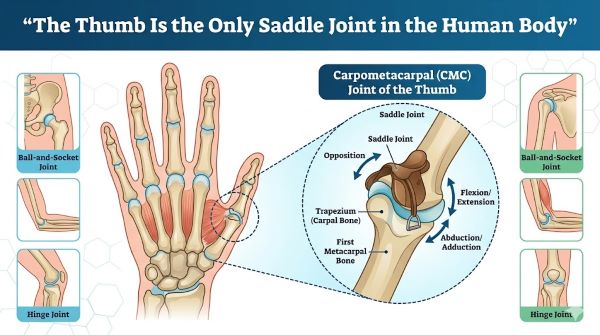
The statement that the thumb is the only saddle joint in the human body is partially true but needs clarification. While the thumb does contain the most prominent saddle joint, the carpometacarpal joint at the base of your thumb, it’s not technically the only one in your body. Understanding this distinction helps you grasp joint anatomy and biomechanics.
A saddle joint is a specialized joint type that allows movement in two directions. It gets its name because the joint surfaces resemble a saddle, with one bone curving one way and the other curving the opposite way. This unique shape enables specific movement patterns that other joints can’t achieve.
What Is a Saddle Joint?
The what is a saddle joint question has a straightforward anatomical answer. A saddle joint is a biaxial joint, meaning it allows movement along two axes. The opposing joint surfaces curve in opposite directions, creating the saddle shape.
This design allows flexion and extension in one direction, plus abduction and adduction in another direction. You can move the joint forward and back, and side to side, but not in rotation. This combination of movements is unique to saddle joints.
The saddle joint structure involves two bones with complementary curved surfaces. One surface curves like the side-to-side curve of a horse saddle. The other surface curves front-to-back like a saddle shape. These opposing curves allow the specific movement patterns.
The Thumb’s Saddle Joint
The joints of the thumb include the carpometacarpal (CMC) joint, which is the most famous saddle joint. Located at the base of your thumb where it connects to your wrist, this joint is responsible for your thumb’s remarkable mobility.
The thumb’s saddle joint allows you to touch your thumb to each of your four fingers. This opposition movement is uniquely possible because of the saddle joint configuration. No other joint in your hand allows this range of motion.
The saddle joint at the base of your thumb enables opposition, flexion, extension, abduction, and adduction. This combination of movements is why your thumb is so versatile. You can grip, pinch, and manipulate objects with precision that would be impossible without this joint type.
Other Saddle Joints in the Human Body
While the thumb is the only saddle joint in the human body is a common statement, it’s not entirely accurate. The thumb’s carpometacarpal joint is the primary example, but anatomists identify at least one other saddle joint.
The joints of the thumb extension includes the sternoclavicular joint where your collarbone meets your breastbone. This joint has saddle-like joint surfaces and allows similar movement patterns. However, it’s sometimes classified differently depending on the anatomical reference.
The saddle joint examples primarily focus on the thumb because it’s the most functional and commonly discussed. Most anatomy textbooks emphasize the thumb when teaching saddle joints due to its importance in hand function.
Saddle Joint Movement and Function
The saddle joint movement involves two primary axes of motion. The joint can move forward and backward (flexion and extension) and side to side (abduction and adduction). Combined, these movements allow circumduction, a circular movement pattern.
The thumb can flex forward and extend backward. It can also move toward the palm (adduction) and away from the palm (abduction). These movements work together to provide the opposition that defines thumb function.
The saddle joint example of the thumb shows why this joint type is so important. Without the saddle joint configuration, your thumb would have much more limited function, similar to the other fingers.
Comparing Joint Types
Understanding saddle joints requires comparing them to other joint types. The human body contains multiple joint classifications based on movement capability.
Saddle joints allow biaxial movement. Condyloid joints (like those in your fingers, excluding the thumb base) allow movement along two axes but not rotation. Ball-and-socket joints (like your hip and shoulder) allow movement along three axes plus rotation.
The explain the difference between a joint’s possible range of motion and its actual range of motion concept relates to how joint structure limits or enables movement. The saddle joint’s shape determines its possible range, which is inherently more limited than ball-and-socket joints but more extensive than simple hinge joints.
Functional Importance of the Thumb’s Saddle Joint
The thumb’s saddle joint gives humans a major evolutionary advantage. The ability to oppose the thumb to other fingers is unique to primates. This enables tool use, fine motor control, and precise manipulation.
Without the saddle joint’s unique configuration, your thumb would move more like your other fingers. You couldn’t pinch with the same precision. Gripping power and control would decrease significantly.
The what is a saddle joint practical answer is that it’s the joint that makes your thumb special. It’s why humans can do things other animals can’t.
Carpometacarpal Joint Anatomy
The carpometacarpal joint of the thumb is formed by the first metacarpal bone and the trapezium carpal bone. These two bones have saddle-shaped surfaces that curve opposite ways.
The first metacarpal’s base is concave from side to side and convex front to back. The trapezium’s surface is convex side to side and concave front to back. This opposition creates the saddle configuration.
This anatomical arrangement enables all the movement we associate with thumb opposition. It’s a remarkably elegant design for a critically important joint.
Other Hand Joints and Their Types
The other joints in your hand are mostly condyloid or hinge joints. The condyloid joint classification applies to your finger knuckles. These joints allow flexion, extension, abduction, and adduction, but not the opposition movement the saddle joint enables.
Your finger joints are more limited than your thumb’s carpometacarpal joint. This is why you can’t touch your fingers to your palm the way your thumb can touch to your fingers.
Understanding biaxial joint types helps you appreciate why the thumb is different.
Clinical Significance of Saddle Joint Disorders
Saddle joints experience unique injuries and disorders. Thumb arthritis commonly affects the carpometacarpal joint. This is one of the most common arthritis locations because the saddle joint handles significant stress.
Thumb sprains often involve the saddle joint. The ligaments supporting the cartilage can be damaged, causing pain and instability. Understanding saddle joint anatomy helps surgeons address these injuries.
Range of Motion: Possible vs. Actual
The explain the difference between a joint’s possible range of motion and its actual range of motion concept is important for joint biomechanics. The saddle joint’s shape determines its possible range of motion.
However, ligaments, muscles, and soft tissues around the joint limit actual range of motion below the anatomical maximum. In thumb saddle joints, this protection prevents overstretching of supporting structures.
Actual range of motion varies between individuals based on flexibility, muscle strength, and previous injuries.
Key Takeaways
- The thumb is the only saddle joint in the human body is mostly true, with the thumb’s carpometacarpal joint being the primary and most functional saddle joint example.
- Saddle joint definition describes a biaxial joint with opposing curved surfaces that resemble a horse saddle, allowing movement along two axes.
- What is a saddle joint: A joint with two curved surfaces that face opposite directions, enabling flexion-extension and abduction-adduction movements.
- Saddle joint movement includes opposition, the ability to touch the thumb to each finger, which is impossible in other joint types.
- Saddle joint examples primarily include the thumb’s carpometacarpal joint and possibly the sternoclavicular joint where the collarbone meets the breastbone.
- Joints of the thumb at the base create the saddle configuration responsible for thumb’s unique mobility and gripping ability.
- Condyloid joint classification applies to finger joints, which allow biaxial movement but lack the opposition capacity of saddle joints.
- Biaxial joint movement is limited to two axes, distinguishing saddle joints from ball-and-socket joints that allow three-axis movement.
- The possible range of motion versus actual range of motion difference reflects how joint shape permits certain movements while ligaments and soft tissues limit how far those movements extend.
- Thumb arthritis commonly affects the saddle joint due to the stress this joint endures during daily activities requiring grip and precision.
- Understanding saddle joints explains why humans can perform fine motor tasks and use tools better than other animals lacking thumb opposition.