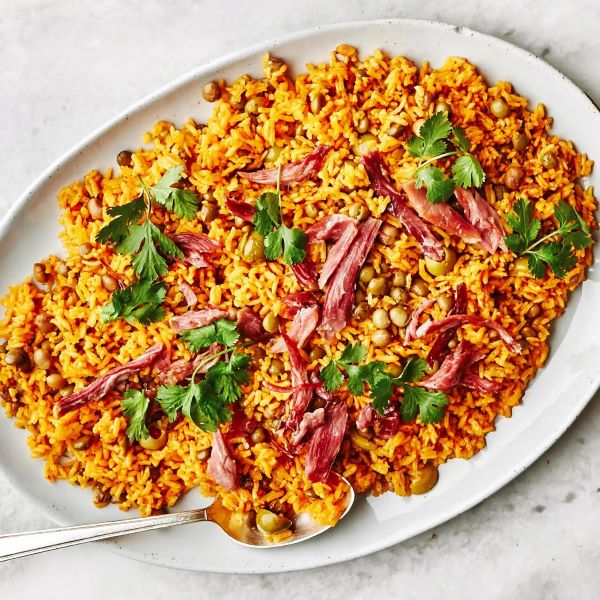
Arroz con gandules is the national rice dish of Puerto Rico, which is saying something significant in a country where rice appears at nearly every meal. It is not just rice with pigeon peas added, which is what a mediocre version produces. At its best, arroz con gandules is a deeply flavored, cohesive dish where the rice, the pigeon peas, the sofrito, the sazon, and the recao all combine into something that tastes unified rather than assembled.
The bottom layer of rice, called pegao, which develops a slight crust from the steam and residual heat at the end of cooking, is one of the most specifically prized elements of the dish for Puerto Ricans who grew up eating it. Finding the best arroz con gandules near me means knowing which restaurants make it with the full traditional sofrito base and understand that the pegao is not a mistake but a goal.
What Arroz con Gandules Actually Is
Gandules are pigeon peas, a small legume widely grown in the Caribbean and central to Puerto Rican cooking. They can be used fresh, dried, or most commonly from canned in their cooking liquid, which adds flavor to the rice as it cooks. The peas have a slightly earthy, nutty flavor with a firmer texture than black beans or kidney beans, and they hold their shape through the cooking process.
The rice preparation begins with a sofrito cooked in olive oil or lard until fragrant and slightly concentrated. The sofrito for arroz con gandules uses the same recao, aji dulce, garlic, onion, and tomato base found throughout Puerto Rican cooking. Sazon, the seasoning blend of garlic, cumin, coriander, annatto, and other spices sold in packets, goes in to add both flavor and the characteristic orange-yellow color of the finished rice. Tomato sauce, olives, and sometimes ham or bacon add additional depth.
The gandules and their liquid go in with the rice, along with water or stock to make up the remaining cooking liquid. The pot is covered and the rice cooks on low heat until the liquid is fully absorbed. In the final minutes of cooking, the heat may be allowed to build slightly to develop the pegao, the crust of slightly toasted rice that forms at the bottom of the pot.
The pegao is scraped from the bottom of the pot when serving and distributed among the plates. It has a slightly crispy, toasted quality and an intensified concentration of the sofrito and sazon flavors from proximity to the heat. Not every version produces a pegao, but a kitchen that allows it to develop and serves it is treating the dish with the appreciation it deserves.
When you search for the best arroz con gandules near me, the recao sofrito flavor running through the rice, the proper orange-yellow color from the sazon and annatto, and ideally the presence of pegao are the markers of a kitchen making it with full traditional technique.
Where to Find It
Puerto Rican restaurants carry arroz con gandules as a permanent side dish or as a component of combination plates. It is so fundamental to Puerto Rican cooking that a restaurant without it on the menu is not a comprehensive Puerto Rican restaurant.
Puerto Rican fondas and casual home-style restaurants in cities with Puerto Rican communities serve arroz con gandules as part of their daily rotating plate offerings. The quality at these informal restaurants tends to be high because the dish is made in volume for a community that will notice if it is not made properly.
Puerto Rican home cooks and community vendors selling through Instagram and Facebook batch orders include arroz con gandules as one of the most frequently requested items. Home cooks who make it with the full sofrito base and who develop a pegao at the bottom of the pot produce versions that are often better than restaurant production at scale.
Latin American restaurants with Puerto Rican ownership or significant Puerto Rican menu representation sometimes carry arroz con gandules as a permanent side option. Any restaurant that lists it alongside pernil, mofongo, and tostones is operating with enough Puerto Rican culinary knowledge to make it properly.
How to Search More Effectively
A direct search for the best arroz con gandules near me will surface Puerto Rican restaurants in your area. Here is how to find the ones making it with full traditional technique:
Search Google Maps for Puerto Rican restaurant in your city and browse menus for arroz con gandules. A menu that lists it as a permanent side dish or as part of a combination plate is making a commitment to having it consistently available and properly prepared.
Search Yelp for Puerto Rican restaurants and read reviews that describe the rice specifically. Reviewers who know arroz con gandules will mention whether the sofrito flavor was present, whether the rice was properly colored, and whether there was a pegao at the bottom. This level of specific detail confirms a reviewer who knows the dish and whose assessment is worth trusting.
Search Instagram with “arroz con gandules” plus your city name. Puerto Rican restaurant accounts and home cook vendors post photos of this dish, and the distinctive orange-yellow rice with visible gandules and sometimes a dark-edged pegao portion on the side is recognizable in a food photo.
Search Facebook for Puerto Rican community groups in your city and ask where to find the best arroz con gandules. Puerto Ricans are specific about which local restaurant or home cook makes the rice with a proper recao sofrito and develops a pegao, and they will give direct recommendations.
What Good Arroz con Gandules Should Look Like
Once you find a source, a few things confirm the quality.
The color. Orange-yellow throughout the rice from the sazon and annatto, uniform rather than patchy. The color indicates the sazon was distributed evenly during cooking. A pale or white rice with gandules added afterward was not cooked with the full sofrito and sazon base.
The grain texture. Separate but cohesive, with each grain fully cooked and slightly sticky from the natural starch of the cooking process. The grains should not be mushy or clumped into a solid mass. A properly made arroz con gandules holds together when scooped but the individual grains are still distinguishable.
The sofrito flavor. Present throughout the rice, not just at the surface. The recao and aji dulce from the sofrito should be perceptible as an herbal, slightly sweet background note in every bite. Rice that tastes only of sazon coloring and plain grain without sofrito depth indicates the sofrito was insufficient or omitted.
The gandules. Distributed evenly through the rice, fully cooked and tender but holding their shape. The pigeon peas should have absorbed some of the sofrito and sazon flavor from the cooking liquid. Plain-tasting gandules that have not absorbed any of the rice cooking flavors were either added too late or cooked separately without the flavor integration.
The pegao. If present, slightly toasted, slightly crispy, and deeply flavored with a concentrated version of the sofrito and sazon. Not every serving will include pegao, but asking the server or cook whether it is available is worth doing.
Ordering and Eating Tips
Order arroz con gandules as a side dish to accompany pernil, pollo guisado, or any other traditional Puerto Rican main. It is designed as a supporting element of a complete Puerto Rican plate rather than a standalone dish, and eating it in this context provides the intended flavor balance.
Ask specifically whether the kitchen produces a pegao and whether it is available. Not every serving will include it, but many Puerto Rican restaurants and home cooks will set aside pegao portions for customers who specifically ask. This is considered a special request that is honored when possible.
Eat the gandules together with the rice in each bite rather than picking through the rice for them. The combination of the seasoned rice with the slightly earthy pigeon pea in the same spoonful is the intended eating experience.
If ordering a combination plate, choose the pernil or pollo guisado as the protein alongside. Both have braising juices that mix with the arroz con gandules in an adjacent serving in a way that ties the entire plate together.
Pricing Expectations
Arroz con gandules as a side dish at a Puerto Rican restaurant typically runs between $4 and $8. As a component of a combination plate, it is included in the main course price of $14 to $24. Home cook and vendor versions sold as part of a prepared meal package are included in the overall plate price rather than sold separately.
Key Takeaways
- The best arroz con gandules near me is most reliably found at Puerto Rican fondas and traditional restaurants with comprehensive menus and through Puerto Rican home cook vendors who make the full recao sofrito base and develop a pegao at the bottom of the pot.
- Arroz con gandules uses a recao and aji dulce sofrito base with sazon and annatto for color, cooked together with pigeon peas and rice until unified and deeply flavored. The orange-yellow color and the sofrito flavor throughout the rice confirm proper preparation.
- The pegao, the slightly crispy toasted rice at the bottom of the pot, is the most prized element for Puerto Rican cooks and eaters. Ask specifically whether it is available.
- Pale, colorless rice with gandules added afterward was not made with the full sofrito and sazon base. Color uniformity and sofrito flavor throughout confirm proper technique.
- Search Instagram with “arroz con gandules” plus your city name and check Puerto Rican community Facebook groups for specific restaurant and home cook recommendations.
- Eat alongside pernil or pollo guisado as part of a complete Puerto Rican plate for the intended flavor balance.
- Expect to pay $4 to $8 as a side dish and $14 to $24 for a full combination plate that includes arroz con gandules.