If you’ve been searching for professional teeth whitening near me, you’re likely weighing it against the convenience of over-the-counter whitening strips and gels, and trying to figure out whether the higher cost is genuinely worth it. Finding professional teeth whitening near me that fits both your budget and your dental needs requires understanding a few key differences first. This guide covers what professional whitening actually involves, how it differs from at-home options, and what to look for when choosing a provider.
What Counts as Professional Teeth Whitening?
Professional teeth whitening refers to whitening treatments performed or directly supervised by a licensed dental professional, typically using higher-concentration whitening agents than what’s available in over-the-counter products. This generally falls into two main categories: in-office whitening, completed in a single dental office visit using a stronger bleaching gel often activated with a specialized light, and professionally dispensed take-home kits, which use custom-fitted trays and a prescription-strength whitening gel applied at home over a series of days.
Both approaches differ meaningfully from drugstore whitening strips and generic whitening toothpaste, primarily in the concentration of the active whitening ingredient (typically hydrogen peroxide or carbamide peroxide) and the level of professional oversight involved in application.
In-Office Professional Whitening: What to Expect
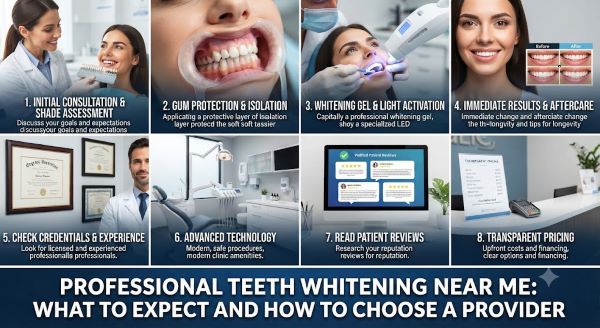
When you search for professional teeth whitening near me and book an in-office appointment, the process typically follows a fairly consistent structure across most dental practices.
Initial assessment. The dentist or hygienist examines your teeth and gums to confirm you’re a good candidate for whitening, checking for any cavities, gum disease, or sensitivity issues that should be addressed before proceeding with a whitening treatment.
Protective preparation. A barrier gel or rubber dam is applied to protect your gums and soft tissue from the whitening agent, since the gel used in professional treatments is significantly stronger than over-the-counter products and can cause irritation if it contacts gum tissue directly.
Application of the whitening gel. A high-concentration hydrogen peroxide gel, typically in the range of 25% to 40% concentration, is applied directly to the teeth.
Activation (in some systems). Certain professional whitening systems use a specialized LED or laser light to activate and accelerate the whitening process, though research on how much this light activation actually improves results beyond the gel alone remains somewhat mixed, and not all reputable whitening systems use this step.
Multiple application cycles. The gel is typically left on for a set period, removed, and reapplied for several cycles during a single appointment, with the entire in-office process usually taking 60 to 90 minutes total.
Results from in-office professional whitening are typically immediate and noticeable right after the appointment, often achieving several shades of improvement in a single visit, which is one of the primary appeals compared to the more gradual results from at-home whitening methods.
Take-Home Professional Whitening Kits
The second major category you’ll encounter when searching for professional teeth whitening near me involves custom take-home kits dispensed by a dental office.
This typically starts with a dental visit where impressions of your teeth are taken to create custom-fitted whitening trays designed specifically for your mouth, offering significantly better gel coverage and fit compared to the generic one-size-fits-all trays included in over-the-counter kits. The dentist then provides a prescription-strength whitening gel, generally lower in concentration than what’s used for in-office treatment but still considerably stronger than drugstore products, along with specific instructions on how long to wear the trays each day and for how many days or weeks to continue the treatment.
Results from take-home professional kits develop more gradually than in-office treatment, typically over one to two weeks, but the custom-fitted trays and professional-strength gel generally produce more even, consistent results than over-the-counter alternatives.
How Professional Whitening Compares to Over-the-Counter Options
Concentration and effectiveness. Professional whitening products use meaningfully higher concentrations of active whitening ingredients than over-the-counter products are legally permitted to contain, which is the primary driver of professional whitening’s typically faster and more dramatic results.
Custom fit. Professionally fitted trays, used in take-home kits, provide more even gel distribution across all tooth surfaces compared to generic strips or trays, reducing the uneven, patchy whitening results that sometimes occur with over-the-counter products.
Safety oversight. A dental professional can identify issues like cavities, exposed roots, or existing dental work (crowns, veneers, fillings) that won’t respond to whitening the same way as natural enamel, and can adjust the treatment approach accordingly, an assessment that’s simply not available when using an over-the-counter product without professional guidance.
Cost. Professional teeth whitening is significantly more expensive than over-the-counter options, with in-office treatments commonly ranging from $300 to $1,000 depending on the specific system used and geographic location, while take-home professional kits typically fall somewhere between $150 and $400, compared to over-the-counter strips that generally cost $20 to $60.
How to Find a Qualified Provider
Search through your existing dentist first. If you have a regular dentist, asking directly about their professional teeth whitening near me options is often the most straightforward starting point, since they already have your dental history and can advise on whether whitening is appropriate given your specific oral health.
Check for licensed dental professionals specifically. Some non-dental businesses, including certain spas and standalone whitening kiosks, offer whitening services using lower-regulation products and without licensed dental oversight. While these can be less expensive, they lack the professional assessment and higher-concentration products that define genuine professional teeth whitening, and the lack of professional oversight is a meaningful trade-off worth considering.
Read reviews specifically mentioning whitening results and professionalism. General dental practice reviews don’t always speak specifically to cosmetic whitening quality, so looking for reviews that mention whitening treatments specifically provides more relevant information than overall practice ratings alone.
Ask about the specific system used. Reputable dental practices can explain which whitening system they use (Zoom, Opalescence, Philips Zoom, and similar branded professional systems are common examples) and the expected results and any associated costs clearly before you commit to treatment.
Who Should Avoid Professional Teeth Whitening
Professional whitening isn’t appropriate for everyone. Pregnant or breastfeeding individuals are generally advised to postpone whitening treatments as a precaution, even though definitive research on risk during this period remains limited. People with significant untreated tooth decay, gum disease, or very sensitive teeth should address these underlying issues before pursuing whitening, since the treatment can exacerbate sensitivity or irritate already compromised gum tissue. Whitening also doesn’t affect crowns, veneers, fillings, or other existing dental work, meaning anyone with significant visible dental restorations on front teeth may end up with a noticeable color mismatch between natural teeth and existing dental work after whitening, a consideration worth discussing with your dentist before proceeding.
Key Takeaways
- Professional teeth whitening near me searches typically lead to two main options: in-office treatment with immediate, dramatic results in a single visit, and custom take-home kits that develop results gradually over one to two weeks.
- In-office treatment uses high-concentration hydrogen peroxide gel (often 25% to 40%) applied by a dental professional, with protective measures in place to shield gums from the strong whitening agent.
- Take-home professional kits use custom-fitted trays, created from dental impressions, paired with prescription-strength gel that’s stronger than over-the-counter products but milder than in-office treatments.
- Professional whitening costs significantly more than over-the-counter options, generally $300 to $1,000 for in-office treatment and $150 to $400 for take-home kits, compared to $20 to $60 for drugstore strips.
- Asking your existing dentist about their whitening options is often the most straightforward way to find a qualified provider, since they already have your relevant dental history.
- Whitening services offered without licensed dental oversight, such as some standalone kiosks or spas, lack the professional assessment and higher-concentration products that define genuine professional whitening.
- Whitening doesn’t affect crowns, veneers, or fillings, which can create a noticeable color mismatch with surrounding natural teeth, a factor worth discussing with your dentist beforehand if you have visible dental restorations.
- Existing dental issues like cavities, gum disease, or significant tooth sensitivity should generally be addressed before pursuing professional whitening treatment.