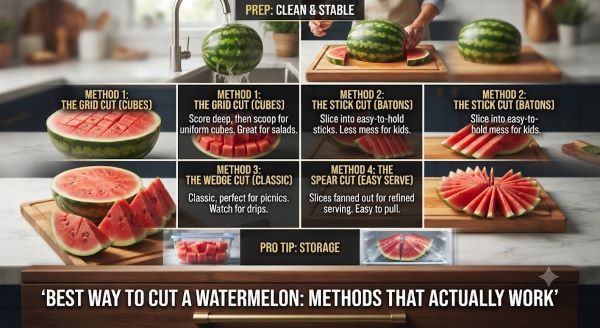
Cutting a watermelon seems simple until you’re actually staring at a 15-pound fruit on your cutting board wondering where to start. Knowing the best way to cut a watermelon depends on what you’re using it for, whether that’s a quick snack, a fruit salad, a party platter, or simply the easiest way to portion it for storage. This guide covers several reliable methods, each suited to a different end goal.
Choosing the Right Knife
Before getting into specific cutting methods, the right tool matters significantly. A large, sharp chef’s knife, ideally 8 inches or longer, is essential for cutting through a watermelon’s thick rind efficiently and safely. A dull knife requires more force to cut through the rind, which increases the risk of the knife slipping, making a sharp blade a genuine safety consideration rather than just a convenience factor.
The Best Way to Cut a Watermelon Into Classic Slices
This is the most traditional approach and works well for serving at a casual gathering where people will eat slices by hand.
Steps:
- Wash the watermelon thoroughly under running water and dry it, since the knife will pass through the rind and any surface bacteria can be transferred to the flesh during cutting.
- Place the watermelon on a large, stable cutting board, ideally one with a groove to catch juice, or place a towel underneath to absorb runoff.
- Cut the watermelon in half lengthwise, applying firm, even pressure with a rocking motion as the knife works through the thick rind.
- Place each half cut-side down for stability, then cut each half into individual slices, roughly 1 to 1.5 inches thick, working from one end to the other.
- For a more refined presentation, you can also cut each half into quarters lengthwise first, then slice each quarter crosswise into triangular pieces.
The Best Way to Cut a Watermelon Into Cubes
Cubed watermelon is ideal for fruit salads, skewers, or simply easier eating with a fork, particularly for younger children or anyone who prefers not to eat directly off the rind.
Steps:
- Cut the watermelon in half, then cut each half into thick slices as described above.
- Stand each slice on its rind edge for stability.
- Cut the flesh away from the rind in one motion, running the knife along the curve of the rind to remove it in a single piece, leaving a flat slab of flesh.
- Cut the flesh slab into strips, then rotate and cut crosswise to create even cubes.
- Repeat for each slice until the entire watermelon has been cubed.
This method is widely considered the best way to cut a watermelon when the goal is uniform, ready-to-eat pieces with no rind for storage in the refrigerator or for serving in a bowl.
The Watermelon Stick Method
This is a particularly clever and increasingly popular approach, well suited to large gatherings or for kids who find watermelon easier to eat as a handheld stick rather than loose cubes or slices.
Steps:
- Cut the watermelon in half, then cut each half into thick slices.
- Stand each slice on its rind edge.
- Without removing the rind, make a series of parallel vertical cuts through the flesh down to (but not through) the rind, spaced about 1 inch apart, creating a row of sticks still attached to the base.
- Rotate the slice 90 degrees and repeat the parallel cuts, creating a grid pattern.
- The sticks can then be popped off the rind individually for eating, or the entire grid can be served on the rind as a presentation piece that guests pick from directly.
This approach is genuinely one of the best ways to cut a watermelon for a party setting, since it requires no additional bowls or plates and lets people grab pieces directly.
How to Cut a Seedless Watermelon vs. a Seeded One
Most watermelons sold in grocery stores today are seedless varieties, technically containing small, soft, white seed coats rather than the larger black seeds found in traditional seeded watermelons. These soft white seed coats are edible and don’t require any special removal during cutting.
If working with a traditional seeded watermelon, the cutting process remains largely the same, though you may want to cut slightly thinner slices to make seed removal easier, or simply plan to pick out visible black seeds after slicing rather than trying to avoid them during the cutting process itself, since watermelon seeds are distributed somewhat randomly throughout the flesh and can’t be reliably avoided through cutting technique alone.
Storing Cut Watermelon
Once cut, watermelon should be refrigerated and is best consumed within three to five days for optimal flavor and texture, since the flesh continues to lose moisture and can develop an unpleasant mealy texture if stored too long after cutting. Storing cut watermelon in an airtight container, rather than loosely wrapped, helps preserve freshness and prevents the fruit from absorbing other odors from the refrigerator. If you’ve used the stick or slice method and want to store the watermelon with the rind still attached for later cutting, wrapping the cut surface tightly in plastic wrap before refrigerating helps maintain freshness for a slightly longer period than fully cubed fruit.
A Faster Method for Quick Snacking
If you don’t need a polished presentation and simply want fast access to watermelon for a quick personal snack, cutting the watermelon into quarters lengthwise and then scooping out bite-sized pieces with a melon baller or large spoon directly from the rind is one of the fastest, lowest-effort approaches available, requiring minimal cutting board cleanup and no need to remove the rind entirely before eating.
Key Takeaways
- The best way to cut a watermelon depends on your end goal: classic slices for casual hand-eating, cubes for fruit salads and easier eating with utensils, or the stick method for parties and easy grab-and-go snacking.
- A large, sharp chef’s knife is essential for safely and efficiently cutting through a watermelon’s thick rind, reducing the risk of slipping that comes with using a dull blade.
- The cube method involves removing the flesh from the rind in slabs before cutting into uniform pieces, making it the best way to cut a watermelon for refrigerator storage or bowl-style serving.
- The watermelon stick method, cutting a grid pattern into the flesh while it’s still attached to the rind, is particularly well suited to parties and kids, since pieces can be popped off individually with no separate plates needed.
- Seedless watermelons contain small, soft, edible white seed coats rather than large black seeds, requiring no special removal technique during cutting.
- Cut watermelon should be stored in an airtight container and consumed within three to five days for the best flavor and texture.
- For traditional seeded watermelon, slightly thinner slices make manual seed removal easier after cutting, since seeds are distributed too randomly to avoid entirely through cutting technique.
- For the fastest possible access without a polished presentation, cutting into quarters and scooping bite-sized pieces directly from the rind with a spoon or melon baller minimizes both cutting time and cleanup.