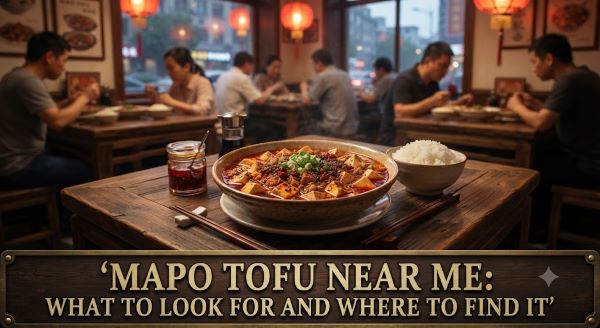
Mapo tofu has become one of the most ordered Sichuan dishes outside of China, but the gap between an authentic, properly spiced version and a watered-down American-Chinese adaptation is significant. If you have been searching for mapo tofu near me, knowing what defines the real dish helps you tell the difference before you order, and helps you find restaurants that are actually taking the dish seriously.
What Is Mapo Tofu?
Mapo tofu is a Sichuan dish made from soft tofu set in a spicy, numbing sauce built from fermented broad bean paste (doubanjiang), fermented black beans (douchi), Sichuan peppercorns, chili oil, and typically ground pork or beef. The name translates roughly to “pockmarked grandmother’s tofu,” referring to the legendary origin story of an elderly woman with a pockmarked face who is said to have created the dish in Chengdu in the nineteenth century.
The defining characteristic of authentic mapo tofu is mala, the combination of “ma” (the tongue-numbing sensation from Sichuan peppercorns) and “la” (spicy heat from chili). This numbing-spicy combination is unique to Sichuan cuisine and is what separates genuinely authentic mapo tofu from versions that are simply spicy without the characteristic numbing element.
What Makes a Great Mapo Tofu
When searching for mapo tofu near me, these elements indicate a kitchen taking the dish seriously rather than serving a simplified, Americanized version.
The numbing element (ma). Genuine mapo tofu should produce a noticeable tingling, numbing sensation on the tongue and lips from Sichuan peppercorns (huajiao), distinct from the burning sensation of chili heat. If a restaurant’s mapo tofu is only spicy without any numbing quality, the dish is likely made without proper Sichuan peppercorn or with too little to register.
The fermented bean paste base. Doubanjiang, a fermented broad bean and chili paste, provides the foundational savory depth and reddish color of the sauce. A version made without proper doubanjiang, substituting a generic chili sauce instead, lacks the complex, fermented depth that defines the dish’s flavor profile.
The tofu texture. Soft or silken tofu is traditional, and it should hold its shape in the sauce without falling apart into mush, while still being notably softer and more delicate than the firmer tofu used in many other Chinese dishes. Overcooked tofu becomes spongy and loses the silky texture that’s central to the dish’s appeal.
The ground meat. Traditional mapo tofu uses a relatively small amount of ground pork or beef, browned until slightly crispy at the edges, providing texture contrast and savory depth without overwhelming the tofu, which should remain the star of the dish.
The sauce consistency. A properly made sauce should be glossy, slightly thickened, and coat the tofu and rice without being either watery or excessively starchy and gluey.
Where to Find Authentic Mapo Tofu Near Me
Sichuan-specific restaurants. This is the most reliable source. Restaurants that specifically identify as Sichuan cuisine, rather than general Chinese-American restaurants, are significantly more likely to use proper doubanjiang and genuine Sichuan peppercorns rather than simplified substitutes designed to appeal to a broader, spice-averse customer base.
Restaurants in or near Chinatown districts. Larger Chinatown neighborhoods in cities with significant Chinese immigrant populations tend to have a higher concentration of regionally specific restaurants, including dedicated Sichuan establishments, compared to suburban Chinese-American restaurants serving a more generalized menu.
Cities with strong Sichuan restaurant scenes. Los Angeles (particularly the San Gabriel Valley), San Francisco, New York (Flushing in Queens), and Houston all have well-established communities with strong concentrations of authentic Sichuan restaurants, significantly increasing your odds of finding well-executed mapo tofu near me.
Restaurants that explicitly mention Sichuan peppercorn or “mala” on their menu. A menu description that specifically references mala, Sichuan peppercorn, or doubanjiang is a positive signal that the kitchen understands and is committed to the dish’s authentic flavor profile, as opposed to a generic listing that simply says “spicy tofu.”
How to Tell If a Restaurant’s Version Is Authentic Before Ordering
A few questions and observations can help you gauge authenticity before committing to an order. Asking the server directly whether the dish includes Sichuan peppercorn, and whether it produces the characteristic numbing sensation, is a reasonable and increasingly common question at restaurants familiar with diners specifically seeking the authentic version. Checking online reviews specifically for mentions of “numbing,” “mala,” or “authentic” rather than just “spicy” can help filter out restaurants serving a simplified adaptation. Restaurants with a broader Sichuan menu beyond just mapo tofu, including dishes like dan dan noodles, kung pao chicken made with proper Sichuan peppercorn, or water-boiled fish (shuizhu), tend to have the ingredient sourcing and kitchen expertise to execute mapo tofu authentically as well.
How to Search Effectively
If a direct search for mapo tofu near me doesn’t return strong results, try these alternative approaches:
- Search “Sichuan restaurant near me” rather than the dish name alone, since this surfaces restaurants more likely to execute the dish authentically.
- Search “mala tofu near me” or “Sichuan tofu near me,” which sometimes returns different and more specifically relevant results.
- Check Chinese food delivery apps and platforms that cater specifically to Chinese cuisine, which sometimes list restaurants and dishes that don’t appear prominently on broader platforms like Yelp or Google.
Key Takeaways
- Mapo tofu near me searches should prioritize restaurants specifically identifying as Sichuan cuisine, since authentic versions require proper doubanjiang and Sichuan peppercorn that general Chinese-American restaurants often substitute or omit.
- The defining characteristic of authentic mapo tofu is mala, the combination of numbing Sichuan peppercorn and spicy chili heat, distinct from dishes that are simply spicy without the numbing element.
- Soft or silken tofu, a glossy and properly thickened sauce, and lightly browned ground pork or beef are all signs of a well-executed, traditional preparation.
- Cities with strong Sichuan restaurant scenes, including Los Angeles’s San Gabriel Valley, San Francisco, and Flushing in New York, offer the best access to authentic mapo tofu.
- Menu descriptions specifically mentioning mala, Sichuan peppercorn, or doubanjiang are positive signals of a kitchen committed to authenticity rather than a simplified adaptation.
- Restaurants offering a broader authentic Sichuan menu, including dishes like dan dan noodles and water-boiled fish, generally have the ingredient sourcing and expertise to execute mapo tofu well too.
- Checking reviews for mentions of “numbing” or “mala” specifically, rather than just “spicy,” helps filter genuinely authentic restaurants from simplified versions.
- If a direct search doesn’t surface useful results, searching “Sichuan restaurant near me” or “mala tofu near me” often produces more relevant results than the dish name alone.