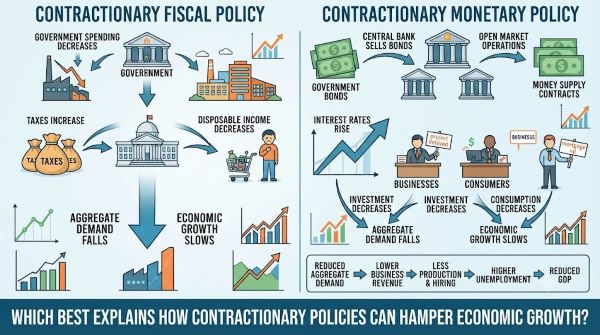
If you have encountered the question “which best explains how contractionary policies can hamper economic growth” in an economics course or standardized test, the answer requires understanding the specific mechanism by which reducing money supply or government spending slows down economic activity. This guide breaks down exactly how contractionary policy works, why it can hamper growth, and the statement that most accurately captures that relationship.
What Are Contractionary Policies?
Contractionary policies are deliberate actions taken by a government or central bank to slow down economic activity, typically used to control inflation when an economy is growing too quickly or overheating. There are two main types:
Contractionary monetary policy involves a central bank (in the US, the Federal Reserve) raising interest rates, increasing reserve requirements for banks, or selling government securities to reduce the amount of money circulating in the economy.
Contractionary fiscal policy involves the government reducing its own spending, increasing taxes, or both, which reduces the amount of money flowing through the economy from government programs and reduces disposable income available to consumers and businesses.
Both types of contractionary policy share the same underlying goal: reducing the total amount of money available for spending and borrowing in order to slow inflation, which occurs when too much money is chasing too few goods and services.
Which Best Explains How Contractionary Policies Can Hamper Economic Growth?
The statement that best explains this relationship is:
“Contractionary policies reduce the money supply and increase borrowing costs, which decreases consumer spending and business investment, slowing overall economic activity.”
This is the core mechanism. When interest rates rise, borrowing becomes more expensive for both consumers and businesses. Consumers take out fewer loans for major purchases like homes and cars. Businesses delay or cancel plans to expand, hire new employees, or invest in new equipment because the cost of financing those investments has increased. As both groups pull back on spending and investment, overall economic activity slows.
A correct answer to which best explains how contractionary policies can hamper economic growth needs to include the chain reaction: reduced money supply or higher rates leads to reduced borrowing and spending, which leads to reduced business activity and potentially reduced employment, which together slow GDP growth.
The Mechanism Step by Step
Understanding the full chain of cause and effect makes it easier to recognize correct answers on this topic and to explain the concept clearly.
Step 1: The central bank or government takes contractionary action. This could be raising the federal funds rate, selling government bonds to reduce money in circulation, cutting government spending programs, or raising taxes.
Step 2: Borrowing becomes more expensive or available money decreases. Higher interest rates directly raise the cost of mortgages, auto loans, credit card debt, and business loans. Reduced money supply makes credit generally tighter and harder to access even at the same nominal rate.
Step 3: Consumers and businesses reduce spending. Faced with higher borrowing costs, consumers delay large purchases. Businesses postpone expansion plans, equipment purchases, and hiring, since the return on investment now needs to clear a higher cost-of-capital hurdle to be worthwhile.
Step 4: Aggregate demand decreases. With both consumer spending and business investment pulling back simultaneously, total demand for goods and services in the economy falls.
Step 5: Economic growth slows. Lower aggregate demand means businesses sell less, which can lead to reduced production, slower hiring or layoffs, and in more severe cases, recession. GDP growth slows or, if the contraction is significant enough, turns negative.
This five-step chain is what underlies any correct answer to which best explains how contractionary policies can hamper economic growth.
Why Governments and Central Banks Use Contractionary Policy Anyway
It might seem counterproductive to deliberately slow economic growth, but contractionary policy exists specifically to address a different problem: inflation. When an economy grows too fast, demand can outpace the supply of goods and services, pushing prices up rapidly. Left unchecked, high inflation erodes purchasing power, distorts long-term planning for both households and businesses, and can become self-reinforcing if people expect continued price increases and adjust their behavior accordingly.
Contractionary policy is essentially a trade-off: accepting slower growth, and sometimes higher unemployment, in exchange for controlling inflation and preventing more severe long-term economic damage. Central banks in particular are often willing to accept short-term pain from slower growth if it prevents inflation from becoming entrenched.
Common Wrong Answers on This Type of Question
When working through which best explains how contractionary policies can hamper economic growth in a multiple-choice format, certain incorrect answer patterns appear consistently.
Wrong: “Contractionary policies increase the money supply.” This describes expansionary, not contractionary, policy. Contractionary policy decreases the money supply or makes borrowing more expensive.
Wrong: “Contractionary policies directly cause businesses to close.” While severe or prolonged contractionary policy can contribute to business struggles, the direct mechanism is reduced spending and investment, not an immediate, direct cause of business closure. This answer skips the actual causal chain.
Wrong: “Contractionary policies lower interest rates to control inflation.” This reverses the actual mechanism. Contractionary monetary policy raises interest rates; lowering rates is an expansionary action.
Wrong: “Contractionary policies increase government spending to stimulate the economy.” This describes expansionary fiscal policy. Contractionary fiscal policy reduces government spending.
A correct answer will always describe higher costs or reduced money availability leading to reduced spending and investment, not the reverse.
A Real-World Example
The Federal Reserve’s response to high inflation in 2022 and 2023 provides a clear real-world example of this mechanism in action. The Fed raised the federal funds rate multiple times over a relatively short period to combat inflation that had reached its highest level in roughly four decades.
As borrowing costs rose, mortgage rates climbed significantly, which slowed home buying and construction activity. Business borrowing for expansion became more expensive, which contributed to more cautious hiring and investment decisions across many sectors. This combination of effects is a textbook illustration of which best explains how contractionary policies can hamper economic growth: higher rates led directly to reduced borrowing, reduced spending, and a deliberate cooling of overall economic activity, with the explicit goal of bringing inflation back under control.
Fiscal Versus Monetary Contractionary Policy: A Quick Comparison
| Policy Type | Tool Used | Direct Effect | Result |
|---|---|---|---|
| Monetary | Raising interest rates | Borrowing becomes more expensive | Reduced consumer and business spending |
| Monetary | Selling government securities | Money supply decreases | Tighter credit conditions |
| Fiscal | Cutting government spending | Less money flows into the economy | Reduced overall demand |
| Fiscal | Raising taxes | Reduced disposable income | Lower consumer spending |
Key Takeaways
- Which best explains how contractionary policies can hamper economic growth comes down to one core mechanism: reduced money supply or higher borrowing costs lead to reduced consumer spending and business investment, which slows overall economic activity.
- Contractionary monetary policy works through raising interest rates or reducing money supply, making borrowing more expensive for consumers and businesses.
- Contractionary fiscal policy works through reduced government spending or higher taxes, which reduces the amount of money flowing through the economy.
- The full causal chain runs from policy action, to higher borrowing costs or reduced money availability, to reduced spending and investment, to lower aggregate demand, to slower GDP growth.
- Governments and central banks accept the trade-off of slower growth specifically to control inflation, which causes its own significant economic damage if left unaddressed.
- Common wrong answers reverse the mechanism, describing expansionary policy actions (increasing money supply, lowering rates, increasing spending) rather than the actual contractionary mechanism.
- The Federal Reserve’s interest rate increases in 2022 and 2023 to combat high inflation provide a clear, recent real-world example of this exact mechanism in action.
- Recognizing which best explains how contractionary policies can hamper economic growth on an exam requires identifying the answer that includes the full chain: tighter money or higher costs leading to reduced spending and slower growth, not just one isolated step in that process.