Incident coordination is one of those terms that gets used broadly in emergency management, cybersecurity, and organizational response frameworks without always being defined precisely. When you encounter the question “which one of the following activities is not an example of incident coordination,” the answer depends on knowing what incident coordination actually covers and, just as importantly, what it does not. It is a question that shows up in FEMA courses, ICS training, and professional emergency management certifications, and getting it right requires more than intuition.
This guide breaks down the core activities that fall within incident coordination, identifies what commonly gets confused with it, and explains how to distinguish between them clearly.
What Is Incident Coordination?
Incident coordination is the organized process of managing communication, resources, and decision-making across multiple parties during an incident. An incident can be an emergency, a cybersecurity event, a public health crisis, a natural disaster, or any situation that requires a structured, multi-party response.
The goal of incident coordination is to ensure that the right people have the right information at the right time, that resources are allocated without duplication or gaps, and that decisions are made through clear chains of authority rather than in isolation.
Incident coordination frameworks include FEMA’s National Incident Management System (NIMS), the Incident Command System (ICS), and various cybersecurity incident response frameworks used by organizations and government agencies.
Activities That Are Examples of Incident Coordination
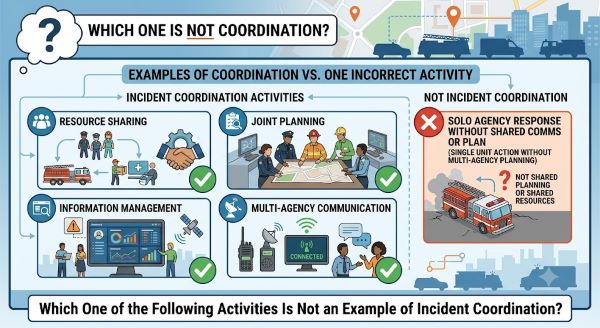
To answer which one of the following activities is not an example of incident coordination, you first need to know what is included, and then recognize the activities that sit outside those boundaries. The following activities are all genuine examples of incident coordination:
Establishing and maintaining communication between response teams. Coordination depends on information flowing between parties. Setting up joint communication channels, situation reports, and briefing schedules are core coordination activities.
Activating an Emergency Operations Center (EOC). An EOC is the centralized hub where incident coordination takes place. Activating it is itself a coordination action.
Conducting joint briefings and situation awareness updates. Sharing current incident status across agencies, departments, or teams is a foundational coordination activity. Without shared situational awareness, independent groups cannot coordinate effectively.
Requesting and allocating resources across agencies. Coordinating the deployment of personnel, equipment, and supplies across organizational boundaries is one of the primary functions of incident coordination. This includes mutual aid agreements and resource tracking.
Establishing unified command. In multi-agency incidents, unified command brings together leadership from each organization into a single command structure. This is a textbook coordination mechanism.
Developing and communicating the Incident Action Plan (IAP). An IAP defines objectives, tactics, and resource assignments for a given operational period. Creating and distributing it is a core coordination task.
Coordinating public information and messaging. Ensuring that public communications are consistent across agencies and do not contradict each other is part of incident coordination, particularly in large-scale events.
Activities That Are NOT Examples of Incident Coordination
The following activities are commonly confused with incident coordination but fall outside its scope:
Conducting the initial response to an incident. Taking direct action to address an incident (putting out a fire, treating a patient, patching a vulnerability) is incident response, not incident coordination. Coordination supports and organizes response; it does not replace it.
Performing a post-incident audit or after-action review independently. After-action reviews that happen in isolation within a single agency without cross-agency input are internal evaluation activities, not coordination. Coordination requires involvement of multiple parties.
Developing long-term mitigation strategies. Mitigation is a pre-incident planning function focused on reducing future risk. It is part of emergency management broadly but is not incident coordination, which is specifically active during and immediately after an incident.
Training individual personnel on incident procedures. Training is a preparedness activity. It builds capacity for future coordination but is not itself coordination. Running a tabletop exercise involves coordination elements, but standard unit-level training does not.
Conducting independent investigations. An investigation carried out by a single entity without coordination with other involved parties is not a coordination activity. Investigations may follow an incident, but they are distinct from the coordination function.
How to Answer This Question on an Exam or Training Assessment
When you see “which one of the following activities is not an example of incident coordination” in a FEMA course, ICS training, or professional certification, the structure of the answer choices matters. Look for the option that describes either a single-agency action with no multi-party element, a pre-incident planning function, or a post-incident activity conducted independently.
The distractor options in these questions are usually activities that sound related to incidents but lack the cross-agency, multi-party communication and resource-sharing element that defines coordination. Training, independent investigation, individual response actions, and long-term mitigation planning are the categories most commonly used as the “not an example” answer.
In FEMA IS courses specifically, incident coordination questions frequently use the following pattern: three answer choices describe multi-agency communication, resource sharing, or joint command activities, and one describes a single-organization function or a response action. The single-organization or response action is almost always the correct answer to “which one is not an example of incident coordination.”
Why the Distinction Matters
The reason this question appears in training and certification programs is that understanding what incident coordination is and is not helps responders avoid role confusion during actual incidents. When someone responsible for coordination starts acting as a direct responder, or when individual agencies begin making resource decisions without coordination, the entire response system becomes less effective.
Clear role definition between who is coordinating and who is executing is what allows large-scale incident response to function.
Key Takeaways
- Which one of the following activities is not an example of incident coordination is a question about recognizing the boundary between coordination, response, preparedness, and recovery functions.
- Answering which one of the following activities is not an example of incident coordination correctly requires knowing that the key feature of all coordination activities is multi-party involvement and shared decision-making.
- Incident coordination covers multi-party communication, joint command, resource allocation across agencies, shared situational awareness, and unified public messaging.
- Direct response actions (treating patients, fighting fires, patching systems) are incident response functions, not incident coordination.
- Training individual personnel is a preparedness activity, not coordination, even though training builds coordination capacity.
- Long-term mitigation planning is a pre-incident function that falls under preparedness and recovery, not coordination.
- Independent investigations and single-agency after-action reviews lack the multi-party element that defines coordination.
- On FEMA IS and ICS certification questions, the answer to which one of the following activities is not an example of incident coordination is typically the option that describes a single-organization action or a direct response activity rather than a cross-agency communication or resource-sharing function.
- Role clarity between coordination and response is a core principle of the Incident Command System and all frameworks built on it.