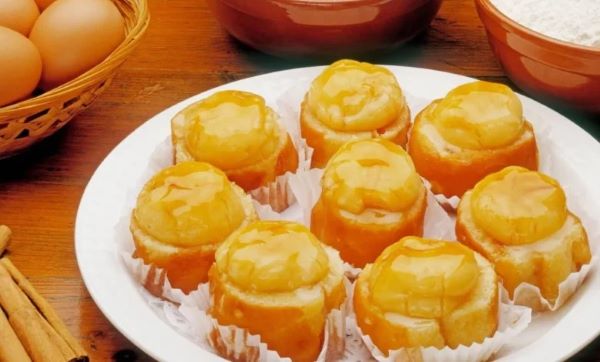
Piononos de Santa Fe are one of those regional pastries that people who have eaten them in the town of Santa Fe, just outside Granada in Andalusia, talk about with a specific kind of loyalty. They are small, scroll-shaped pastries made from a thin layer of rolled sponge cake soaked in syrup, formed into a cylinder, topped with a cream filling, and finished with a brief pass under the broiler or a kitchen torch that caramelizes the cream surface into something between a brulee and a meringue. They are not complicated. They are also very specific, and the versions that travel outside of their hometown are rarely as good as the original.
If you have been searching for the best piononos de santa fe near me, this guide gives you a realistic sense of where to look and what to expect.
What Piononos de Santa Fe Actually Are
The pionono is named after Pope Pius IX, whose Italian name was Pio Nono, likely as a tribute during his papacy in the mid-19th century when the pastry was reportedly created. The original pionono from Santa Fe, a small municipality in the province of Granada, is a precisely made small pastry that has become the defining product of that town. Bakeries in Santa Fe have been making them for generations and the pastry has protected status as a local specialty.
The construction involves a thin genoise-style sponge baked in a flat sheet, soaked in a simple syrup while still warm to keep it pliable, then rolled tightly around itself to form a small cylinder roughly the diameter of a large coin. The cylinder stands upright, and a rosette of cream or custard filling is piped onto the top surface. This filling is then caramelized briefly under intense heat, producing a surface that is browned and slightly firm on top while remaining soft and creamy underneath.
The flavor combination is of sweet, syrup-soaked sponge, slightly eggy cream, and burnt caramel. The texture combination is of moist, dense rolled cake against soft cream with a crisp caramel top. They are eaten in one or two bites and are typically sold by the unit at bakeries rather than served as a restaurant dessert course.
When you search for the best piononos de santa fe near me, understanding that this is a small, specific bakery item rather than a restaurant dessert helps you direct your search correctly.
Where to Find It
Spanish bakeries with Andalusian focus are the most likely source. A Spanish bakery that specifically carries Andalusian sweets and pastries rather than a generic selection of Spanish baked goods is more likely to carry piononos or a version of them. Look for bakeries that carry other Andalusian specialties like polvorones, mantecados, or pestiños alongside the pionono.
Spanish specialty food stores and delis in cities with Spanish communities sometimes import or carry piononos from Spanish producers. Pre-packaged versions are available from Spanish specialty food suppliers and while they do not match a freshly made pionono, they give you access to the product in cities without Spanish bakeries.
Spanish restaurants with dessert programs focused on regional pastries occasionally carry piononos as a dessert course or as a pastry offering. A restaurant that specifies Andalusian cooking or that emphasizes regional Spanish sweets is worth asking directly.
Spanish cultural events and food festivals sometimes feature vendors carrying piononos, particularly events organized by Andalusian communities or Spanish cultural associations that focus on representing specific regional traditions.
Online specialty food retailers that import Spanish food products carry piononos from Santa Fe bakeries in vacuum-sealed or controlled atmosphere packaging. For cities without any local Spanish bakery options, this is a practical way to access a version of the pastry that is reasonably close to the original, particularly from reputable Spanish food importers.
How to Search More Effectively
A direct search for the best piononos de santa fe near me will return very limited results in most cities outside of Spain. Here is how to search more productively:
Search Google Maps for Spanish bakery in your city and browse their product listings and photo sections. A bakery that posts photos of individual pastries and includes regional Andalusian items in their selection is worth contacting directly to ask whether they carry or can order piononos.
Search Instagram with “pionono santa fe” broadly to understand what they look like in photos, then add your city name to see whether any local posts exist. Spanish bakery accounts and food importers occasionally post piononos, and a local account doing so is worth following up with.
Search Facebook for Spanish community groups in your city and ask whether anyone knows where to find piononos. Members from Andalusia or Granada specifically will know what you are looking for and may point you to a bakery, home baker, or importer you would not find through standard searches.
Search online Spanish food retailers for pionono santa fe or piononos granada. Several Spanish specialty food importers ship to the United States and Europe and carry authentic products from the original Santa Fe bakeries. This is the most reliable way to access the real product outside of Spain.
What Good Piononos de Santa Fe Should Look Like
If you find a source, a few things confirm whether the product is made properly.
The shape. A tight, uniform cylinder of rolled sponge standing upright, not a loose roll or a flat pastry. The cylinder should hold its shape cleanly without unrolling or collapsing. The diameter should be consistent from top to bottom, indicating the sponge was rolled evenly before forming.
The sponge. Moist and slightly dense from the syrup soak, not dry or crumbly. The sponge should be pliable enough to have been rolled tightly without cracking. A dry sponge was either not soaked in enough syrup or was made with insufficient eggs for a proper genoise texture.
The cream. Present as a rosette or small mound on top of the cylinder, soft and slightly sweet with an eggy richness. The cream should be firmly enough piped to hold its shape before caramelization but soft enough to yield immediately when eaten.
The caramelized surface. Brown to dark brown on top, slightly firm when tapped, with a cracking quality similar to a thin brulee. This surface should be applied immediately before serving. A pionono whose top cream has softened back to uniform softness without any resistance was caramelized too far in advance.
The size. Small. A proper pionono from Santa Fe is a bite-sized or two-bite pastry, not a large individual dessert. Something significantly larger than this is not following the original format and will have a different texture ratio between cake and cream.
Ordering and Eating Tips
Piononos are eaten at room temperature or slightly cool, never refrigerator-cold. The cold dulls the syrup flavor in the sponge and makes the cream filling less soft and fragrant. If you receive them cold, allow 15 to 20 minutes before eating.
They are best eaten on the day they are made or purchased. The caramelized top softens as it sits and the sponge continues absorbing moisture from the cream, which changes the texture over time. A same-day pionono is noticeably better than a next-day one.
In Granada and Santa Fe, piononos are typically eaten with a small coffee as a mid-morning or afternoon snack. The sweetness of the pastry and the bitterness of a short espresso are a classic pairing. Applying this pairing when you find them outside of Spain gives you the intended eating context.
Order multiple if available. A single pionono is not a full dessert portion. Three to four is typical as a serving alongside coffee.
Pricing Expectations
Individual piononos at a Spanish bakery typically run between $2 and $5 each depending on the market and the bakery. At a Spanish restaurant that carries them as a dessert course, a serving of three to four pieces may run between $10 and $18. Imported versions from online Spanish food retailers vary widely depending on the producer and shipping method but typically run $15 to $30 for a box of six to twelve pieces before shipping.
Key Takeaways
- The best piononos de santa fe near me are most reliably found at Spanish bakeries with Andalusian focus, Spanish specialty food importers, and online Spanish food retailers rather than through standard restaurant searches.
- Piononos de Santa Fe are small, cylindrical rolled sponge pastries soaked in syrup, topped with a cream rosette, and briefly caramelized on top. They are a protected local specialty from Santa Fe, a municipality near Granada in Andalusia.
- The caramelized cream top should have resistance when tapped and should be applied immediately before serving. A softened top means too much time has passed since caramelization.
- Online Spanish food importers are a practical and often the only option for accessing authentic piononos in cities without Spanish bakeries. Search for pionono santa fe from reputable Spanish specialty food retailers.
- Search Instagram broadly for “pionono santa fe” to understand what the correct product looks like before searching locally, since substitutions and approximations are common.
- Eat them at room temperature, not cold, and ideally on the day of purchase. Pair with a short espresso for the traditional Granada serving context.
- Order three to four pieces as a serving. A single pionono is a one or two-bite pastry, not a standalone dessert portion.
- Expect to pay $2 to $5 per piece at a Spanish bakery and $10 to $18 for a restaurant dessert portion of three to four pieces.