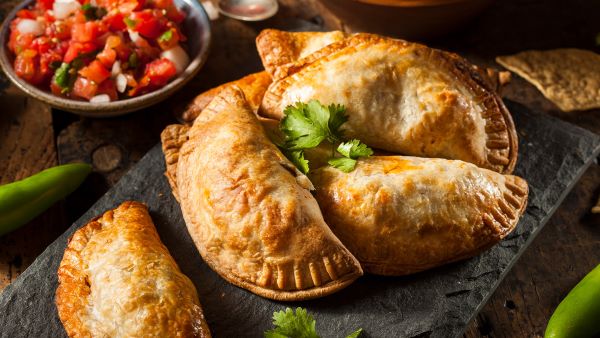
Colombian empanadas are immediately distinguishable from Argentine, Chilean, or Venezuelan versions the moment you hold one in your hand. They are small, half-moon shaped, made from a masa of precooked corn rather than wheat dough, and deep fried until the exterior is golden and slightly blistered. The filling is compact, subtly spiced, and typically contains a mixture of potato and meat or just potato, enclosed in a corn casing that is crispy on the outside and slightly soft just beneath the crust.
They are street food, eaten standing up alongside a container of aji sauce for dipping, and when they are made well they represent one of the most satisfying handheld snacks in any food tradition. If you have been searching for the best empanadas colombianas near me and finding only wheat-dough versions that do not match what you know this dish should be, this guide helps you find the real thing.
What Empanadas Colombianas Actually Are
The defining characteristic of Colombian empanadas is the dough. While most of Latin America uses a wheat-based dough for empanadas, the Colombian version uses masa de maiz, made from precooked white corn flour, which is the same base as arepas but formed differently and used as a wrapper rather than a patty. This corn dough produces an empanada with a slightly coarser, more rustic texture than a wheat pastry and a corn flavor that complements the filling rather than being neutral.
The filling most associated with Colombian empanadas uses a combination of seasoned ground beef or chicken with cooked potato, bound with a sofrito of onion, garlic, and tomato and seasoned with cumin. The potato is not incidental. In many versions, the potato makes up the majority of the filling volume and provides the starchy body that absorbs the sofrito flavors. Some regions of Colombia use only potato as the filling. Others add rice or chopped hard-boiled egg alongside the meat.
The frying produces an exterior that is golden, slightly blistered, and slightly crispy without being heavily crunchy. The corn masa exterior is thicker than a wheat pastry but not dense, and the interior just beneath the crust remains slightly soft and corny in a way that contrasts pleasantly with the crispier outer layer.
Aji sauce is not optional. Colombian empanadas are always served with aji, a fresh Colombian chili sauce typically made from fresh chili peppers, scallion, cilantro, and lime juice. The bright, herbal acidity of the aji against the savory fried corn empanada is one of the most important flavor relationships in Colombian street food, and eating a Colombian empanada without it is a diminished experience.
When you search for the best empanadas colombianas near me, the corn masa dough, the potato-based filling, and the accompanying aji sauce are the three markers that confirm the authentic Colombian preparation.
Where to Find It
Colombian bakeries and panaderias are the most reliable source. A Colombian bakery that fries its empanadas fresh will have them available throughout the day, with the best versions coming out during morning and midday service when turnover is highest.
Colombian restaurants and cafes that serve traditional Colombian snack food sometimes carry empanadas as a starter or as a snack item alongside the main menu. A restaurant that also carries buñuelos, pandebono, and other Colombian baked and fried snacks is operating with a full Colombian snack food program and is likely to make its empanadas properly.
Colombian areperas and street food operations are particularly worth seeking out. Operations focused on Colombian street food will almost always carry empanadas colombianas as a core item alongside their arepas.
Colombian home cooks and community vendors selling through Instagram and Facebook batch orders frequently include empanadas colombianas as a primary item. Home cooks from Colombia who make empanadas using the corn masa dough and traditional potato filling produce versions that are often better than commercial bakery production because the small batches are made with more care.
Latin American food markets and festivals with Colombian representation sometimes feature empanada vendors specifically from the Colombian tradition. These vendors are worth seeking out because the live frying ensures maximum freshness.
How to Search More Effectively
A direct search for the best empanadas colombianas near me will surface Colombian restaurants and bakeries in your area. Here is how to find the ones making them correctly:
Search Google Maps for Colombian bakery or Colombian restaurant and browse photo sections for empanada images. The small, golden, half-moon corn masa empanada of the Colombian tradition is immediately distinguishable from larger, wheat-dough Argentine or Chilean empanadas in a photo.
Search Instagram with “empanadas colombianas” plus your city name. Colombian bakery accounts and home vendors post photos of their freshly fried empanadas alongside the aji sauce that accompanies them. A vendor who shows the aji alongside the empanadas is following the traditional serving format.
Search Facebook for Colombian community groups in your city and ask where to find the best empanadas colombianas. Colombian community members are specific about which local bakery or home cook makes the most authentic corn masa version with proper aji.
Ask any Colombian bakery or restaurant directly whether their empanadas are made with corn masa or wheat dough. The corn masa version is the Colombian style. A wheat dough version is either a different regional tradition or an adaptation that moves away from the authentic preparation.
What Good Empanadas Colombianas Should Look Like
Once you find a source, a few things confirm the quality.
The exterior color. Golden to deep golden across the entire surface, slightly blistered in places where the corn masa surface made contact with the hot oil. The blisters are not imperfections. They indicate properly heated oil and a corn masa that was correctly prepared. A pale, uniformly smooth exterior means the oil was not hot enough or the empanada was not fried long enough.
The exterior texture. Slightly crispy at the moment of eating with a slightly softer layer just beneath. The corn masa does not produce the same sharp crunch as a thin wheat pastry, but there should be distinct crispness on the outside that gives way to softer corn as you bite through.
The filling. The potato should be tender and seasoned, with the meat present but not dominating. The sofrito flavor, including the tomato, onion, garlic, and cumin, should be present in every bite of filling. A flat, underseasoned filling indicates insufficient sofrito or inadequate cooking time for the flavors to develop.
The size. Small, handheld, roughly the size of a large palm. Colombian empanadas are street food portions, not full meal portions. A very large empanada is likely following a different national tradition.
The aji sauce. Served alongside, fresh and bright green from the cilantro and chili, with visible herbal flecks and a pourable rather than thick consistency. A version served without aji or with a substituted commercial hot sauce is missing the traditional accompaniment.
Ordering and Eating Tips
Eat empanadas colombianas immediately after frying. The corn masa exterior softens within minutes of leaving the oil and the crispness that makes the first bite satisfying diminishes quickly. A freshly fried empanada is significantly better than one that has been sitting for 30 minutes.
Dip generously in the aji sauce. The aji is not a light condiment for adding a hint of heat. It is a structural part of the eating experience and should be applied in quantity to each bite.
Order more than one. Colombian empanadas are small and the eating experience of one establishes the appetite for several more. Two to three is a standard serving as a snack.
If the vendor or bakery also carries buñuelos or pandebono, order one of each alongside the empanadas. The combination of different Colombian fried and baked items is how this food is traditionally eaten, and trying them together gives a fuller picture of Colombian snack food culture.
Pricing Expectations
Individual empanadas colombianas at a Colombian bakery or restaurant typically run between $2 and $4 each depending on the size and the market. A serving of three to four runs between $6 and $14. Home cook and vendor versions sold through batch orders are priced similarly. Event and market versions are often priced per piece in the same range.
Key Takeaways
- The best empanadas colombianas near me are most reliably found at Colombian bakeries that fry them fresh throughout the day, and through home cook vendors from Colombia on Instagram and Facebook who make the traditional corn masa version with potato filling.
- Colombian empanadas use a precooked corn masa dough rather than wheat dough, making them fundamentally different from Argentine, Chilean, or Venezuelan empanadas. The corn dough is the defining characteristic.
- The filling uses seasoned ground meat and potato bound with a cumin-forward sofrito. The potato is not a filler but a structural element that absorbs the sofrito flavors.
- Aji sauce served alongside is not optional. The fresh herbal chili sauce is part of the dish and eating Colombian empanadas without it is a diminished experience.
- Ask directly whether the empanadas are made with corn masa or wheat dough. Corn masa confirms the Colombian preparation.
- Eat immediately after frying. The corn masa exterior softens quickly and the best texture is in the first few minutes after leaving the oil.
- Search Instagram with “empanadas colombianas” plus your city name. A vendor who shows the aji sauce alongside the empanadas is following the traditional serving format.
- Expect to pay $2 to $4 per empanada and $6 to $14 for a serving of three to four at a Colombian bakery or from a home cook vendor.