Most people encounter crema catalana and assume it is just the Spanish name for creme brulee. That is understandable but not quite right. The two desserts share a caramelized sugar crust and a creamy base, but they are made differently and they taste different. Crema catalana uses milk rather than heavy cream, which makes it lighter in body. It is flavored with lemon zest and cinnamon, which gives it a brightness and warmth that the more neutral French version does not have. And the custard base is thickened with egg yolk and cornstarch rather than just yolks and cream set in an oven water bath.
If you have been searching for the best crema catalana near me and keep finding restaurants that serve a generic brulee with a Spanish name attached to it, this guide helps you find the real thing and recognize it when you do.
What Crema Catalana Actually Is
Crema catalana is the oldest recorded custard dessert in Europe, with references in Catalan cookbooks going back to the 14th century. It predates the French creme brulee by several centuries, a fact Catalans will mention with some satisfaction if the subject comes up.
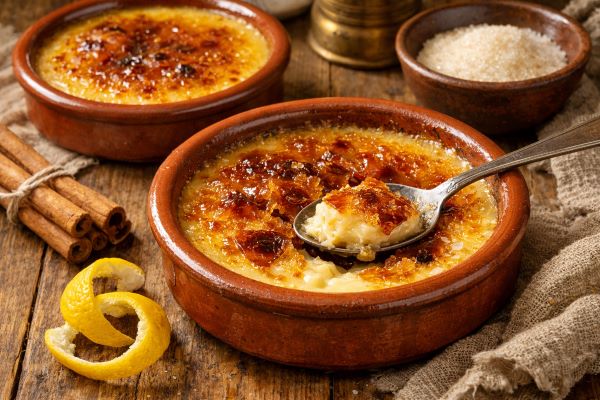
The traditional preparation starts with whole milk infused with a strip of lemon peel and a cinnamon stick over low heat. The flavored milk is then combined with egg yolks, sugar, and cornstarch whisked together, and the mixture is cooked on the stovetop while stirring until it thickens into a pourable custard. It goes into shallow clay dishes called cassoles de fang and is refrigerated until set. Just before serving, sugar is sprinkled across the surface and caramelized with a hot iron or, in modern kitchens, a kitchen torch.
The result is a custard that is set but not firm, with a clean lemon and cinnamon flavor underneath and a brittle caramel crust on top that cracks when you tap it with a spoon. The milk-based body makes it noticeably lighter than cream-based custards.
When you search for the best crema catalana near me, the lemon and cinnamon flavors are the first thing to check when the dessert arrives. If you taste neither, the kitchen made something else and called it crema catalana.
Where to Find It
Catalan and Spanish restaurants are the primary source, and as with other specifically Catalan dishes, the options depend heavily on where you live. Cities with dedicated Spanish or Catalan restaurants are more likely to carry crema catalana than those with only generalist Mediterranean menus.
Spanish tapas bars almost always carry it. It is a standard dessert across Spain even outside Catalonia, though the quality and authenticity of the preparation vary. A tapas bar that makes its crema catalana in-house from scratch will be noticeably better than one that uses a powdered mix or serves a pre-made version from a supplier.
Higher-end Spanish restaurants tend to treat it as a serious dessert course rather than an afterthought. These kitchens are more likely to use the traditional clay dish, infuse the milk properly, and torch the sugar to order rather than preparing caramelized tops in advance.
Spanish delis and specialty food stores sometimes carry crema catalana as a prepared dessert. The quality is variable but worth checking if restaurant options are limited in your area.
How to Search More Effectively
A search for the best crema catalana near me will surface Spanish restaurants in your area, but not necessarily those doing the dessert properly. Here is how to narrow it down:
Search Google Maps for Spanish or Catalan restaurant in your city and look at dessert menus specifically. A restaurant that lists crema catalana alongside other made-in-house desserts is more likely to be making it from scratch than one that has a single line item for dessert on an otherwise short menu.
Search Yelp for Spanish restaurants and read reviews that mention desserts specifically. Diners who order crema catalana will comment on whether it tasted of lemon and cinnamon, whether the crust was fresh and crisp, and whether the texture was right. These are the details that tell you what the kitchen is actually doing.
Search Instagram with “crema catalana” plus your city name. Restaurants that are proud of their version will post photos of the torched crust regularly, and those photos will show you whether the sugar was caramelized to order or prepared in advance.
Ask the restaurant directly whether the crema catalana is made in-house. The answer will tell you immediately how seriously they take the dessert. A kitchen that makes it fresh will answer without hesitation.
What Good Crema Catalana Should Look Like
Once the dessert arrives, a few things confirm whether the kitchen made it properly.
The crust. Freshly torched and still warm on top. The caramel should be a deep amber, not pale gold and not dark brown to the point of bitterness. When you tap it with a spoon, it should crack cleanly across the surface. A soft or rubbery crust was either caramelized in advance and has since softened, or was not torched at sufficient heat.
The custard body. Set but not firm. A spoon pushed into the surface should meet some resistance before giving way, and the custard should hold its shape on the spoon without running. A watery custard was undercooked. A very firm, almost gelatinous custard has too much cornstarch or was over-chilled.
The flavor. Clean lemon and cinnamon in the custard itself, not just as an aftertaste. The infusion step is what builds this flavor into the base, and a custard that tastes only of vanilla or of sweet egg without any citrus or spice was made with a shortcut or a different recipe.
The dish. Traditionally served in a shallow, wide clay dish rather than a deep ramekin. The shallow shape gives a better surface area for the caramel crust relative to the amount of custard underneath. A deep ramekin version is not necessarily wrong but suggests the kitchen is not following the traditional preparation.
Crema Catalana Versus Creme Brulee: A Practical Distinction
When you order the best crema catalana near me, knowing the difference helps you identify whether you are getting the real thing.
Crema catalana uses milk. Creme brulee uses heavy cream. The result is a lighter, less rich custard in the Catalan version.
Crema catalana is flavored with lemon and cinnamon. Creme brulee is typically flavored with vanilla only.
Crema catalana is thickened on the stovetop with cornstarch. Creme brulee is set in an oven water bath using only egg yolks and cream.
If what arrives at the table is very rich, very thick, vanilla-flavored, and served in a deep ramekin, you have been served creme brulee with a different label. It may still be delicious, but it is not what you searched for.
Pricing Expectations
A crema catalana at a Spanish restaurant typically runs between $8 and $14 as a dessert course. Higher-end restaurants in major cities may price it slightly above that range, particularly if it is served with additional accompaniments. Casual tapas bars tend to keep it in the $8 to $11 range.
A very cheap version at a non-specialized restaurant is worth approaching with caution. The ingredients for a properly made crema catalana are not expensive, but a $5 version at a restaurant that is not focused on Spanish food is unlikely to have been made with proper technique.
Key Takeaways
- The best crema catalana near me is most reliably found at Catalan or Spanish restaurants that make it in-house rather than using pre-made mixes or supplier-prepared desserts.
- Crema catalana uses whole milk, lemon zest, and cinnamon, thickened with cornstarch on the stovetop. It is lighter and more aromatic than creme brulee, which uses heavy cream and vanilla and is set in an oven water bath.
- The lemon and cinnamon flavor in the custard is the primary quality indicator. A version that tastes only of sweet egg without citrus or spice was not made to the traditional recipe.
- A freshly torched crust that cracks cleanly under a spoon is a strong sign the dessert was caramelized to order rather than prepared in advance and left to soften.
- Search Google Maps dessert menus directly and read Yelp reviews that specifically mention crema catalana rather than relying on overall restaurant ratings.
- The traditional serving vessel is a shallow, wide clay dish. A deep ramekin is not disqualifying but suggests the kitchen is not following the classic preparation.
- Ask whether the dessert is made in-house. A confident answer is a good sign. Vague or evasive answers usually mean a pre-made product.
- Expect to pay $8 to $14 at a Spanish restaurant, with higher-end spots occasionally pricing above that range.