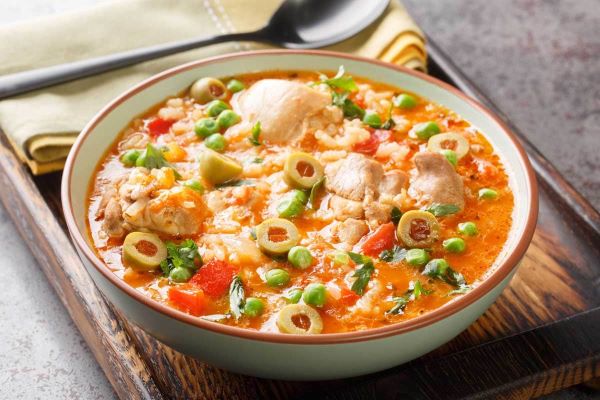
Asopao de pollo sits at the intersection of soup and rice dish, which is exactly the point. It is neither one nor the other and is better for it. Puerto Rican chicken and rice stew, built on a sofrito base with chicken pieces, rice that absorbs the broth as it cooks, green olives, capers, tomatoes, and whatever vegetables the cook has on hand, produces a bowl that is more substantial than a soup and more fluid than a rice dish. The rice swells into the broth during cooking, releasing starch that thickens the liquid slightly while the chicken gives its flavor to everything around it. When it is made properly with a proper sofrito base, good olives, and enough time for the rice to absorb the broth’s full flavor, asopao de pollo is one of the most complete and satisfying things on a Puerto Rican restaurant menu.
If you have been searching for the best asopao de pollo near me, this guide gives you the most direct path to finding a kitchen making it correctly.
What Asopao de Pollo Actually Is
The word asopao comes from sopao, meaning big soup, and the dish lives up to that name. It is a Puerto Rican wet rice stew that falls between a thick soup and a soupy rice, similar in concept to a Spanish arroz caldoso but with a Caribbean flavor profile built around sofrito and the specific combination of olives and capers that runs through so much Puerto Rican cooking.
The sofrito used in asopao de pollo is the same recao-based sofrito that defines much of Puerto Rican cooking: culantro, also called recao, along with garlic, onion, aji dulce, and sometimes tomato blended together into a fresh herb and vegetable paste. This sofrito goes into the pot first and cooks down in oil until fragrant, building the aromatic base that will carry the entire dish.
Bone-in chicken pieces, typically thighs and drumsticks, go in next and cook in the sofrito briefly before the liquid is added. Tomatoes, chicken stock or water, and the spice blend go in, along with green olives and capers that add brine throughout the stew. The rice goes in when the chicken is nearly cooked, and the whole pot simmers together until the rice is fully cooked and has absorbed enough of the broth to feel dense and swollen rather than separate and fluffy.
The finished asopao de pollo should be thick enough to hold its shape briefly in a spoon before flowing. Too thick and the rice has absorbed too much liquid and the stew becomes a dense rice dish. Too thin and the rice is floating in broth rather than integrated into it. The correct consistency is right between these extremes, what Puerto Rican cooks call a pega, a texture that is slightly sticky and cohesive.
The asopao improves and thickens as it sits. A bowl made two hours ago will be thicker than one made fresh, because the rice continues absorbing the broth. This means asopao served immediately from the pot will be slightly more fluid than one that has been resting, and both are correct depending on preference.
When you search for the best asopao de pollo near me, the recao-based sofrito flavor, the briny olives and capers integrated throughout, and the properly swollen rice in a cohesive broth are the three quality markers to evaluate.
Where to Find It
Puerto Rican restaurants are the primary source. Asopao de pollo appears on Puerto Rican restaurant menus as a main course soup or stew, and a restaurant with a comprehensive traditional Puerto Rican menu will carry it either as a permanent item or as a rotating daily special. Restaurants that also carry sopa de pollo, caldo gallego, and other brothy preparations indicate a kitchen that takes its liquid-based dishes seriously.
Puerto Rican fondas and casual home-style restaurants in cities with Puerto Rican communities are often the best source. New York, New Jersey, Connecticut, Florida, and Chicago all have established Puerto Rican restaurant traditions where asopao de pollo is considered an essential menu item rather than an occasional offering.
Puerto Rican home cooks and community vendors selling through Instagram and Facebook are a strong source in cities where dedicated Puerto Rican restaurants are scarce. Home cooks who make asopao de pollo follow the traditional sofrito-based preparation and will often describe the specific recao and aji dulce components in their posts, which signals authentic preparation.
Latin American restaurants with Caribbean menus sometimes carry asopao de pollo alongside dishes from other Caribbean traditions. Look specifically for restaurants that identify Puerto Rican cooking rather than a generalist Caribbean menu, since the sofrito base and the specific olive and caper combination are distinctly Puerto Rican.
How to Search More Effectively
A direct search for the best asopao de pollo near me will surface Puerto Rican restaurants in your area. Here is how to identify the ones making it properly:
Search Google Maps for Puerto Rican restaurant in your city and browse menus for asopao. A menu that specifically lists asopao de pollo rather than just chicken soup or chicken rice indicates a kitchen aware of the specific Puerto Rican preparation and its place in the cuisine.
Search Yelp for Puerto Rican restaurants and read reviews that mention asopao. Reviewers familiar with the dish will describe whether the sofrito flavor was present, whether the olives and capers added brine, and whether the rice texture was correct. These details distinguish a kitchen following the traditional preparation from one making a generic chicken rice soup.
Search Instagram with “asopao de pollo” plus your city name. Puerto Rican restaurant accounts and home cook vendors post photos of asopao regularly, and the thick, golden-orange broth with rice and chicken visible alongside the distinctive green of the olives is identifiable in a photo.
Search Facebook for Puerto Rican community groups in your city and ask directly where to find the best asopao de pollo. Puerto Ricans are specific about which local restaurants or home cooks make the sofrito base correctly and will give you direct recommendations.
Ask any restaurant making asopao what they use in their sofrito. A kitchen using recao or culantro alongside aji dulce is following the Puerto Rican preparation specifically. A kitchen that cannot describe its sofrito components in detail is likely making a simplified version.
What Good Asopao de Pollo Should Look Like
Once you find a source and the bowl arrives, a few things immediately tell you whether the kitchen made it properly.
The broth color. Golden to orange from the sofrito, tomatoes, and sazon, slightly cloudy from the rice starch released during cooking. A pale, clear broth means the sofrito was insufficient or the cooking time was too short for the colors and flavors to fully develop. A properly made asopao broth should look similar in color to a good chicken sofrito base, warm and slightly orange-tinted.
The rice consistency. Swollen, slightly sticky, and fully integrated into the broth rather than sitting separately in clear liquid. Each grain of rice should be soft throughout and have absorbed the broth flavor. Rice that is still separate and individual in a clear broth has not been cooked in the liquid long enough. Rice that has completely dissolved into mush was either cooked too long or used too much liquid relative to rice.
The chicken. Fully tender, releasing from the bone with minimal pressure, and seasoned throughout from the sofrito and adobo marinade. Bone-in pieces contribute collagen to the broth during cooking, which adds body. A boneless version is easier to eat but produces a slightly less rich broth.
The olives and capers. Present and visible, distributed through the stew. Green olives should be whole or halved, not completely dissolved into the broth. The brine from both the olives and capers should be perceptible as a savory sharpness that runs through every spoonful.
The sofrito flavor. The herb brightness of recao and aji dulce should be present as an aromatic background note throughout the stew. This is the flavor that specifically marks asopao de pollo as Puerto Rican and distinguishes it from any other chicken rice soup.
Ordering and Eating Tips
Order asopao de pollo as a main course rather than a starter. It is substantial enough to be a complete meal and does not need much alongside it except bread for soaking the broth and possibly tostones as a traditional Puerto Rican accompaniment.
Ask whether the asopao has been sitting or was made fresh. A version that has been resting for an hour or two will be noticeably thicker than one made fresh, because the rice continues absorbing the broth as it sits. Both versions have their appeal, but knowing what to expect helps you evaluate the texture when the bowl arrives.
Eat it hot and promptly. Asopao thickens quickly as the temperature drops because the rice starch sets when cooled. A bowl eaten immediately from the pot is noticeably more fluid than one left to cool at the table. Eat while it is hot for the best texture experience.
Add a squeeze of fresh lime if the restaurant or vendor has it available. The acidity from the lime lifts the sofrito flavors and adds a brightness that complements the brine from the olives and capers in a way that feels specifically right for a Puerto Rican preparation.
Pricing Expectations
A full bowl of the best asopao de pollo near me at a Puerto Rican restaurant typically runs between $14 and $22 depending on the market and the portion size. Puerto Rican fondas at the lower end of that range often produce the most traditional and satisfying versions. Home cook and community vendor versions sold by the container typically run $10 to $16 per serving.
Key Takeaways
- The best asopao de pollo near me is most reliably found at Puerto Rican fondas and traditional restaurants in cities with Puerto Rican communities, and through home cook vendors who use recao-based sofrito and traditional olive and caper components.
- Asopao de pollo is a Puerto Rican wet rice stew with a recao and aji dulce sofrito base, bone-in chicken, green olives, capers, tomatoes, and rice cooked together until the rice is swollen and integrated into the broth.
- The recao-based sofrito flavor is the primary marker that distinguishes an authentic Puerto Rican asopao from a generic chicken rice soup. Ask about the sofrito components before ordering.
- The rice should be swollen and slightly sticky in a cohesive broth, not separate in clear liquid and not dissolved into mush. This middle consistency, slightly thick and integrated, is the correct texture.
- Green olives and capers should be visible and their brine should be perceptible throughout. Their absence changes the flavor profile significantly.
- Eat hot and immediately. The stew thickens quickly as it cools because the rice starch sets at lower temperatures.
- Search Instagram with “asopao de pollo” plus your city name and check Puerto Rican community Facebook groups for direct recommendations.
- Expect to pay $14 to $22 at a sit-down Puerto Rican restaurant and $10 to $16 per portion from a home cook or community vendor.