If you have encountered the question “which statement summarizes the main idea of reciprocal determinism” in a psychology course, on a standardized test, or in an assigned reading, the answer requires more than a one-line definition. Reciprocal determinism is one of the foundational concepts in social cognitive theory, and understanding what it actually says makes the difference between recognizing the correct answer and guessing. This guide explains the theory clearly, identifies the statements that best capture its main idea, and shows you how to apply that understanding to exam questions and real-world examples.
What Is Reciprocal Determinism?
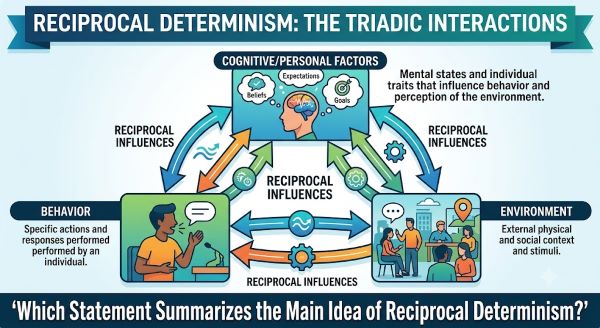
Reciprocal determinism is a concept developed by psychologist Albert Bandura as part of his social cognitive theory. It describes the relationship between three factors that constantly influence each other:
- The person (internal factors including beliefs, expectations, personality, and cognitive processes)
- The behavior (actions the person takes)
- The environment (external conditions, social context, and the reactions of others)
Bandura’s core argument was that these three factors do not operate independently. They interact with and influence each other in an ongoing, bidirectional cycle. A person’s beliefs affect their behavior. Their behavior changes the environment. The changed environment then influences the person’s beliefs and future behavior. This cycle continues without a fixed starting point or ending point.
The word “reciprocal” refers to the mutual, back-and-forth nature of these influences. The word “determinism” refers to the idea that behavior is determined by these interacting forces rather than by any single cause.
Which Statement Summarizes the Main Idea of Reciprocal Determinism?
The statement that best summarizes the main idea of reciprocal determinism is:
“A person’s behavior, personal factors, and environment all influence one another in a continuous, bidirectional interaction.”
This statement captures all three required elements of the theory: the person, the behavior, and the environment. It also captures the defining characteristic of the theory, which is that the relationship between these elements is mutual and ongoing rather than one-directional.
Other statements that accurately summarize the main idea of reciprocal determinism include:
- “Behavior is shaped by the interaction between a person’s internal characteristics, their actions, and their surrounding environment.”
- “People are neither purely the products of their environment nor purely the products of their own internal drives. Instead, behavior emerges from the dynamic interaction of personal, behavioral, and environmental factors.”
- “The environment influences the person, the person influences the environment, and both influence behavior simultaneously.”
What Makes a Statement a Good Summary Versus a Bad One
When answering a multiple-choice question about which statement summarizes the main idea of reciprocal determinism, knowing what to look for in the answer choices helps you eliminate wrong answers quickly.
A correct summary will:
- Reference all three components: person (internal factors), behavior, and environment
- Describe the relationship as bidirectional or mutually influential
- Avoid suggesting that any single factor is the sole cause of behavior
A wrong answer will typically:
- Suggest that the environment alone determines behavior (this describes behaviorism, not reciprocal determinism)
- Suggest that internal factors alone determine behavior (this describes a purely cognitive or psychodynamic view)
- Describe a one-way relationship rather than a mutual interaction
- Leave out one of the three components entirely
A common distractor on exams is a statement like “the environment shapes a person’s behavior.” This sounds related to reciprocal determinism but is actually a description of simple environmental determinism, which is what Bandura was specifically arguing against. The key word missing from that statement is “reciprocal.” The relationship goes both ways.
A Concrete Example of Reciprocal Determinism in Action
Understanding the theory through an example makes it easier to recognize correct summaries.
Imagine a student who believes she is bad at math (personal factor). Because of this belief, she avoids participating in math class and does not complete extra practice problems (behavior). Her avoidance means she misses feedback from the teacher and falls further behind, and the classroom environment reinforces her belief that she does not belong in advanced math (environment affects person). Her teacher, seeing her disengagement, stops calling on her and gives her less challenging material (environment changes in response to behavior). This confirms her belief that she is not capable (environment reinforces personal factor), and the cycle continues.
Now flip the scenario. If the same student receives encouragement from a new teacher (environment changes), she might attempt a difficult problem (behavior change). Successfully solving it builds her confidence (personal factor changes). Her increased confidence leads her to engage more in class (behavior), which prompts the teacher to give her harder problems and more attention (environment responds), which builds her confidence further.
Both cycles illustrate reciprocal determinism. The behavior, the person, and the environment are all changing each other simultaneously. There is no single starting cause.
Why Bandura Developed This Theory
Bandura introduced reciprocal determinism partly as a response to two dominant psychological frameworks of the mid-twentieth century.
Behaviorism, represented by B.F. Skinner, argued that the environment shapes behavior through reinforcement and punishment. The person’s internal states were considered irrelevant or unknowable. Behavior was essentially a product of external conditions.
Traditional cognitive psychology focused heavily on internal mental processes but sometimes underemphasized how behavior and environment feed back into those processes.
Bandura argued that both were incomplete. He observed through his famous Bobo doll experiments that people learn by observing others and that their beliefs about their own capabilities (which he called self-efficacy) play a significant role in what they choose to do. Neither environment alone nor internal belief alone could explain behavior. The interaction of all three was necessary.
Reciprocal determinism formalized this observation into a model that is now central to social cognitive theory, health psychology, education, and behavioral medicine.
Self-Efficacy and Its Role in Reciprocal Determinism
Self-efficacy is a personal factor that plays a particularly important role in the reciprocal determinism cycle. Self-efficacy refers to a person’s belief in their own ability to perform a specific behavior successfully.
High self-efficacy leads a person to attempt challenging tasks (behavior), which produces experiences of success or failure that alter the environment and feed back into the person’s beliefs. Low self-efficacy leads to avoidance (behavior), which limits positive environmental feedback, which reinforces low self-efficacy.
This is why which statement summarizes the main idea of reciprocal determinism often needs to account for personal cognitive factors like self-efficacy and not just generic “internal traits.” The personal component in the model is specifically about the beliefs, expectations, and cognitive processes a person brings to a situation, not just fixed personality traits.
How This Theory Applies Beyond the Classroom
Reciprocal determinism is not just an academic concept. It has direct applications in fields that work to change human behavior.
Health psychology uses it to design interventions. If a patient believes exercise is impossible for them (personal factor), their behavior reflects that belief, and the environment (a gym that feels unwelcoming) reinforces it. An effective intervention changes one element of the cycle, such as pairing the person with a supportive trainer (environmental change), which shifts behavior, which then changes beliefs.
Education applies it through the understanding that a student’s learning environment, their own academic self-concept, and their study behaviors all mutually reinforce or undermine each other. Teachers who understand this design classrooms that support positive cycles.
Therapy and counseling use it to identify which element of the cycle to target first in order to break negative patterns. Changing behavior through behavioral activation, for example, can shift both the environment and the person’s beliefs even when direct belief change feels inaccessible.
Key Takeaways
- Which statement summarizes the main idea of reciprocal determinism is answered by any statement that describes a mutual, bidirectional interaction between personal factors, behavior, and the environment.
- The best single summary is: behavior, personal factors, and environment continuously influence one another in an ongoing, reciprocal cycle.
- Bandura developed reciprocal determinism as a response to behaviorism (which ignored internal factors) and purely cognitive approaches (which underemphasized environment and behavior).
- A correct answer must include all three elements and describe them as mutually influential. Statements that describe a one-way relationship are describing something else.
- Self-efficacy is the personal factor most closely associated with reciprocal determinism. It mediates how people interpret their environment and what behavior they choose.
- On exam questions, eliminate answers that name only one or two of the three components, or that describe behavior as solely determined by either environment or internal traits alone.
- Which statement summarizes the main idea of reciprocal determinism always points back to the word “reciprocal.” The relationship goes both ways between all three components simultaneously.
- The theory applies in health psychology, education, and therapy to design interventions that break negative behavioral cycles by targeting whichever element of the three-part model is most accessible.